Incident details
- Updated on
- Date of incident
- May 29, 2026
- Location
- New Brunswick, New Jersey
- Status of prior restraint
- Pending
- Mistakenly released materials?
- No
Prior Restraint
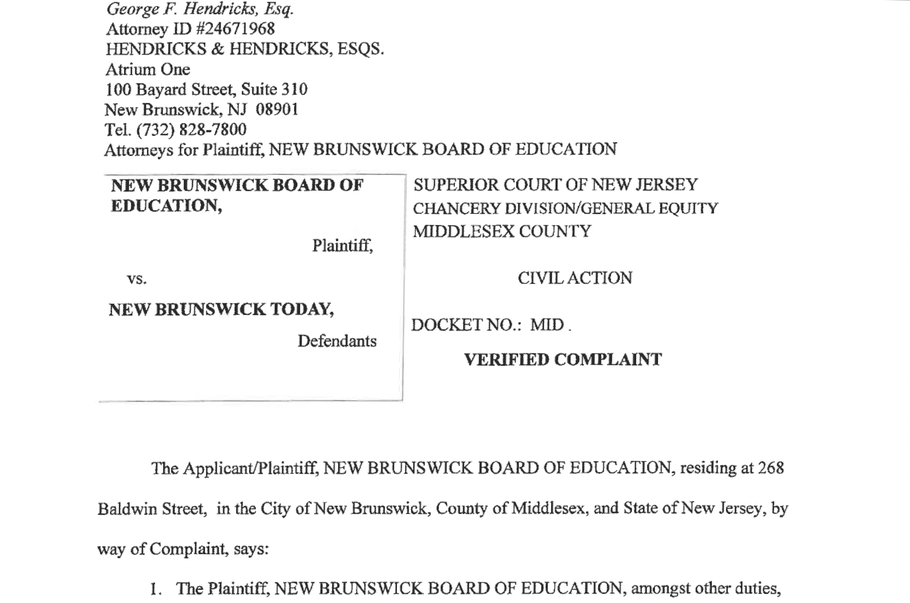
A portion of the May 29, 2026, order placing a prior restraint on New Brunswick Today and compelling the New Jersey newspaper to unpublish footage on its YouTube channel from a school surveillance system.
Judge partially lifts gag order on paper, but extends it to all press
A prior restraint against New Brunswick Today was partially lifted on July 9, 2026, with a New Jersey Superior Court judge allowing the news outlet to republish footage and to publish written descriptions, but only under specific conditions, all while extending the restraint to the media as a whole.
On May 28, the newspaper published surveillance footage from New Brunswick High School, showing a student entering the building and security finding that he was carrying a concealed weapon, later identified as a BB gun.
The local board of education immediately contacted the news outlet’s founder and editor, Charlie Kratovil, demanding that he remove the video. When Kratovil refused, the board filed a complaint with the Middlesex County Superior Court the next day.
Superior Court Judge Thomas McCloskey temporarily granted the district’s request, ordering New Brunswick Today to unpublish the footage and stipulating that even describing the video would be a violation.
McCloskey heard oral arguments at a July 7 hearing, with the newspaper calling for the dissolution of the restraints and the school board arguing for a preliminary injunction to reinforce them.
In his July 9 ruling, McCloskey partially granted and denied both requests.
The judge modified the temporary restraints, allowing New Brunswick Today to write about the footage as long as it does not reveal the names or identities of the students depicted.
He also said the newspaper could republish the footage so long as it blurs or otherwise redacts the faces and identifying markers of any minors in the video, and is submitted to the board of education for review and approval.
“In retrospect, now that time has permitted a constitutional analysis of the issues joined, in the first instance, the Court agrees that certain of its temporary restraints may have been overbroad,” McCloskey wrote. “A narrowly tailored restraint, limited to the specific video and for a defined location — i.e., New Brunswick High School — is here justified as a means to balance the First Amendment rights of the press with the statutory and ethical obligations of the school district to protect its students.”
However, he specified that the revised restrictions would also be applied to “the press” as a whole.
The Freedom of the Press Foundation, of which the U.S. Press Freedom Tracker is a project, raised significant concerns about that expansion.
“Forcing news outlets to delete or withhold information and to submit their work for government approval before they can publish is censorship, full stop,” wrote FPF Senior Adviser for Advocacy Caitlin Vogus. “Judge McCloskey was right to narrow his order against New Brunswick Today, but it’s outrageous that he’s extended it to purport to apply to any member of the press who wants to publish or write about this video.”
In a statement shared with the Tracker, Kratovil said that while the newspaper is pleased that the order preventing written reporting on the footage was lifted, it cannot abide further restraints on its work.
“The Judge is now ordering us to seek and receive approval from the BOE before releasing the video that shows what actually happened that day,” Kratovil wrote. “That’s the kind of government censorship the First Amendment was intended to prevent, so we will appeal.”
New Brunswick Today was ordered by a New Jersey state court to remove footage from its website and YouTube on May 29, 2026, following a complaint by the New Brunswick Board of Education.
According to court filings reviewed by the U.S. Press Freedom Tracker, the footage obtained by the newspaper and published May 28 was taken by surveillance cameras at New Brunswick High School, and showed a student entering the building and triggering the alarm on a metal detector. The student was searched by security and was found to be carrying a concealed weapon.
“The district has reason to believe that the footage was recorded from a computer by an individual with access to the district’s surveillance system and disseminated without authorization,” Aubrey Johnson, superintendent of the school district, wrote in an affidavit.
Johnson argued that the release of the footage could violate student privacy rights and reveal security-related information about the school facilities.
The day the footage was published, an attorney for the board of education emailed the news outlet’s founder and editor, Charlie Kratovil, demanding that he immediately remove the video, lest the matter be brought before a judge. The attorney also asked Kratovil to disclose how he obtained the footage.
Kratovil refused.
A case was filed with the Superior Court for Middlesex County the following day, asking for the removal of the footage and to restrain the newspaper “from any and all future postings of confidential school security/surveillance video” from schools in the district.
Superior Court Judge Thomas McCloskey temporarily granted the district’s requests during an emergency hearing May 29, additionally stipulating from the bench that even publishing descriptions of what was seen in the video would violate his order.
Attorneys representing New Brunswick Today filed a request June 5 to appeal the order and have the restraints lifted, but the state’s Appellate Division denied their request, stating that they had not filed a motion to dissolve the restraints with the lower court. The paper’s attorneys filed such a request with the Superior Court on June 10.
“The United States Supreme Court has repeatedly made it clear that prior restraints are the least tolerable infringement on First Amendment rights,” they wrote. “Ordering content to be removed from the internet and enjoining future publications are unequivocally prior restraints that must be analyzed under the prior restraint doctrine, which this Court ignored.”
The parties are not scheduled to appear until July 7 to argue whether the court should order permanent restraints on the newspaper and whether the temporary restraints should be dissolved.
But in a June 11 letter to the judge, the newspaper’s attorney Bruce Rosen asked that the hearing be moved to June 15. He argued that the delay violated the judge’s own order stipulating that the motion could be heard within three business days, as well as the Appellate Division’s decision, which requires that it be heard “expeditiously.”
After the judge again refused to hear the matter sooner, Rosen filed emergency motions June 12 with both the Appellate Division and, when that too was denied, the New Jersey Supreme Court. He asked that the prior restraint be lifted while the motion to dismiss is pending or that the motion be heard the week of June 15.
The U.S. Press Freedom Tracker catalogs press freedom violations in the United States. Email tips to [email protected].