Incident details
- Updated on
- Date of incident
- January 23, 2026
- Legal orders
-
-
subpoena
for
other testimony
- Jan. 23, 2026: Pending
- Jan. 27, 2026: Objected to
- Feb. 3, 2026: Dropped
-
subpoena
for
other testimony
- Legal order target
- Journalist
- Legal order venue
- Federal
Subpoena/Legal Order
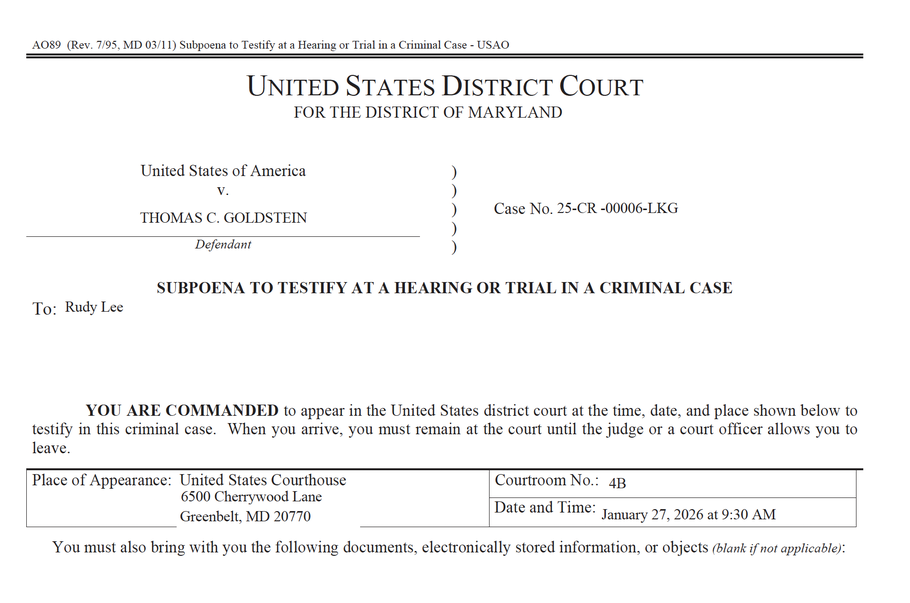
A portion of a subpoena for testimony issued to The New York Times Magazine researcher Rudy Lee, on Jan. 23, 2026, for a federal trial in Greenbelt, Maryland.
Subpoena for testimony by NY Times Magazine researcher dropped
A subpoena for testimony from research editor Rudy Lee at a criminal trial in Greenbelt, Maryland, was dropped by federal prosecutors on Feb. 3, 2026, according to Lee’s attorney.
Lee had fact-checked a December 2025 article written by reporter Jeffrey Toobin for The New York Times Magazine about Thomas Goldstein, who is on trial for charges related to violating federal tax laws and making false statements on loan applications.
In January 2026, prosecutors in Goldstein’s case asked the court to admit portions of the article into evidence, arguing that statements Goldstein made to Toobin about poker games and mortgage applications were relevant.
U.S. District Judge Lydia Kay Griggsby denied the request but said it was fair to consider calling the reporter to testify, which would allow prosecutors to introduce the evidence and give defense attorneys a chance to cross-examine him.
Prosecutors then subpoenaed Toobin and Lee.
In a motion to quash the subpoenas, attorneys for the Times argued that they constituted “a serious intrusion into the newsgathering process that will chill future journalism.”
On Feb. 3, prosecutors dropped the subpoena of Lee. And on Feb. 4, federal prosecutors and the defendant’s lawyers reached an agreement under which jurors would instead consider passages from Toobin’s article, rather than requiring his testimony.
Lee’s attorney did not respond to a request for further information about why the subpoena against Lee was dropped.
Rudy Lee, a research editor for The New York Times Magazine, received a legal order from federal prosecutors on Jan. 23, 2026, compelling him to testify in a criminal trial in Greenbelt, Maryland.
Lee fact-checked a December 2025 article written by Jeffrey Toobin that focused on prominent attorney Thomas Goldstein, who is on trial for charges related to violating federal tax laws and making false statements on loan applications. It traced Goldstein’s rise in the legal world, where he argued before the Supreme Court, and the exposure of his secret life as a high-stakes gambler.
On Jan. 6, prosecutors asked the court to admit portions of the article into evidence, arguing that statements Goldstein made to Toobin about poker games and mortgage applications were relevant to their case. Goldstein’s attorneys objected, saying the article was hearsay and arguing they should be allowed to cross-examine Toobin if any part of it were admitted, court records show.
District Judge Lydia Kay Griggsby denied the request to admit the article as evidence, but said it was fair to consider calling the reporter to testify, which would allow prosecutors to introduce the evidence and give defense attorneys a chance to cross-examine him, court documents state.
Prosecutors later notified lawyers for The New York Times that subpoenas had been issued for both Toobin and Lee. In a motion to quash them, attorneys for the publication argued that the testimony would intrude on the journalists’ independence, while providing little value to the government’s case.
“It comes at the cost of a serious intrusion into the newsgathering process that will chill future journalism,” lawyer Chad Bowman wrote.
Bowman also argued that the subpoenas were issued late, noting prosecutors waited two weeks after the judge’s ruling and until the trial was underway. If the court declined to set aside the subpoenas, the filing asked that any testimony be strictly limited to the accuracy and authenticity of Goldstein’s statements in the article.
In a separate filing, Goldstein’s defense attorney Jonathan Kravis also argued the court should strike down the orders, writing they were issued too late and would lead to a distracting “minitrial.” Kravis added that limiting the testimony would also infringe on his client’s right to cross-examine the witnesses about Goldstein’s interviews with the magazine and its editorial decisions.
The judge has yet to rule on the matter.
The U.S. Press Freedom Tracker catalogs press freedom violations in the United States. Email tips to [email protected].