Incident details
- Date of incident
- July 2, 2026
- Location
- New Orleans, Louisiana
- Targets
- Danny Monteverde (WWL-TV)
- Arrest status
- Detained and released without being processed
- Arresting authority
- Orleans Parish Sheriff's Office
- Unnecessary use of force?
- Yes
Arrest/Criminal Charge
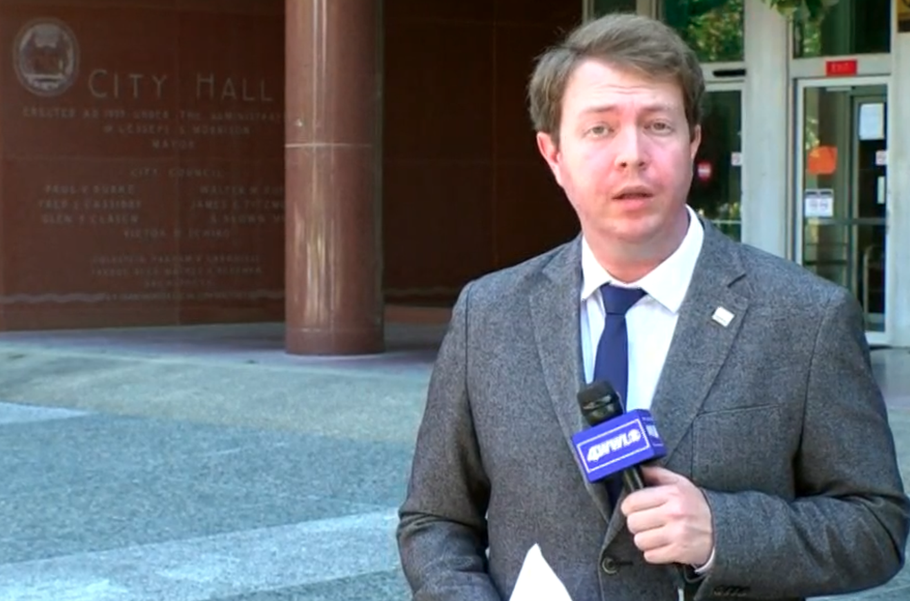
A screen grab of producer Danny Monteverde during a WWL-TV newscast. Monteverde was handcuffed by deputies after questioning the closing of a courtroom during a grand jury proceeding in New Orleans, Louisiana, on July 2, 2026.
WWL-TV investigative producer Danny Monteverde was handcuffed and detained by deputies after questioning a judge’s decision to close a court proceeding announcing the indictment of the Louisiana attorney general on July 2, 2026, in New Orleans.
Judge Leon Roche ordered the courtroom sealed before the grand jury returned the indictment against Attorney General Liz Murrill, though he did not explain why at the time. Louisiana law requires grand jury indictments be handed up in open court.
About a half-dozen news reporters waited in the hallway for the judge to reopen the courtroom. At that time, Monteverde asserted the proceedings should be public. He contacted WWL-TV’s First Amendment lawyer Elana Beiser, who quickly arrived with a motion seeking to open proceedings. But the courtroom remained locked.
“They basically ignored me,” Beiser told the U.S. Press Freedom Tracker.
Then, close to a dozen Orleans Parish Sheriff’s Office deputies arrived and ordered reporters away from the courtroom doors. When reporters questioned why they were barred from entering, a man who did not identify himself emerged from the courtroom and warned they could face contempt of court charges if they did not leave.
At least one deputy threatened to handcuff anyone who refused to move. A Times-Picayune reporter who left the building was denied reentry a few minutes later.
“Danny kept saying to the deputies, ‘Why? I don’t understand. I’m not going to leave the public hallway,’” Beiser told the Tracker. “They cuffed Danny. They cuffed him behind his back quite tightly, and they led him toward the security checkpoint by the entrance.”
Deputies also detained Beiser, who had repeatedly insisted that she was an attorney representing Monteverde’s station. Instead, they grabbed her cellphone, tossed it away and handcuffed her behind her back. She said one deputy read her her Miranda rights.
Beiser told the Tracker that she and Monteverde were both detained for around 20 minutes; the restraints left red marks on their wrists. Monteverde did not return a request for comment by the Tracker.
In a statement to the Tracker, Orleans Parish Sheriff’s Office spokesperson Keith Lampkin said deputies were directed by the judge to secure the courtroom door and surrounding area to protect the integrity of the grand jury process. He added that the office was continuing to gather all available details about what occurred.
“It is our understanding that OPSO personnel acted in accordance with the directives they received and worked to ensure an orderly conclusion to the proceedings and safe passage for all persons involved,” Lampkin said.
The judge and prosecutor later said the media was removed from the courtroom to protect the anonymity of the grand jury. At a news conference, special prosecutor Laurie White said she asked deputies to release Monteverde and Beiser.
“You all were handcuffed by sheriff’s deputies because you wouldn’t obey an order,” White said. “You all weren’t willing to walk out when you were asked to do so.”
Roche, who did not respond to a Tracker request for comment, later defended his decision to close the proceedings. In a court filing, he claimed he received credible information that reporters were trying to film and communicate with grand jurors, and ordered the deputy sheriffs to clear the room out of an abundance of caution.
Roche said in the filing that he “never instructed deputy sheriffs to remand or detain any members of the media.” He added that the media was not handcuffed inside the courtroom.
Murrill, who was indicted on 16 counts related to violating anti-intimidation laws, denies any wrongdoing. In a statement posted to X, she criticized the handling of the grand jury proceedings and called the decision to lock out the media and handcuff Monteverde a “clear violation of Louisiana law.”
The state Supreme Court has since halted Murrill’s indictment. In its order, the court cited “disturbing defects” in the proceedings, including that Roche had closed the courtroom to the press and public.
In his responding court filing, Roche argued that “open court” refers to the presence of a judge on the bench, not that the proceedings must be open to the public.
Update: This article was revised to include a comment from the Orleans Parish Sheriff’s Office.
The U.S. Press Freedom Tracker catalogs press freedom violations in the United States. Email tips to [email protected].