Incident details
- Updated on
- Date of incident
- March 4, 2026
- Case number
- 3:26-cv-00247
- Case status
- Ongoing
- Type of case
- Civil
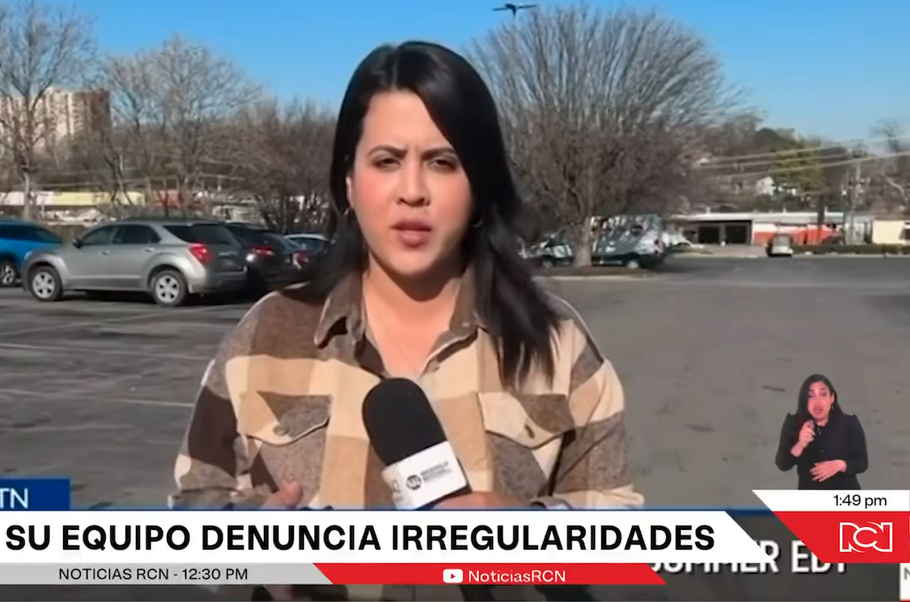
Reporter Estefany Rodríguez, who was taken into custody by Immigration and Customs Enforcement officers in Nashville, Tennessee, on March 4, 2026, is seen in an earlier reporting assignment.
Spanish-language reporter freed from ICE facility after Tennessee arrest
Journalist Estefany Rodríguez was released on March 19, 2026, from an Immigration and Customs Enforcement facility in Louisiana, two weeks after agents arrested her in Nashville, Tennessee.
Rodríguez’s attorney, Michael Holley, confirmed her release to the U.S. Press Freedom Tracker and said he plans to continue legal action against the government, alleging she was targeted because she is a journalist.
“For people reporting without full status or citizenship, it makes it a very brave thing to do. They serve a crucial role,” Holley told the Tracker. “The Nashville Noticias station played an important role in getting the stories of the community out, which otherwise wouldn’t be heard. The chilling effect on reporters still working there, or in that type of role, is significant.”
Rodríguez, a Spanish-language reporter for Nashville Noticias, had been held since March 4, when ICE agents surrounded her work car in a gym parking lot and detained her.
The native Colombian had reported frequently on ICE activity in the months leading up to her arrest, including enforcement actions in the days immediately before she was taken into custody, according to court records.
Rodríguez was initially detained at the Etowah County Jail in Gadsden, Alabama, before being transferred March 12 to the South Louisiana ICE Processing Center in Basile. On March 16, an immigration judge set her bond at $10,000. She remained in custody after the Department of Homeland Security reserved its right to appeal.
In federal court in Tennessee, Rodríguez’s attorneys argued her detention violated her constitutional rights. Her attorneys wrote that she was illegally detained without a warrant or due process and that her arrest was retaliation for her reporting on ICE operations.
“She had committed no crime and had done nothing wrong, except report on ICE’s enforcement actions,” wrote Holley.
Rodríguez had filed an emergency petition for a writ of habeas corpus March 4, asking a judge to review the legality of her detention and order her immediate release. The government maintained that Rodríguez was arrested under a valid warrant after her visa expired.
“All of her claims are without merit,” the U.S. attorney’s office in Nashville wrote. After a judge granted Rodríguez bond, the government asked the judge to dismiss Rodríguez’s petition for emergency release.
Rodríguez’s attorneys said she remained in the United States legally while her asylum application was pending. She is seeking asylum, they added, because she faces persecution in Colombia over her reporting.
Her attorneys also claimed that Rodríguez experienced harsh conditions while in ICE custody. After a day at the Alabama jail, she was being taken to Louisiana when officers inspected her for lice and forced her back to the jail to comb and shampoo her hair, according to court records.
After she was held in isolation for five days, she was taken to a shower and told to strip naked. An officer then poured a chemical over her head, “which seemed to be something used to clean floors and which burned her eyes,” alleged Holley, her attorney.
Throughout her detention, Rodríguez had little contact with her husband and worried about her 7-year-old daughter, the attorney said in the filing.
“It is clear she suffered both physically and emotionally,” Holley wrote.
Spanish-language reporter Estefany Rodríguez was taken into custody by Immigration and Customs Enforcement officers in Nashville, Tennessee, on March 4, 2026 — one day after reporting on ICE arrests in the area.
Rodríguez has worked for the Hispanic news outlet Nashville Noticias since 2022 and began regularly covering immigration arrests for the outlet in November 2025, federal court records show.
On the morning of March 4, immigration agents followed Rodríguez and her husband as they drove to the gym in her work car, which bore the Nashville Noticias logo, the station reported. When they parked, several men surrounded the car and demanded Rodríguez be taken into custody.
During the encounter, Rodríguez noted that one ICE agent had a photograph of her work car on his cellphone, her attorney wrote in a court filing.
After her arrest, Rodríguez filed a complaint against the Department of Homeland Security, ICE and other federal officials, arguing that her detention violated her constitutional rights. Her attorneys wrote that she was illegally detained, without a warrant or due process, and in retaliation for her reporting on ICE operations.
Rodríguez’s attorneys filed an emergency petition in federal court seeking a writ of habeas corpus, asking a judge to review whether her detention was lawful and to order her immediate release. According to court documents, Rodriguez was most recently being held in Alabama.
The federal government disputed Rodríguez’s claims in court filings, asserting she was arrested under a valid warrant issued two days earlier and that her visa had expired in September 2021, leaving her in the country without legal status.
Rodríguez had entered the United States legally in 2021 on a tourist visa, but later applied for political asylum, fearing persecution for her reporting on armed militia groups if she returned to her native Colombia. While her asylum case was pending, she received a work permit in 2022 and applied for a green card after marrying a U.S. citizen in January 2026.
That same month, ICE asked her to appear at its field office, but the appointment was canceled and later rescheduled due to a winter storm. In February, agents said they could not find a record of her appointment and issued a new reporting date for March 17, according to court records.
Rodríguez’s case comes amid broader concerns about journalists covering immigration enforcement. In a separate case, Salvadoran journalist Mario Guevara was deported in October after being arrested four months earlier while covering a “No Kings” protest in Atlanta, Georgia.
After Rodríguez was arrested, a coalition of 41 press freedom groups called for her immediate release.
“Rodriguez’s detention is part of a broader erosion of democratic norms and human rights in the United States in which immigration authorities are increasingly being used to chill free expression and First Amendment rights,” the coalition wrote in a statement.
The National Association of Hispanic Journalists said it “denounces immigration tactics that detain journalists and any efforts to interfere with news coverage of immigration enforcement.”
In a statement, Nashville Noticias wrote it respects the laws of the U.S. and “hopes that this situation will be resolved favorably for our colleague so that she can be released soon, as she needs to reunite with her young daughter and husband.”
District Judge Eli Richardson will decide whether to grant Rodriguez’s emergency request for release. He has ordered the government to file a response justifying her arrest and detention. A hearing is set for March 17.
The U.S. Press Freedom Tracker catalogs press freedom violations in the United States. Email tips to [email protected].