- Published On
- August 31, 2026
- Written by
- Kirstin McCudden from Freedom of the Press Foundation
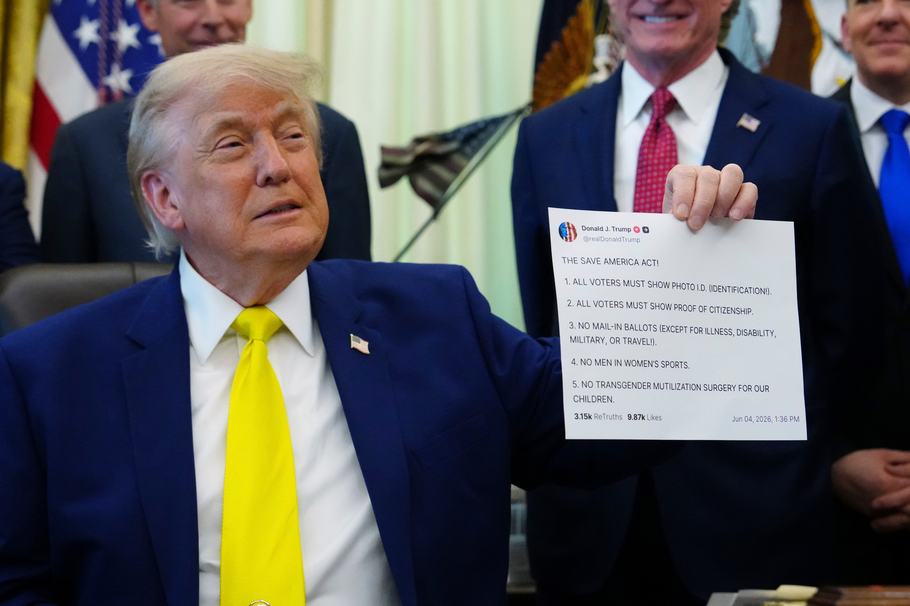
President Donald Trump holds up an image taken from his Truth Social account at a June event in the White House. Karoline Leavitt, the outgoing White House press secretary, has said that Trump’s posts represent official U.S. policy.
Dear Friend of Press Freedom,
Welcome back to your newsletter around press freedom violations in the United States as captured by the U.S. Press Freedom Tracker, a project by FPF.
Access to the president’s Truth Social posts, where he routinely makes official government announcements, should be equal to all. We’ve been reviewing Trump’s social media posts dating all the way back to 2015 — first on Twitter, now on Truth Social — for anti-press language, and cataloging them in a Trump Anti-Press Social Media Tracker.
Today, the dataset has more than 3,720 entries in it. That amounts to nearly one anti-press post a day for 11 years.
To get that number, Managing Reporter Stephanie Sugars sorts through the president’s posts for missives with anti-press sentiments in them — from calls of “fake news” (1,628 times) and “enemy of the people” (77 times), to name-calling individual journalists (776 times). Pulitzer Prize-winning journalist Maggie Haberman alone is mentioned more than 20 times, including in July when Trump wrote a 449-word post insulting Haberman (“Maggot Hagerman, one of the most unattractive people in the News ‘Business’”), Jonathan Swan (her “lightweight assistant”) and The New York Times (“The Failing New York Times”). By our count, the Times is called out by the president 440 times.
Trump also uses the platform to allege crimes. In an Aug. 6 Truth Social post, he dismissed The Washington Post’s reporting on Iran as “fake” and “treasonous,” referring to the outlet as “The Washington ComPost, one of the worst Media Outlets in the business.”
Other times, Trump uses the platform to threaten news organizations. In December — in a 487-word post — he said the Times and other news outlets were “seditious” and “true Enemies of the People,” adding that “we should do something about it.”
On MS NOW’s “State of Play with Peter Alexander,“ I explain why FPF and The Intercept are taking the president to court.
FPF/YouTube
Other notable Tracker updates
- Wilmer Solano Dávila, a Venezuelan journalist, was released from federal immigration detention in Miami, Florida, on Aug. 14, ending a nearly three-week detainment. And this month marks more than 300 days in federal immigration detention for independent journalist Carlitos Ricardo Parias. In June 2025, Parias was injured in Los Angeles, California, while reporting on federal agents, and in October was shot in the arm while being taken into custody.
- Phyllis Zorn, a former reporter with the Marion County Record, settled her federal lawsuit against the city of Marion, Kansas, on Aug. 11 for $850,000 in damages over the 2023 raid on the newsroom’s office. Zorn, whose personal cellphone had been seized during the raid, previously settled a claim with Marion County.
- Court filings on Aug. 6 revealed that a Department of Homeland Security agent had issued an administrative subpoena to T-Mobile for call and text data earlier this year for Georgia Fort. The subpoena was issued without judicial oversight. Fort was arrested alongside Don Lemon and another journalist on federal charges in late January after covering an anti-deportation protest that disrupted a church service in St. Paul, Minnesota.
- Another court record in this case, filed the next day, revealed that six news media outlets and journalists — including Fort, Lemon, Megyn Kelly and others — were the target of an April subpoena issued to YouTube by the DHS agent, again without judicial oversight. The subpoena sought names and IP addresses associated with the journalists’ accounts; a spokesperson for Google, YouTube’s parent company, told the Tracker that it did not comply with the request. An agency spokesperson told the Tracker it would not divulge its investigative methods.
Correction: This newsletter has been updated to clarify details around the legal orders issued by the Department of Homeland Security in connection with the arrests of journalists Georgia Fort and Don Lemon. An emailed version of this article was sent without these corrections.