Incident details
- Date of incident
- September 2025
- Targets
- Media
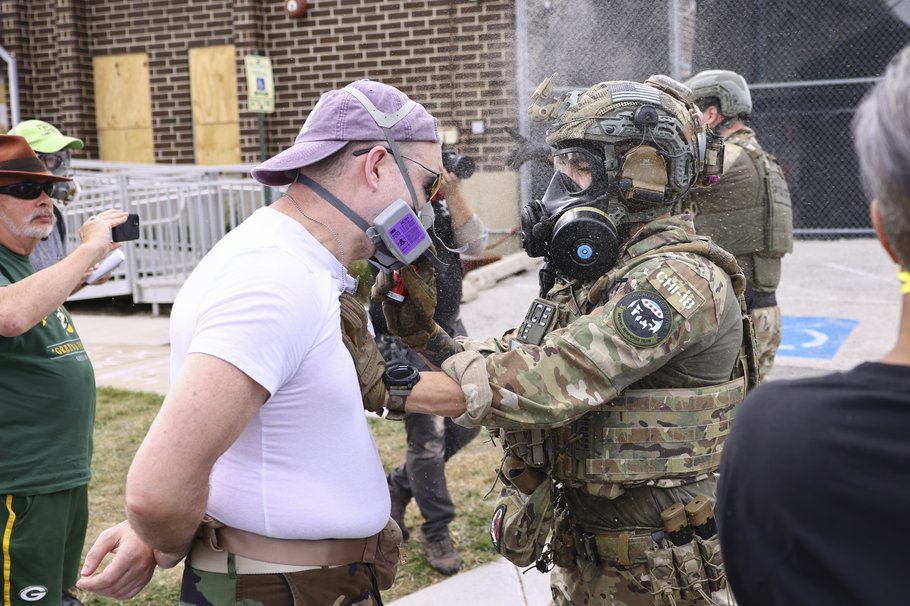
A federal agent pushes a protester outside an ICE processing facility in Broadview, Illinois, on Sept. 19, 2025. Dozens of journalists were exposed to chemical irritants while covering several weeks of anti-deportation protests there.
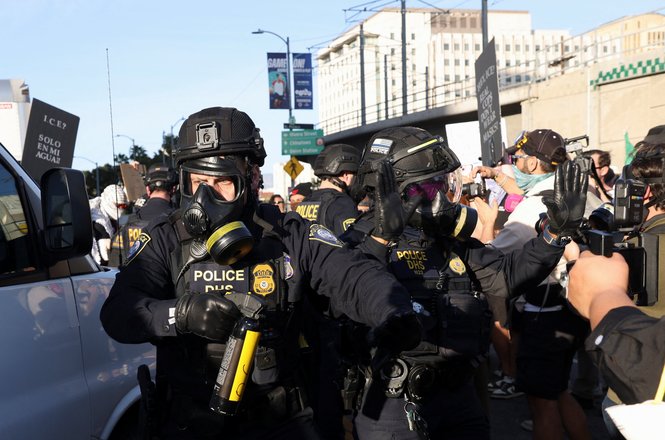
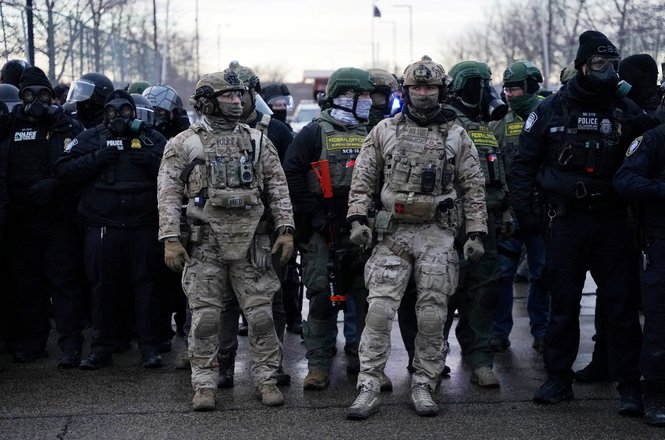
Federal immigration raids began in the Chicago, Illinois, area in early September 2025, after the Department of Homeland Security launched Operation Midway Blitz. For weeks, anti-deportation protests in response largely centered around an Immigration and Customs Enforcement processing facility in nearby Broadview.
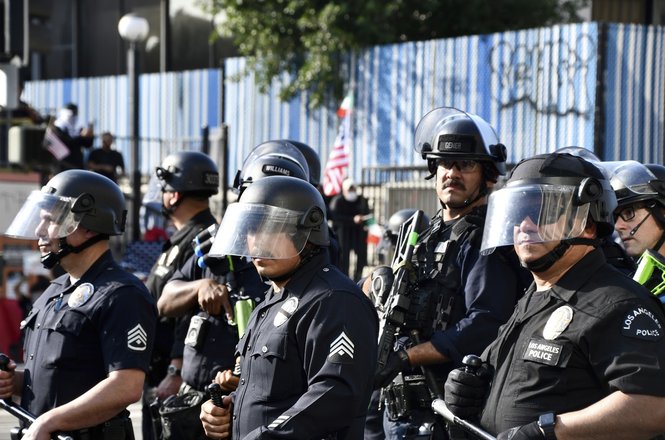
Journalists covering the Broadview demonstrations were affected by the law enforcement response — which included a sweeping use of chemical irritants — initially led by federal officers with DHS before being taken over by local agencies.
While these September incidents do not fall under the 11 types of press freedom violations formally cataloged for the U.S. Press Freedom Tracker database, we’ve provided a roundup of them below, organized by date. This roundup will be updated as additional incidents are verified.
Meanwhile, an array of Chicago-area journalists and others sued President Donald Trump and various federal agencies Oct. 6 over the violent federal response to the protests in Broadview. The plaintiffs were granted a temporary restraining order forbidding federal agents from dispersing, arresting, threatening or using physical force against journalists without probable cause of a crime. That temporary order was superseded a month later by a preliminary injunction establishing the same limitations, but was paused Nov. 19 following an appeal that determined it was “overbroad.”
The journalists dropped the suit Dec. 2, following the temporary departure of Border Patrol Chief Greg Bovino and his agents from the Chicago-area, but said they are prepared to refile if federal law enforcement returns in force.
A full accounting of incidents in which members of the press were assaulted, arrested or had their equipment damaged while covering protests in Broadview can be found here. To learn more about how the Tracker documents and categorizes violations of press freedom, visit our FAQ page.
Sept. 12, 2025
- An unidentified photojournalist with the Chicago Sun-Times was exposed to tear gas and pepper balls deployed during morning protests, the Chicago News Guild told the Tracker.
Sept. 19, 2025
- Freelance reporter Leigh Giangreco, on assignment for Block Club Chicago, said in a report posted on social video platform TikTok that she was exposed to chemical irritants fired by federal officers. “I will say I was also in the middle of these protests and the pepper spray was on the air, was getting in your eyes,” she said, adding, “It’s still in my throat now.” She was also shot with multiple pepper balls.
- Freelance photojournalist Audrey Richardson told the Tracker she was tear-gassed when federal officers deployed stun grenades and chemical irritant into the crowd. She was also shot with crowd-control munitions.
- Independent photojournalist Chana Shapiro was exposed to tear gas and pepper spray fired by federal officers. The irritants seeped into cuts on her knees and elbows. “My body was really hurt and stung for the rest of the day. And then, because it kept happening, it kept exacerbating it,” she told the Tracker. She was also hit with pepper balls.
- An unidentified photojournalist with the Chicago Sun-Times was exposed to tear gas that landed near the photojournalist’s feet, the Chicago News Guild told the Tracker. The photographer was also struck by two pepper balls.
- An unidentified reporter with the Sun-Times was also exposed to tear gas while covering protests that evening, according to the News Guild.
- An unidentified photojournalist with the Chicago Tribune was exposed to tear gas by federal officers while covering protests outside the facility, according to the Sun-Times.
Sept. 21-22, 2025
- An unidentified reporter with the Chicago Sun-Times was exposed to chemical irritants that were pervasive in the air while covering protests on back-to-back days, the Chicago News Guild told the Tracker.
Sept. 26, 2025
- Colin Boyle, photography director for nonprofit newsroom Block Club Chicago, wrote in court records that he was affected by tear gas deployed by federal agents, which clung to his clothes and affected him throughout the day. “Tear gas seeped into my respirator and visor. My eyes watered and I coughed a lot, making it difficult to do my job.” He was also shot with pepper balls.
- Status Coup video journalist Jon Farina was covering protests at the facility early that morning, the outlet reported, when he texted his colleagues, “It’s not even 9 a.m., and I’m burning from pepper spray and tear gas.”
- Freelance photojournalist Matthew Kaplan was affected by tear gas fired by federal officers without any warning, which incapacitated him for about 10 minutes. “No one said, ‘Get away.’ No one said, ‘We’re going to throw tear gas,’” Kaplan told the Tracker. “There was no communication.” He was also shot with multiple crowd-control munitions.
- Federal agents fired tear gas directly at Chicago Reader editor Shawn Mulcahy and other clearly identifiable journalists, he wrote in a court declaration. He was also shot with a crowd-control munition.
- Independent photojournalist Chana Shapiro told the Tracker that she was caught in tear gas and pepper spray deployed by federal agents while documenting protests outside a fence erected around the facility. One of the agents also chased her in an attempt to tackle her, while another pointed and primed a taser at her chest.
- Photojournalist Jon Stegenga, co-founder of independent outlet Humanizing Through Story, told the Tracker he was exposed to tear gas fired by federal agents; the canisters shattered glass and went inside nearby businesses. He was also struck in the arms and chest by crowd-control munitions.
- Freelance reporter Charles Thrush said in court records that federal officers shot pepper balls and tear gas at him and other journalists. Thrush reported that the exposure from the pepper ball, as well as tear gas, caused burning on his skin for about 12 hours. He was also shot in the hand with a pepper ball.
- An unidentified photojournalist with the Chicago Sun-Times was exposed to tear gas and other crowd-control munitions fired by federal agents, the Chicago News Guild told the Tracker. The photographer was also hit six times with projectiles.
- An unidentified reporter with the Sun-Times was also exposed to tear gas and was pepper-sprayed by law enforcement while covering protests that morning, according to the Chicago News Guild.
Sept. 27, 2025
- Independent photojournalist Chana Shapiro was covering what she described as peaceful protests that, after dark, devolved into a violent confrontation with law enforcement. She told the Tracker that the crowd remained calm until federal agents suddenly emerged through the fence and began firing what she described as a barrage of crowd-control munitions — including pepper balls, rubber bullets, sponge grenades, baton rounds and flash bangs — some of which were launched hundreds of feet through the air, forcing protesters to flee through smoke and fire. Shapiro said she was heavily tear-gassed, injured while diving to avoid the stampede and pulled aside by medics for treatment. Though she didn’t recall being directly hit, she told the Tracker she returned home bleeding, coughing and both physically and emotionally overwhelmed, describing it as one of the most terrifying and traumatic experiences of her life.
- Photojournalist Jon Stegenga, co-founder of independent outlet Humanizing Through Story, told the Tracker that he was affected by a flurry of chemical irritants fired by federal agents that got under his mask, burning his eyes and face so badly he needed help to rinse them off. He also lost his camera lens.
- Chicago Sun-Times photojournalist Anthony Vazquez told the Tracker he was tear-gassed by federal agents. “It was three separate instances of conflict among protesters and federal agents that resulted in me getting hit by a total of five of the rubber bullets/pellets and once by a pepper ball on top of the tear gas.”
Sept. 28, 2025
- An unidentified reporter with the Chicago Sun-Times was exposed to chemical irritants in the air while covering afternoon protests, according to the Chicago News Guild.
The U.S. Press Freedom Tracker catalogs press freedom violations in the United States. Email tips to [email protected].