Incident details
- Updated on
- Date of incident
- July 10, 2026
- Targets
- Max Blumenthal (The Grayzone)
- Case number
- 1:26-mc-00016
- Case status
- Ongoing
- Type of case
- Civil
- Border point
- Washington Dulles International Airport
- Target nationality
- US citizenship status of target
- U.S. citizen
- Denied entry?
- No
- Stopped previously?
- Yes
- Asked for device access?
- Yes
- Asked intrusive questions about work?
- Yes
Border Stop
- Equipment searched or seized
- Status of equipment
- Returned in full
- Search warrant obtained
- No
Equipment Search or Seizure
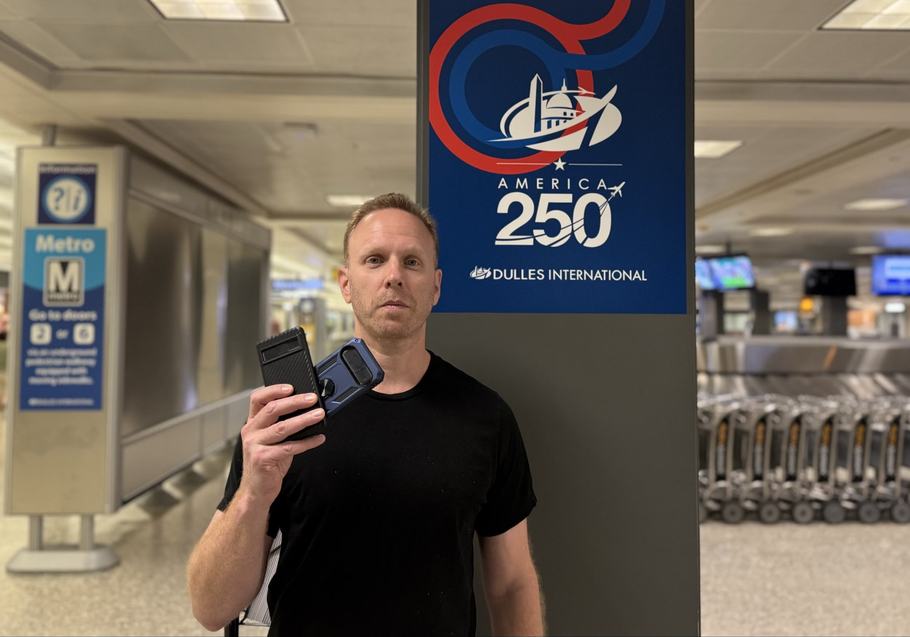
Journalist Max Blumenthal holds up his two cellphones, which were seized and searched by U.S. Customs and Border Protection at Dulles International Airport in Virginia on July 10, 2026. They were later returned.
Editor sues federal agencies over cellphone seizure at Virginia airport
Journalist Max Blumenthal sued federal officials on Aug. 17, 2026, arguing that U.S. Customs and Border Protection violated his First and Fourth amendment rights when agents seized his cellphones at Washington Dulles International Airport in Virginia.
Blumenthal was stopped and questioned July 10 after returning from a reporting trip to Iran. Customs officials searched his luggage and confiscated two cellphones, telling him they would connect the devices to equipment to extract data, according to court documents.
Blumenthal had traveled to Iran on a press visa to cover the funeral of Iran’s Supreme Leader Ayatollah Ali Khamenei for The Grayzone, the online news outlet he edits and founded in 2015.
The lawsuit, filed by the American-Arab Anti-Discrimination Committee on behalf of Blumenthal, says the search was unlawful and in retaliation for his journalism.
The complaint points to public statements by conservative activist Laura Loomer, an informal adviser to President Donald Trump, who urged the administration to arrest Blumenthal. Elon Musk, the tech billionaire who previously worked with the Trump administration, also amplified a post accusing Blumenthal of supporting “Antifa, Palestine, Russia, and the Islamic Republic of Iran.”
“There is good reason to believe that the government was targeting and punishing him for his views and journalism—in violation of the First Amendment,” Blumenthal’s attorneys wrote. The defendants in the lawsuit are Department of Homeland Security Secretary Markwayne Mullin, CBP Commissioner Rodney Scott and acting Deputy Commissioner Ronald Vitiello.
As part of his lawsuit, Blumenthal seeks a permanent injunction barring the government from targeting him because of his journalism or searching or seizing his electronic devices without a warrant or individualized suspicion.
Separately, Blumenthal filed a motion July 16 demanding his devices be returned. The government handed them over the next day, but the dispute over whether agents extracted or obtained any data remains unresolved.
At a July 29 hearing about the devices, District Judge Leonie Brinkema said she was concerned that Blumenthal’s phones had been held for nearly a week and were subject to an advanced search. A Fourth Circuit court precedent distinguishes routine cellphone searches at the border from more intrusive searches that use forensic technology, which require a warrant, she noted.
Brinkema also highlighted Blumenthal’s status as a reporter, stating the case raised particular concerns about the government’s efforts to interfere with journalists’ ability to report, according to court records.
The government had submitted a declaration stating that agents tried but failed to extract data from the phones. But Blumenthal’s attorneys have argued the declaration was too vague.
“We want to know more. We want records of what happened to the phones,” attorney Jenin Younes told the U.S. Press Freedom Tracker.
The matter remains pending after the judge ordered limited discovery into what happened to the phones and whether the government obtained any data from them.
The encounter with CBP has already affected Blumenthal’s work, according to court documents. He has stopped communicating with some sources because he fears government scrutiny and has avoided travel because he fears being subjected to another search.
“If people are worried that their identification as confidential sources will be discovered by the U.S. government, they might not be willing to serve as confidential sources anymore,” Younes said. “It has really detrimental impacts.”
CBP said in a statement after the incident that anyone entering the United States is subject to inspection.
“Additional scrutiny and increased inspection may be conducted, including if an individual has worked in or traveled to a high-risk country such as a State Sponsor of Terrorism, including Iran,” the agency said.
Journalist Max Blumenthal was stopped, questioned and had his cellphones seized and searched by U.S. Customs and Border Protection agents at Washington Dulles International Airport in Virginia after returning from a reporting trip to Iran on July 10, 2026.
Blumenthal had traveled to Iran on a press visa to cover the funeral of Iran’s Supreme Leader Ayatollah Ali Khamenei for The Grayzone, the online news outlet he edits and founded in 2015.
While there, he covered official press events alongside reporters from other U.S. news organizations. He also reported on the aftermath of the joint U.S.-Israeli strikes on Iran, and interviewed government officials and residents for a series of videos and articles.
Blumenthal told the U.S. Press Freedom Tracker that the boarding pass for his connecting flight from Istanbul, Turkey, to Dulles was flagged for secondary screening before he arrived in the United States.
When he landed, CBP officers escorted him to a secondary inspection room, where he waited about 30 minutes before being questioned, according to a federal lawsuit filed later against Department of Homeland Security Secretary Markwayne Mullin.
Officers searched Blumenthal’s carry-on bags and asked whether he felt threatened while reporting in Iran, whether he had been compensated for interviews he conducted there, how he paid for his travel and whether he planned to return to Iran.
After about 10 minutes of questioning, officers accompanied Blumenthal to baggage claim, where they also searched his checked luggage, according to the federal complaint. They then told him they needed to examine his two cellphones to look for evidence of criminal activity or child sexual abuse material.
When Blumenthal declined to provide the passcodes, officers seized both his cellphones. One officer told him they were going to “hook them up to machines” to extract data from them, according to the lawsuit. Blumenthal was detained for about 2 1/2 hours before being released without his phones.
Blumenthal said he has never been accused of or convicted of a crime, and that officers had no basis to suspect him of criminal activity. He questioned why they seized only his phones, rather than his laptop or digital camera, if they were searching for such material.
Blumenthal told the Tracker that the stop came after conservative activist Laura Loomer, who has been an informal adviser to President Donald Trump, publicly urged the administration to arrest him.
He said the CBP officers’ questions mirrored Loomer’s accusations and that he believes he was targeted because he reports critically, and sometimes shares his opinion, on U.S. foreign policy and Israel.
“It’s pretty obvious that I’m being targeted for political reasons and for my reporting,” Blumenthal said. “The only political activity I engage in is reporting. I don’t do activism, I don’t organize protests, I’m not running for office.”
The search of Blumenthal’s cellphones could expose the identities of his confidential sources, communications with his contacts, unpublished reporting and the methods by which he conducts his journalism, the lawsuit alleged.
“Every journalist should be concerned and especially vigilant when the First and Fourth amendments are subjugated ruthlessly in order to repress those who are perceived as enemies for their reporting,” Blumenthal told the Tracker.
After he filed his lawsuit on July 16 seeking the return of his devices, Blumenthal posted on social platform X that he had received a phone call informing him that he could retrieve them.
“This does not make our case moot, however,” he wrote. “I demand the return of any information, data, or copies obtained from my phones, and will be exploring further action related to the violation of my First and Fourth amendment rights.”
In a response to a request for comment, CBP said in a statement that anyone entering the U.S. is subject to inspection.
“Additional scrutiny and increased inspection may be conducted, including if an individual has worked in or traveled to a high-risk country such as a State Sponsor of Terrorism, including Iran,” the statement said.
The statement did not address agents’ questions about Blumenthal’s journalistic work or the seizure of his cell phones.
Blumenthal was also stopped by CBP in 2025 after returning from a vacation in Nicaragua.
Update: This article was revised to include a comment from Customs and Border Protection.
The U.S. Press Freedom Tracker catalogs press freedom violations in the United States. Email tips to [email protected].