
Incident details
- Date of incident
- January 21, 2026
- Arrest status
- Charged without arrest
- Arresting authority
- Franklin County Circuit Court
- Charges
-
-
Contempt of court
- Jan. 21, 2026: Charges pending
- Jan. 26, 2026: Convicted
- Jan. 29, 2026: Pending appeal
- March 16, 2026: Acquitted
- April 15, 2026: Pending appeal
-
Contempt of court
- Unnecessary use of force?
- No
Arrest/Criminal Charge
- Equipment searched or seized
- Status of equipment
- Returned in full
- Search warrant obtained
- No
Equipment Search or Seizure
- Equipment damaged
- Actor
- Politician
Equipment Damage
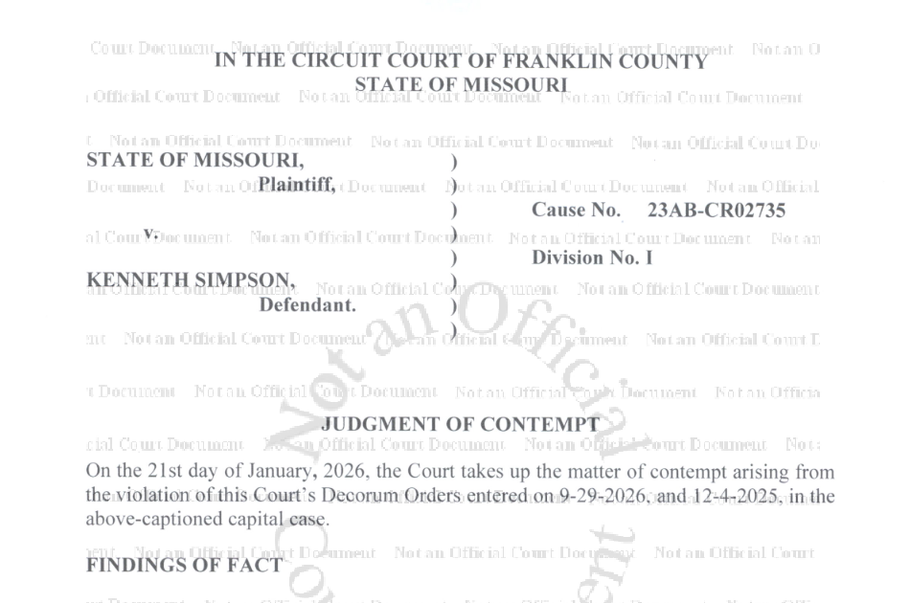
A portion of a court judgment finding Cathi Utley, general manager for The Hermann Advertiser-Courier, guilty of contempt of court for using her cellphone to photograph proceedings in a high-profile murder trial in Union, Missouri, on Jan. 21, 2026.
Cathi Utley, general manager for The Hermann Advertiser-Courier, was convicted of contempt of court for using her cellphone to photograph trial proceedings for a capital case in Union, Missouri, on Jan. 21, 2026. Her sentence was lifted following an appeal, and the case was argued before the state’s Supreme Court in October.
Utley had been covering the trial of Kenneth Simpson, who was charged with nine felonies for the shooting of two Hermann police officers and the resulting death of one of them, Sgt. Mason Griffith, KOMU-TV reported. His trial — in which prosecutors planned to pursue the death penalty — began Jan. 20.
Months before the proceedings, the court issued a media order and two decorum orders dictating access and behavior restrictions for those in the courtroom. The edicts barred all cellphones and cameras, but established an exception for a single member of the press to take still photographs during non-evidentiary portions of the trial.
The following day, according to court records reviewed by the U.S. Press Freedom Tracker, Utley was acting as the pool photographer, but after arriving at the courthouse, she discovered that her camera was not working.
During a recess, she retrieved her cellphone, later telling the court that security gave her clearance to bring it inside. She then used the phone in place of a camera to cover the trial, also capturing two brief videos which she told the court had been accidental.
Judge Craig Hellmann saw Utley do so, and called her to the bench to confront her about her actions.
A transcript of the exchange revealed that Hellmann demanded Utley hand over her phone so he could review the captured images and, upon viewing the brief clips, asserted without explanation that her filming had been intentional.
Utley offered to delete the images and clips, to which Hellmann replied, “Oh, you will.”
Court staff then oversaw the deletion, ensuring no copies remained in cloud storage or the device’s trash. Utley was ultimately ordered to leave the courtroom and informed that she and all employees of the Advertiser-Courier would be barred from the remainder of the trial.
Hellmann declined to issue a final judgment of direct contempt against Utley, initially announcing that he would assign the matter to another judge. But he then issued a judgment of guilt Jan. 26.
At a hearing the morning of Jan. 29, Utley was sentenced to five days’ incarceration and immediately taken into the custody of the Franklin County Sheriff’s Office. Her attorneys quickly filed a petition for her release, and an appeals court suspended the judgment while hearing the request.
Utley, who did not respond to a request for comment, was released under her own recognizance that afternoon.
The Missouri Court of Appeals for the Eastern District granted Utley’s petition March 16, overturning her conviction based on procedural issues.
Assistant Attorney General Andrew Clarke appealed the case to the Missouri Supreme Court in April, and the court heard arguments Oct. 14.
The Missouri Press Association argued in an amicus brief that the court violated the state constitution by punishing Utley for her choice of equipment.
“This mandate of the Missouri Constitution—expressly precluding impairment of expressive and press rights based on the means by which they are accomplished—leaves no room for the Circuit Court’s criminal penalization of a journalist for her choice of camera,” it wrote.
The association also asserted that the court must weigh the public’s interest in open courts alongside its interest in the integrity of the judicial process.
“Such a balancing approach would inevitably result in imposing only the minimum punishment upon a journalist doing her job of reporting on the important events of a trial, functioning as the eyes for the public at large,” it wrote. “Jailing, for any length of time, the journalist designated to take photography of an important trial would never be warranted under such a balancing test.”
The U.S. Press Freedom Tracker catalogs press freedom violations in the United States. Email tips to [email protected].


