Incident details
- Updated on
- Date of incident
- March 23, 2026
- Targets
- Media
- Case number
- 1:26-cv-01690
- Case status
- Ongoing
- Type of case
- Civil
- Government agency or public official involved
- Type of denial
- Change in policy or practice
Denial of Access
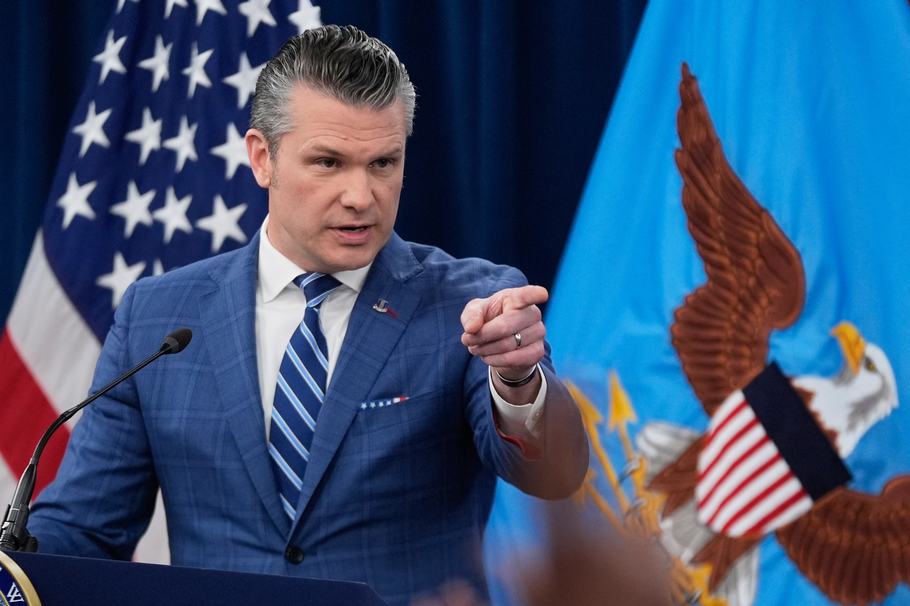
Defense Secretary Pete Hegseth at an April 8, 2026, press briefing at the Pentagon, in Arlington, Virginia. The Defense Department instituted new policy guidelines on March 23, 2026, severely curtailing journalists’ access to the building.
Appeals panel reinstates Pentagon rule requiring media escorts
Members of the media must once again be escorted while reporting at the Pentagon, following the reinstatement of a Department of Defense rule by a federal appeals panel on July 16, 2026.
The panel’s ruling reverses a June 30 order by a U.S. district judge that had granted a temporary suspension of the rule.
The escort policy was announced March 23 after an earlier court order declared parts of a previous set of Pentagon press guidelines unconstitutional.
The New York Times then sued the department in federal court over the escort rule on May 18, calling the revised policy “retaliatory, utterly unreasonable, and manifestly arbitrary and capricious.”
After a June 30 preliminary injunction prevented the Pentagon from enforcing the escort requirement, the DOD appealed.
The latest ruling, from two of the three panel’s judges, ordered the escort rule to be reinstated while the case moves through the appeal process. They wrote that the DOD would likely succeed in its argument that the rule was not a First Amendment retaliation, in that it applies evenhandedly to all reporters.
A third judge dissented, arguing that the policy being evenhanded had no bearing on its alleged retaliatory effect. “Perhaps a policy that places a speaker at a unique disadvantage would be even more chilling in certain circumstances,” Judge Bradley Garcia wrote, “But a retaliatory government policy should not be immunized simply because it is broadly and evenly applied.”
Pentagon spokesman Sean Parnell celebrated the panel’s ruling on X, writing, “Reporters do not have a First Amendment right to freely roam the halls of the Pentagon.”
A Times spokesman told the newspaper: “While The Times is disappointed with this interim decision, we appreciate that the court has expedited the appeal and look forward to litigating it on the merits.”
Judge pauses Pentagon rule requiring media escorts
A federal judge temporarily suspended a Department of Defense rule on June 30, 2026, that would have required members of the media to be accompanied by escorts while reporting at the Pentagon.
The escort rule was announced March 23 by Pentagon spokesperson Sean Parnell, who framed it as a necessary security measure in response to a March 20 court order that declared unconstitutional portions of departmental press guidelines implemented in September 2025.
The change prompted The New York Times to sue the department in federal court on May 18, 2026, calling the revised policy “retaliatory, utterly unreasonable, and manifestly arbitrary and capricious.”
The Times also requested a preliminary injunction preventing the Pentagon from enforcing the escort requirement, pointing out that to ask one question of a Pentagon official, credentialed journalists “must obtain an appointment, get an escort, ask their question, and return to the library located in a separate building—only to repeat the process for the next official.”
In his decision, District Judge Paul Friedman touched on the importance of the free press. “This court has spoken at several points about the critical importance of protecting the freedoms enshrined in the First Amendment,” Friedman wrote. “As our country celebrates its 250th anniversary this very week, that principle must not be abandoned now.”
Charlie Stadtlander, executive director of media relations for the Times, told Courthouse News in an emailed statement, “Today’s well-reasoned decision reaffirms the First Amendment rights of the press to cover the Pentagon without restrictions designed to prevent the public from knowing what the military is doing.”
In an X post, Parnell said, “The Department strongly disagrees with today’s decision. This ruling strips away reasonable security measures and will make it easier for sensitive and classified information to reach our adversaries.”
He added that the DOD would appeal the decision.
Pentagon spokesperson Sean Parnell announced March 23, 2026, that the Defense Department would move journalists from their designated offices in the building into a separate annex and mandate escorts for journalists at the Arlington, Virginia, complex.
Parnell, in a statement, framed the rules as necessary security measures in response to a March 20 court order that declared portions of the department’s press guidelines, implemented last fall, to be unconstitutional.
The New York Times, in response, sued the department in federal court on May 18, calling the revised rules unconstitutional.
In September 2025, the Pentagon distributed new restrictions mandating that journalists pledge to obtain approval for releasing information gathered there, even if unclassified, and warning that press credentials could be revoked or denied if a journalist “is reasonably determined to pose a security or safety risk.”
Dozens of Defense Department correspondents refused to sign on to the new guidelines and were then forced to surrender their press badges.
In December, The New York Times sued the Defense Department, Defense Secretary Pete Hegseth and Parnell over the guidelines.
In March 2026, U.S. District Judge Paul Friedman ruled that portions of the September guidelines under which press credentials could be revoked violated the First and Fifth amendments and could not be enforced. He also mandated that the Pentagon restore press credentials to seven Times journalists.
Three days after the ruling, Parnell announced that the Defense Department would move journalists from their designated offices in the building into a separate annex and mandate escorts for journalists at the Pentagon, framing those changes as necessary security measures.
Parnell also issued a memo to senior Pentagon leadership announcing changes to the wording of the original policy, including a change from prohibiting “solicitation” of information by reporters to “intentional inducement of unauthorized disclosure” of confidential information.
The next day, the Times filed a motion to compel the department to comply with the March 20 order, calling the new policy “an attempted end-run around this Court’s ruling” and the Pentagon’s actions “disrespectful to the Court, the Constitution, and the American public.”
Friedman agreed, granting the motion and ruling that the prohibitions on “intentional inducement of unauthorized disclosure,” the escort requirements and the access restrictions on journalists violated his March 20 order and could not be enforced.
The Pentagon immediately appealed the ruling and filed an emergency request with the appeals court to put the portion of the order reinstating journalists’ unescorted access to the Pentagon’s main building on hold.
On April 27, two members of a three-judge appellate panel allowed the request. They wrote that the escort requirement hadn’t been included in the original guidelines at the core of the Times’ lawsuit, and therefore, the district court’s March order didn’t address it. Also, they wrote, “the district court did not hold that the escort requirement independently violates the First or Fifth Amendment.”
In a dissent, Circuit Judge J. Michelle Childs argued that the revised policy had clearly violated the March order and had “imposed a new access regime.”
Rather than reinstate the Times reporters’ credentials as the March order intended, Childs wrote, the revisions had substantially reduced access for all credential holders. “Reporters can hardly verify sources, gather information, or speak candidly with Department personnel with an escort looming over their shoulders,” she wrote.
Parnell applauded the majority’s ruling, writing on social media, “Despite what many in the media have told you, the Department’s policy has never been about limiting journalism — it is about safeguarding classified information that protects American lives.”
The Times then filed a new suit in federal court against the Department of Defense, Hegseth, Parnell and department advisor Timothy Parlatore. The outlet’s complaint argued that the revised policy violated both the First and Fifth amendments and asked the court to vacate it.
The filing called the revised policy “retaliatory, utterly unreasonable, and manifestly arbitrary and capricious,” and alleged the Pentagon issued it “as a means to thwart a district court order and to punish The Times both for its editorial viewpoint and its successful suit vindicating its constitutional rights.”
The Times also requested a preliminary injunction preventing the Pentagon from enforcing the escort requirement, pointing out that to ask one question of a Pentagon official, credentialed journalists “must obtain an appointment, get an escort, ask their question, and return to the library located in a separate building—only to repeat the process for the next official.”
The Department has thus made sure, the filing argues, “that certain newsworthy information—obtained through unplanned interactions between credentialed journalists and Department officials on Pentagon grounds, or through conversations with multiple press officials in different press offices—will be simply unavailable to The Times and, accordingly, the public.”
The U.S. Press Freedom Tracker catalogs press freedom violations in the United States. Email tips to [email protected].