Incident details
- Date of incident
- October 2025
- Targets
- Jordyn Gualdani (Independent)
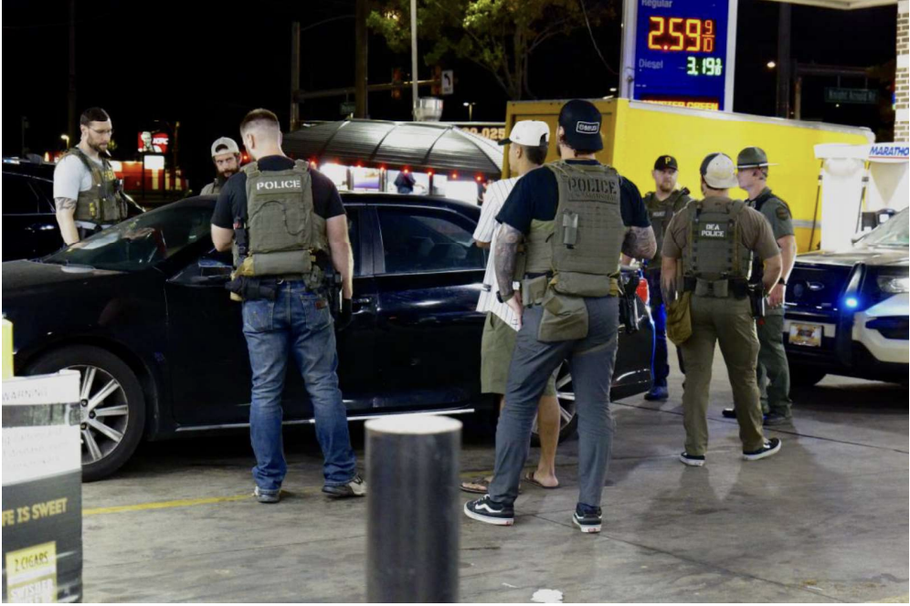
Law enforcement officers conduct an ID check at a gas station in Memphis, Tennessee, on Oct. 4, 2025. Jordyn Gualdani, the photojournalist who captured the image, alleges that the agents later followed his car.
Independent photojournalist Jordyn Gualdani faced retaliation by federal and state agents starting in October 2025 for his coverage of a law enforcement partnership that ramped up immigration arrests in Memphis, Tennessee.
In a May 28, 2026, declaration that Gualdani submitted as part of a lawsuit filed by four Memphis residents, he alleged that members of the Memphis Safe Task Force had engaged in a pattern of retaliation and intimidation against observers, and complicated his job as a journalist.
For instance, he said federal and state agents “arbitrarily” enforced Tennessee’s Halo Law, which invokes a 25-foot shield around law enforcement activity.
As Gualdani arrived to report on immigration enforcement stops, law enforcement officials would declare “Halo Act” and move forward, pushing Gualdani back so he no longer had a vantage point to document the activity.
The journalist also cited the aftermath of a tense stop at a gas station on Oct. 4, 2025, where he and other photojournalists documented a team of agents nearly breaking the window of an individual’s car.
Gualdani alleged that in the days after the incident, he was followed several times in his vehicle by the same agents involved in the stop, some of whom were wearing FBI and Homeland Security Investigations vests.
He said they also targeted him by “bumper rushing” — accelerating toward his car at high speeds as if to crash into him. At one point, Gualdani swerved to the side of the road, fearing a collision.
“I was terrified,” he wrote. “I was also concerned that the agents had damaged my car by pushing me off the road.”
In an interview with the U.S. Press Freedom Tracker, Gualdani characterized the actions as retaliation for documenting the gas station stop. “I think it was immaturity. It was one of, ‘You blocked us from doing what we wanted to do, and now we’re just going to try and mess with you,’” he said.
“I wish I could say that it was just a couple of agents that went rogue and have been behaving this way,” added Gualdani. “But it really is just how the task force behaves.”
The journalist also told the Tracker about additional retaliatory incidents, such as when unmarked vehicles parked on multiple occasions in the driveway or in front of his rural home about four hours from Memphis.
Another time, while he was away covering anti-immigration enforcement protests in Minneapolis, Minnesota, in January 2026, an individual came to his property and asked Gualdani’s partner whether a journalist lived at the address. The individual did not identify themselves, but Gualdani and their partner suspected they were a federal agent.
“That caused some problems with how my family feels, safety-wise,” he said. “Messing with me on the road or while I’m at work or at a demonstration, OK, go for it. But coming to our home where our family is, it’s not OK.”
“I’ve had to really think about just disclosing certain things and what risk that puts me and my family at,” Gualdani added.
The U.S. Press Freedom Tracker catalogs press freedom violations in the United States. Email tips to [email protected].