- Published On
- May 28, 2026
- Written by
- Briana Erickson from Freedom of the Press Foundation
Arrests and border scrutiny tied to immigration enforcement raise concerns for reporters arriving to cover the massive sporting event
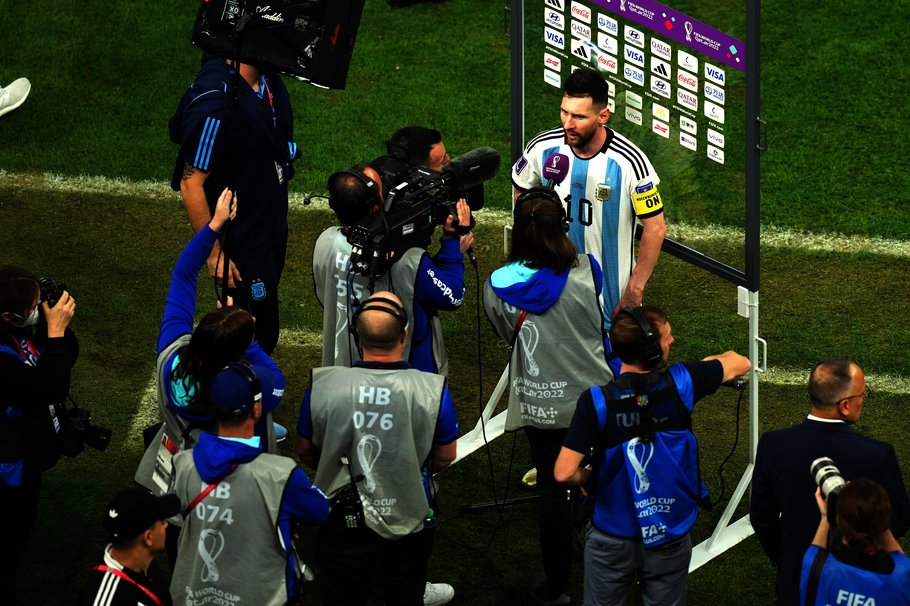
Argentina’s Lionel Messi is interviewed by the media following a victory in the FIFA World Cup quarterfinal match in Lusail, Qatar, on Dec. 9, 2022.
The day after Spanish-language journalist Estefany Rodríguez reported a story critical of Immigration and Customs Enforcement in March 2026, federal agents swarmed her newsroom car, handcuffed her and took her into ICE detention.
Rodríguez, a reporter for Nashville Noticias, spent two weeks in custody and now faces deportation back to her native Colombia, where she fears persecution for her work.
Her arrest is one of several incidents fueling concerns that the United States is no longer a safe place to report — not only for immigrant journalists, but also for the thousands of foreign reporters expected to travel here to cover the 2026 FIFA Men’s World Cup in June.
Ratcheting up the worry is that ICE will play a “key part” in security at the tournament, according to acting Director Todd Lyons, similar to the agency’s recent presence at the Winter Olympics in Italy.
ICE and its parent Department of Homeland Security have committed nearly 300 press freedom violations since 2017, as documented by the U.S. Press Freedom Tracker. Almost half occurred in the past year; most were assaults connected to immigration protests. And six of the eight known ICE detentions, where journalists are held by the agency while seeking asylum or facing deportation, have taken place during President Donald Trump’s two administrations.
DHS-related press freedom violations
Fear of ‘stepping out of bounds’
FIFA told the Tracker that it distributed about 16,000 media accreditations for the World Cup in the United States, Mexico and Canada. But journalists traveling to the U.S. for this year’s tournament may be especially worried about consequences for reporting on topics beyond the event, according to Michael Holley, an attorney representing Rodríguez.
“They would feel that maybe their visa will be revoked, and they’ll be taken into custody if they step out of bounds,” Holley said.
It’s happened before to journalists covering immigration issues. Months before ICE arrested Rodríguez, police in Georgia detained journalist Mario Guevara as he livestreamed a “No Kings” protest near Atlanta, wearing a press helmet and vest, and broadcasting to his large Spanish-language audience on Facebook.
“I’m a member of the media, officer,” Guevara said before his cellphone fell and the livestream abruptly ended. He was transferred to ICE custody and deported to his native El Salvador after nearly four months in detention.
Like Rodríguez, Guevara had regularly reported on ICE operations. Both journalists, while not U.S. citizens, lived in the United States legally on work permits. Both had started the green card process.
“I have had a work permit for the last 20 years,” Guevara told the Tracker.
“But for the immigration topic right now, your work permit is nothing.”
Mario Guevara
For its part, FIFA issued guidelines on First Amendment protections and required World Cup host cities, 11 of which are in the U.S., to submit human rights action plans.
But one host city, Los Angeles, doesn’t even mention journalists in its related webpage, despite LA accounting for half of all press freedom violations documented in the Tracker this year. And Atlanta’s 57-page plan references journalists only once, even though two of the seven reporters documented in the Tracker’s ICE detention cases were detained in the state. As of late April, most cities still had not published their plans.
While FIFA reviews human rights complaints and has a policy that vows to protect journalists during its tournaments, including by using its leverage with authorities to help reporters, advocates say enforcement is inconsistent and can take months to resolve problems, if at all.
“This year really puts those policies to a test. And right now, FIFA is failing to live up to its own policies,” said Andrea Florence, executive director of the Sport & Rights Alliance, a global coalition of organizations focused on protecting human rights in sport.
A FIFA spokesperson told the Tracker that entry into host countries is an immigration matter outside the organization’s control, though FIFA provides support to accredited journalists and helps them obtain expedited visa interview appointments if needed.
The spokesperson said FIFA has “developed excellent relations with the governments of Canada, Mexico, and the United States,” and called those relationships crucial to the success of the tournament. Asked how FIFA would uphold its policies to safeguard press freedom, the spokesperson pointed to the organization’s sustainability strategy and human rights framework.
Scrutiny in airports and at the border
In a statement emailed to the Tracker, DHS said the agency is working with local and federal partners to secure the World Cup and that international visitors coming into the United States legally have nothing to worry about.
“What makes someone a target for immigration enforcement is whether or not they are illegally in the U.S. — full stop. Speculation to the contrary is ill-informed,” the statement said. “At the same time, foreign visitors MUST be proactive and should start working on their travel plans and documents well ahead of time to ensure a smooth travel experience.”
Yet, in the last decade, federal officials at U.S. airports and border crossings have frequently questioned journalists about their reporting and political views, searched their devices in more than one-third of cases, and, in some instances, denied them entry.
One officer told Australian writer Alistair Kitchen, who was deported after arriving in LA in mid-2025: “It’s because of what you wrote online about the protests at Columbia University.”
It’s not just foreign journalists who are stopped. Most of the 59 border stops documented by the Tracker since 2017 involved U.S. citizens.
Affected journalists told the Tracker the aggressive, targeted immigration enforcement appeared designed to pressure them into compliance — whether by giving up information, self-deporting or enduring public humiliation. They said officials used other allegations as a pretext for detention, where they were subjected to questioning that sometimes lasted hours.
“It’s clear the government’s actions were meant to instill fear in journalists like me, to cow us into standing down from reporting what is happening on the ground,” said Bing Guan, one of five photojournalists who sued DHS after officers interrogated them about their coverage of a Central American migrant caravan’s arrival in Mexico in 2018. The group finally reached a settlement in January 2026.
Ecuadorian broadcaster Diego Arcos, who is preparing for his ninth World Cup, said he expects a heightened ICE presence around stadiums and hotels. Some of his colleagues are skipping the tournament this year, he added, thanks to rising costs, tighter immigration enforcement and difficulty obtaining a work visa.
While on assignment, Arcos plans to protect his devices and create daily backups of his reporting and sources. He plans to not only carry his media credentials, but also his passport and visa at all times.
“If I have all my paperwork with me, I’m going to feel safe,” Arcos said.
Immigrant journalists allege retaliation
Guevara’s arrest in Georgia, one of the states hosting the World Cup, is a textbook case of retaliation against an immigrant journalist, advocates say.
“It’s sending the message that anybody’s First Amendment rights in the country, citizens and immigrants alike, are not guaranteed — and by exercising them, you’re putting yourself at risk,” said Guevara’s attorney Zach Gaeta.
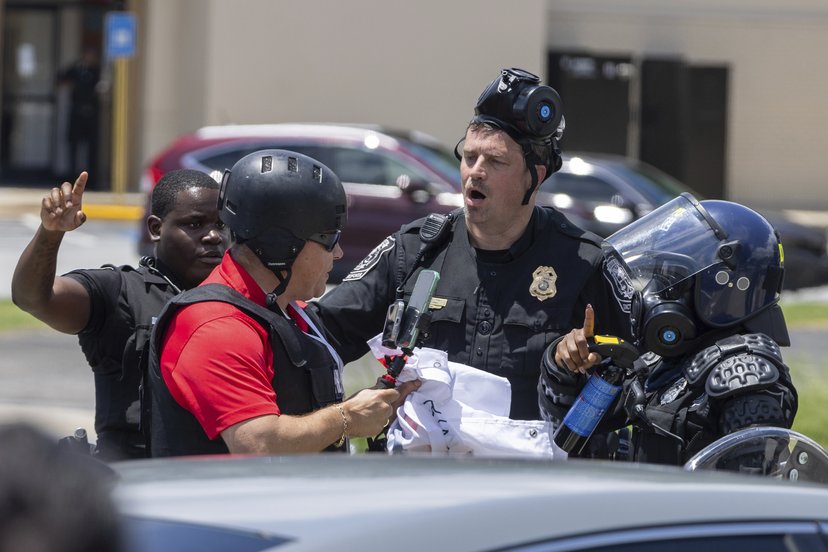
Police with reporter Mario Guevara during an immigration protest in metro Atlanta on June 14, 2025.
— Atlanta Journal-Constitution/Arvin Temkar via APGuevara faced three misdemeanor charges tied to his arrest at the June 2025 protest. While he was in custody, authorities in another jurisdiction added three alleged traffic violations from an incident more than a month earlier, which he and his attorneys said was a tactic to hurt his immigration case. Deputies also searched his phone and shared its contents with federal officials.
Although all charges were eventually dropped, Guevara remained in custody for months before being deported to El Salvador. Weeks later, he got his cellphones back and found that videos he shot of ICE agents and local deputies were gone. The livestream of his arrest had also disappeared from his social media account.
“I was a victim because of my job,” Guevara said. “You can have retaliation for that. That was my case. Probably, I was the first one, but I don’t think I’ll be the only one.”
Rodríguez, speaking in Spanish through a translator, told the Tracker she finds it ironic that she and Guevara, like many other foreign reporters, sought sanctuary in the United States after facing threats for reporting in their home countries.
She was released from custody without her driver’s license, Colombian passport and identification, forcing her to work from home and curtail her coverage of ICE. She said other journalists coming here, including those covering the World Cup, should be prepared to work under pressure.
“The duty to report chases us, and we have to keep doing it,” Rodríguez said. “We can’t stop being journalists.”