- Published On
- September 30, 2026
- Written by
- Kirstin McCudden from Freedom of the Press Foundation
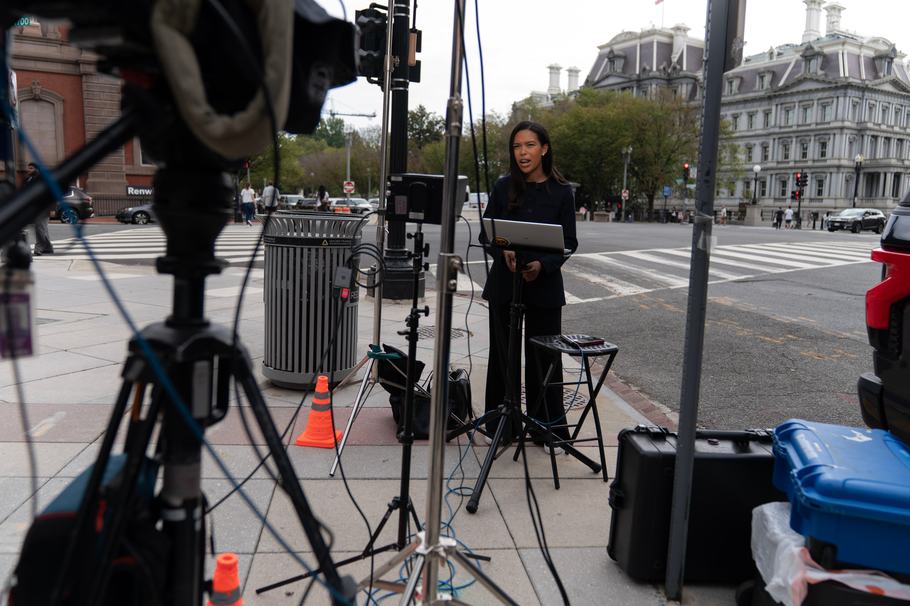
MS NOW White House reporter Akayla Gardner works from a makeshift setup near the White House after being denied entry on Sept. 20, 2026, following President Donald Trump’s ban on her outlet, as well as CNN and Politico.
Dear Friend of Press Freedom,
Welcome back to your newsletter around press freedom violations in the United States as captured by the U.S. Press Freedom Tracker, a project by Freedom of the Press Foundation.
What started as a Friday afternoon threat by the president on Truth Social turned into a Saturday question of constitutionality, as three news outlets — CNN, MS NOW and Politico — were banned from the White House on Sept. 19 for publishing articles Donald Trump didn’t like. Let’s look at the bigger picture.
If the question was whether the administration could lawfully deny access to media that the president doesn’t like, the answer was a swift no. District Judge Timothy J. Kelly issued a ruling temporarily lifting the ban in the early morning hours of Sept. 24. The judge cited D.C. Circuit precedent that included the first Trump administration’s failed attempt to bar a reporter without due process, with reporter Brian Karem in 2019. (Kelly had also presided over a 2018 hearing when the White House suspended reporter Jim Acosta’s press pass for asking questions the president didn’t like.)
Trump’s attempt to ban three major outlets while disparaging them on social media is straight out of his playbook. Just one day after Kelly’s order, the White House told CNN that its journalists would not be allowed to travel on Air Force One for a presidential trip to Tennessee; meanwhile, Trump used Truth Social as a platform to criticize the outlet’s coverage and the judge’s decision.
Last July, Trump barred Wall Street Journal reporter Tarini Parti from Air Force One days after the outlet reported on a birthday letter allegedly written in 2003 by the president to disgraced financier Jeffrey Epstein. After the article was published, Trump took to Truth Social to threaten to sue (which he later did), and called it “fake news,” a “pile of garbage” and defamatory, among other terms. In roughly a decade — first on Twitter, then on Truth Social — he’s insulted, threatened or accused the outlet of bias more than 115 times.
In February 2025, Trump banned The Associated Press from the White House for its editorial decision to continue to use Gulf of Mexico rather than Gulf of America for its international audience. For years, Trump has posted that the AP is “fake news” and “dishonest,” among other insults. The AP has sued the administration to restore its access; that lawsuit is under appeal.
What’s followed this latest White House pool coverage ban has been chaos, fueled by the administration’s at best poor communication and at worst outright contempt for the judicial branch’s ruling. CNN’s Brian Stelter and Alayna Treene, among others, have a great ticktok of the multiweek “shenanigans” and outlines the importance of pool reporting for the American people.
On Sept. 28, the three outlets filed for a preliminary injunction of the ban. A hearing is set for early October.
Notable Tracker incidents and updates: Federal government edition
Department of Defense
- In California, five reporters were held at gunpoint by security as they arrived to cover an Aug. 17 event at Vandenberg Space Force Base. The journalists, invited to cover the groundbreaking of a new training center, missed the event while sitting on a curb in handcuffs, along with two uniformed officer escorts. The base defended its treatment of the journalists, telling Stars and Stripes that heightened security measures and miscommunication led to the detentions.
- The Pentagon polygraphed approximately 50 members of the U.S. military’s Joint Staff in August as part of a massive leak investigation into the sources behind reporting on the nation’s dwindling weapons stockpiles.
Department of Homeland Security
- On Sept. 14, a federal judge blocked DHS from implementing new, tighter visa restrictions for foreign journalists a day before they were scheduled to take effect. In July, the department had said it would limit visas for journalists in the U.S. to just 240 days, and those for Chinese journalists to 90 days. The policy was challenged in court by a coalition of unions and university associations.
- After nearly two weeks in detention in Miami, Florida, journalist Luis Galeano was released from Immigration and Customs Enforcement custody on Sept. 26. The Café con Voz director had fled political persecution for his journalism in Nicaragua in 2018 and has an asylum application pending in the U.S.
Department of the Treasury
- Certain reporters from The New York Times, The Wall Street Journal and Bloomberg News, along with local North Carolina outlet Asheville Watchdog, were denied credentials to the Group of 20 summit in Asheville at the end of August. While the agency gave no explanation for the decisions, Treasury Secretary Scott Bessent told the AP that they were not related to the journalists’ point of view.
Conference roundup: Midterms and panels
While at the International Symposium on Journalism on the University of Texas campus earlier this month, I attended a panel on reporting on the U.S. midterms. An audience member asked the panelists if they had safety concerns while reporting from the field or sending peers into the field during this election cycle. (It was me. I asked the question.) Panelist Anna Johnson, the AP’s Washington bureau chief, quickly jumped in with her answer: “Absolutely.”
Johnson described how dealing with threats to physical safety and online harassment is paramount. “We have put a lot of focus on this in recent years,” she said, noting how journalists have been targeted at campaign events in the past. Johnson said the AP is offering training and guidance for its staff and thinking about safety all the time. “It’s at the forefront of my mind in everything we do,” she said.
Watch the full ISOJ panel and follow Tracker coverage of midterms press freedom aggressions through the tag election. For an extra boost of digital safety, sign up for FPF’s weekly security newsletter, the Digital Security Digest.
In the coming days, I’m sitting on two panels on press freedom at the Society of Professional Journalists’ major conference — “Incorporating the First Amendment in Your News Beat” and, with the aforementioned Stelter, “Americans’ Views on Press Freedom, 250 Years After the Nation’s Founding.” If you’re in Ohio, come say hi.