- Published On
- March 31, 2026
- Written by
- Kirstin McCudden from Freedom of the Press Foundation
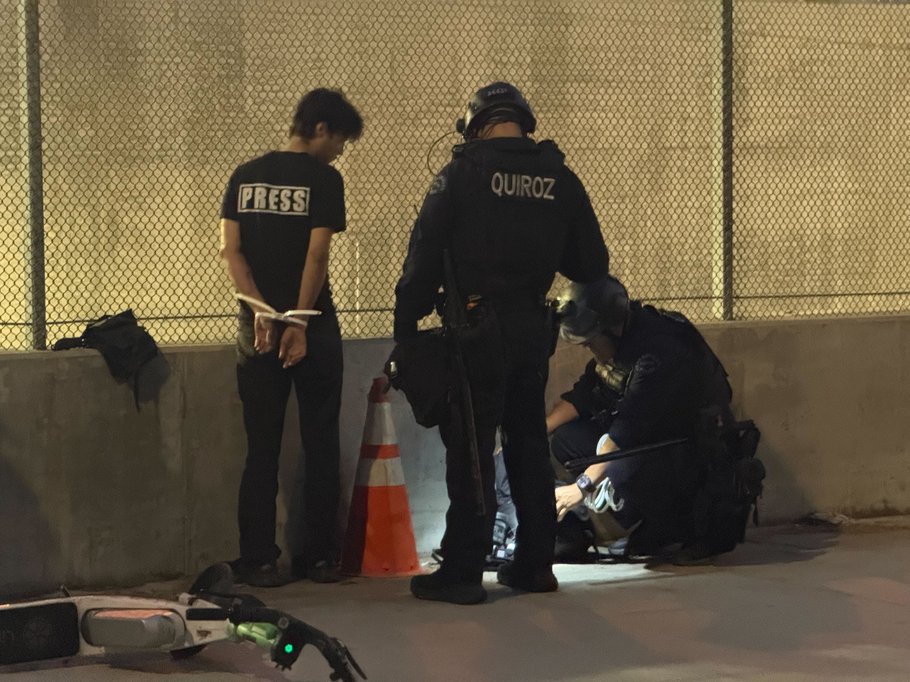
After being detained in a police kettle, journalist Neil Rivas waits in zip ties while his bag is searched by police officers during a “No Kings” protest on March 28, 2026, in Los Angeles, California.
Friends of the U.S. Press Freedom Tracker:
According to organizers, more than 8 million people turned out Saturday for the third iteration of coast-to-coast “No Kings” demonstrations against the Trump administration and its policies. In downtown Los Angeles, journalists covering the protests reported being targeted with tear gas and collared by law enforcement to be pulled away from the action. At least five were detained in a kettle. In Portland, Oregon, despite a court order lifting limits on federal agents’ use of chemical weapons and other crowd-control munitions, there were no reports of the use of tear gas or other chemical sprays throughout the day by law enforcement.
Here at the Tracker, we’re working to verify and thoroughly report on incidents from across the nation. As we do, find them in the Tracker database, and follow us on social media — Bluesky, X and Instagram — for the latest.
The rest of the month saw few assaults of journalists relative to the first two months of 2026, when we documented more press aggressions in that time period than any other year.
On March 1, independent documentarian Adriano Kalin was pushed by a sheriff’s deputy while documenting a protest outside a federal building in Minnesota. We’re also investigating a possible assault of a photojournalist covering Immigration and Customs Enforcement officers at New York’s JFK Airport. ICE agents were deployed to JFK, among other airports across the U.S., as the federal shutdown slowed security clearance for airline passengers.
This month’s press freedom news has instead come from the judicial branch. Several major court rulings curbed government restrictions on media access, while one case on First Amendment protections for a journalist didn’t make it to the Supreme Court docket at all.
On March 23, the Supreme Court declined to hear the appeal of Texas citizen journalist Priscilla Villarreal, who was arrested in 2017 for publishing information she received from her source, a police officer. Charges were dismissed in early 2018, and Villarreal sued Texas officials for wrongful arrest. After many years in state and federal appeals courts, the Supreme Court rejected Villarreal’s petition to revive her lawsuit.
Justice Sonia Sotomayor dissented, writing Villarreal’s 2017 arrest violated basic First Amendment protections. The high court’s decision to not hear the case, Sotomayor wrote, “leaves standing a clear attack on the First Amendment’s role in protecting our democracy.”
Court rulings against Pentagon press restrictions, VOA suspensions
On March 20 — a Friday — a federal judge ruled in favor of The New York Times, agreeing that the Pentagon’s 2025 press guidelines, which include requiring journalists to sign a loyalty pledge and obtaining approval before publishing, were unconstitutional. By Monday, the Department of Defense had responded to the ruling by further restricting press access (and vowing to appeal). Journalists are now required to have an escort in the Pentagon and were moved from their designated offices to a separate annex. The Times returned to court, and oral arguments began this week.
Watch FPF’s executive director break down the importance of the Times’ lawsuit.
And in a rebuke to the Trump administration’s efforts to shutter Voice of America, a federal judge on March 17 ordered the broadcaster to resume newsroom operations. The outlet had been effectively shut down for nearly a year, after President Donald Trump signed a late-night executive order reducing funding to the United States Agency for Global Media, which oversees VOA. More than 1,300 journalists and support staff were suspended.
This followed a ruling earlier in the month from U.S. District Judge Royce Lamberth, finding that Trump’s appointment of Victor Morales as acting CEO to USAGM — and Morales’ delegation of his duties to agency special advisor and de facto head Kari Lake — was unlawful, voiding all of Lake’s actions. VOA staffers have since filed another suit against the Trump administration, alleging it’s attempting to interfere with the outlet’s editorial independence.
Other notable updates
- Spanish-language reporter Estefany Rodríguez was released from an ICE facility in Louisiana on March 19, two weeks after her arrest in Tennessee. Her attorney told the Tracker she was targeted because she is a journalist, and that they plan to continue legal action against the government.
- On March 9, the Pentagon published a memo outlining its plan to expand oversight of military newspaper Stars and Stripes, including barring its reporters from filing Freedom of Information Act requests or publishing wire service reports. Ombudsman Jacqueline Smith told The Washington Post that the memo threatens the outlet’s continued editorial independence.
- Also on March 9, two Oregon journalists won a preliminary injunction in their federal suit against Trump, the Department of Homeland Security and its then-head, Kristi Noem. Journalists Mason Lake, Hugo Rios and others alleged indiscriminate, retaliatory violence by DHS agents during 2025 protests near an ICE facility in Portland. In February, a U.S. district judge granted a temporary restraining order, and this month’s order extended those protections, including around use of chemical or projectile munitions and pepper sprays. On March 25, however, just ahead of the “No Kings” protests, a 9th Circuit panel put a temporary hold on the preliminary injunction.
- More Pentagon press restrictions: Starting March 4, days after the U.S. began military operations in Iran, photographers were barred from two Pentagon news briefings after photos of Defense Secretary Pete Hegseth that his staff deemed “unflattering” were published.