- Published On
- September 21, 2026
- Written by
- Jem Bartholomew from Columbia Journalism Review
The Trump administration is ramping up its hostile environment for journalists, from American streets to the corridors of the White House
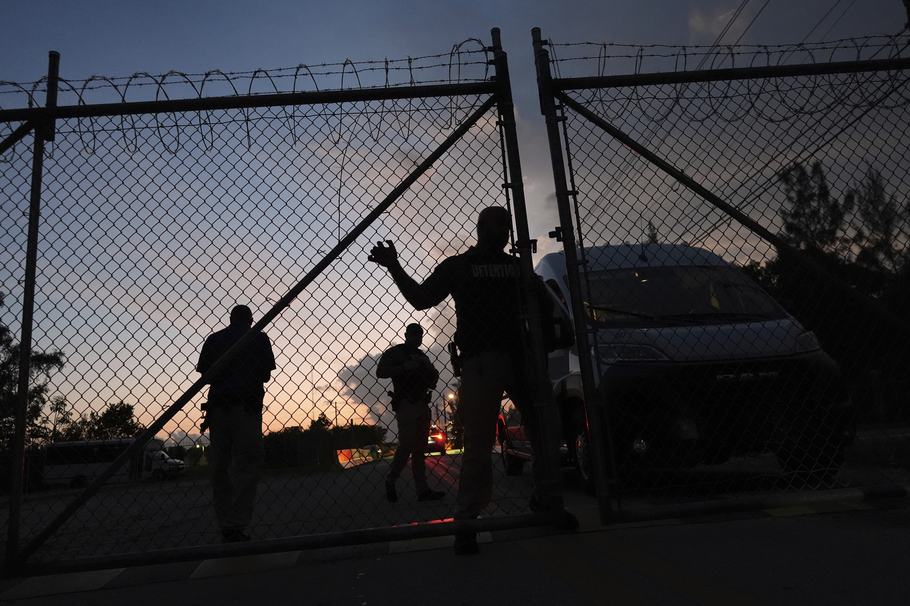
Officers at an entrance to the Krome immigration detention center in Miami, Florida, on May 24, 2025.
On December 21, 2018, as part of a brutal crackdown on the press by Daniel Ortega, Nicaragua’s leader, police raided the offices of 100% Noticias, a cable and online news station. That year, the country had been convulsed by protests calling for an end to the Ortega regime, which were met with stiff repression. 100% Noticias had been reporting on how police and allied paramilitary forces were “spreading terror,” crushing demonstrations “at any cost.” This included opening fire on protesters. During the newsroom raid, officers arrested two prominent staff members—Miguel Mora, 100% Noticias’ director, and Lucía Pineda, the news director—and charged them with “inciting hate and violence.” The Committee to Protect Journalists (CPJ) called the incident “unacceptable.” The pair spent a hundred and seventy-two days in prison, in cells that felt like being “buried alive,” Mora told CPJ.
On the day the newsroom was raided, Luis Galeano, a journalist whose show Café con Voz aired on 100% Noticias, landed in the United States with his wife, Deykel Santamaría. “Luis narrowly escaped the dictatorship’s prison,” Pineda later told El País. “He happened to go on vacation the same day the police detained Miguel Mora and me.” In 2019, Galeano applied for political asylum in the US. He continued to run Café con Voz on YouTube from Florida, alongside Santamaría, and was a persistent critic of Ortega. In 2023, the regime stripped Galeano and ninety-three others of their citizenship for criticizing the regime. Authorities confiscated all of Galeano’s assets and property back home. “They took everything we owned in Nicaragua,” Santamaría later told CNN en Español.
Last week, on the morning of September 14, Santamaría got a call to her landline. It was Galeano, who said he’d been detained by US Immigration and Customs Enforcement (ICE). Galeano was arrested while working his second job, as a driver for Uber and Lyft, in Orlando. The detention, alongside an announcement by Donald Trump on Friday that his administration would arbitrarily revoke access to the White House for reporters from multiple outlets he dislikes—namely MS Now, CNN, and Politico—made for a particularly alarming week in press-freedom news. In a video posted to Instagram, Georgia Fort—an independent journalist who was arrested in January while reporting on the mass deployment of ICE officers to Minnesota—said the White House restrictions must be seen as part of a systematic attack on the press, and pointed the finger at “big corporate newsrooms” that have, until now, “tolerated the rights of journalists being violated.” She warned, “Journalists and journalism institutions cannot be neutral about the dismantling of our democracy and then still expect to be protected by it.”
Galeano seems to have understood the looming risks. Before his arrest, he and his wife had “talked about what we could do if we faced this situation,” she told CNN. After his arrest, Galeano told Santamaría to contact a lawyer and alert journalists about his detention. But despite their readiness, “I didn’t see it coming,” she said. “Because you talk about it, but you never think it will actually happen to you.”
Galeano, who is forty-eight, is being held at the Krome North Service Processing Center in West Miami, according to ICE’s website. A spokesperson for the Department of Homeland Security told me that Galeano is an “illegal alien from Nicaragua” who was arrested “during routine enforcement operations” by ICE. “In violation of our nation’s laws, he overstayed his welcome. He will remain in ICE custody pending removal proceedings,” the spokesperson said, adding that “being in detention is a choice,” because the US “is offering illegal aliens three thousand dollars and a free flight to self-deport now.”
“What they are stating there, it’s not true,” José Zamora, CPJ’s regional director for the Americas, told me. Galeano “fled Nicaragua because of persecution connected to his journalism. He came to the US seeking protection. He followed the right process; he did everything correctly.” Zamora said that Galeano will likely stay in detention until a court hearing, which is scheduled for October 2. Where the US intends to deport Galeano—who is officially stateless—remains unclear. (The DHS spokesperson ignored my question about that.) “We are in danger if they deport us to Nicaragua,” Santamaría told CNN. On social media in recent days, she said, “people loyal to the dictatorship express the threats of what would await my husband if he were to be deported to Nicaragua.”
Galeano’s case echoes that of Wilmer Solano, another journalist who was arrested and detained—not for committing any crime, but for enduring the same indolent asylum system Galeano did. In 2011, Solano, who is Venezuelan, had been attacked by supporters of the Hugo Chávez regime for his reporting. On July 26 of this year, while his asylum application was still pending, he was disappeared from the streets of Miami by US Customs and Border Protection agents. I wrote for CJR at the time that Solano joined a growing list of journalists detained in the US under the second Trump administration: Mario Guevara, Estefany Rodríguez, Fort, and Don Lemon. A crowdfunding campaign helped cover Solano’s bond, which was five thousand dollars, and he was released on August 14. He has rejoined his family in Miami, where he is monitored by a shackle on his ankle, according to El Nuevo Herald.
While detained at Krome, Solano told me on Sunday, he was “subjected to extremely cold temperatures, very poor-quality food, contaminated air, moldy mattresses, and spaces lacking smoke detectors, fire sprinklers, fire extinguishers, or accessible emergency exits,” as well as “degrading treatment” from border agents and facility staff. (A DHS spokesperson did not respond to a request for information about these allegations by the time this story was published.) Human Rights Watch and Amnesty International have alleged human rights violations at Krome, including that some detainees have been “forced to kneel to receive food, shackled, and held in frigid, overcrowded cells.” “The United States government is violating the Fifth Amendment to the Constitution by imprisoning people without due process,” Solano told me. Like Galeano, Solano was arrested while working as a private taxi driver in the gig economy. Santamaría, who did not respond to my interview request, told Expediente Público that both she and Galeano hold second jobs alongside Café con Voz to supplement their income.
The Trump administration’s arrest and detention of Galeano—who was labeled a “traitor to the homeland” by the Ortega regime and has been subject to what researchers call “citizenship deprivation”—coincided with eerily similar threats from the government of Israel against Israeli journalists who dared to cover the war in Gaza critically. Israel’s culture minister, Miki Zohar, called for revoking the citizenship of Yuval Abraham and Rachel Szor, the directors of a new documentary on the Israeli military’s campaign of air strikes in Gaza, and accused them of “treason against the state.” (My CJR colleague Amos Barshad has a piece this morning on the film and the threats its makers now face.) Benjamin Netanyahu, Israel’s prime minister, who is campaigning to keep his job, posted a video on social media saying he would pursue legislation to strip the citizenship of “anyone who defames IDF soldiers.” Some members of a crowd that gathered outside Szor’s family home in the Israeli city of Savyon last Wednesday were filmed chanting: “Death sentence for traitors.”
In the US, where stripping people of their citizenship is legally very difficult, the Trump administration has sought to intimidate critics and stifle dissent with threats, lawsuits, subpoenas, regulatory pressure, access constraints, deportation efforts, and more. Trump’s announcement that he would ban MS Now, CNN, and Politico from the White House because they write “FICTION and LIES” came with threats to other outlets; when asked to specify, he named the New York Times and Washington Post. (Trump seemed to be enjoying himself; on Sunday he posted what looked like an AI-generated meme of the three expelled outlets as trash bags sitting outside the White House.) News organizations widely condemned the restrictions. Today, according to New York magazine’s Michael Calderone, the three targeted outlets will reportedly file a joint lawsuit “to defend the principle that the government does not decide what the press reports or publishes.”
The Fox News anchor Jacqui Heinrich, who is the new president of the White House Correspondents’ Association, called for access to be restored immediately. But as of Monday morning it did not appear that the White House press corps would be doing much else—for instance, organizing a walkout to express solidarity and pressure the administration to reinstate their exiled colleagues.
The Reporters Committee for the Freedom of the Press pointed out that the expulsion of the news outlets is “flatly unconstitutional” and likely to be reversed by the courts. But to focus on the legality of the ban is to miss the point: ahead of November’s midterm elections, Trump is creating an increasingly hostile environment for news organizations trying to hold public officials to account, and loudly signaling that hostility to his base. “What we’re experiencing is democratic backsliding,” Zamora, of CPJ, told me. “They are using the whole toolbox, all of the administrative powers they have, to try to silence journalists.”
But journalists are refusing to go quietly. On Saturday, Akayla Gardner, an MS Now reporter whose access badge was revoked, continued broadcasting from just outside the White House gates. And on September 16, two days after Galeano’s arrest, Café con Voz launched a livestream on YouTube, informing viewers that the director of the program was still in detention. After an introductory segment, the camera opened on Galeano’s usual spot—a sleek desk, a small Nicaraguan flag, a coffee mug—and his empty black swivel chair. “There is the chair of Luis Galeano,” the voice of Santamaría, who is carrying on the show, could be heard saying. “He isn’t here right now, but I am.”