Incident details
- Updated on
- Date of incident
- May 20, 2025
- Location
- Washington, District of Columbia
- Targets
- NewsGuard
- Case number
- 1:26-cv-00353
- Case status
- Ongoing
- Type of case
- Civil
- Legal orders
-
-
subpoena
for
communications or work product
- May 20, 2025: Pending
- June 3, 2025: Carried out
- July 17, 2025: Carried out
- Sept. 11, 2025: Carried out
- Nov. 18, 2025: Carried out
- Dec. 8, 2025: Carried out
- Jan. 16, 2026: Objected to
- April 16, 2026: Dropped
-
subpoena
for
communications or work product
- Legal order target
- Institution
- Legal order venue
- Federal
Subpoena/Legal Order
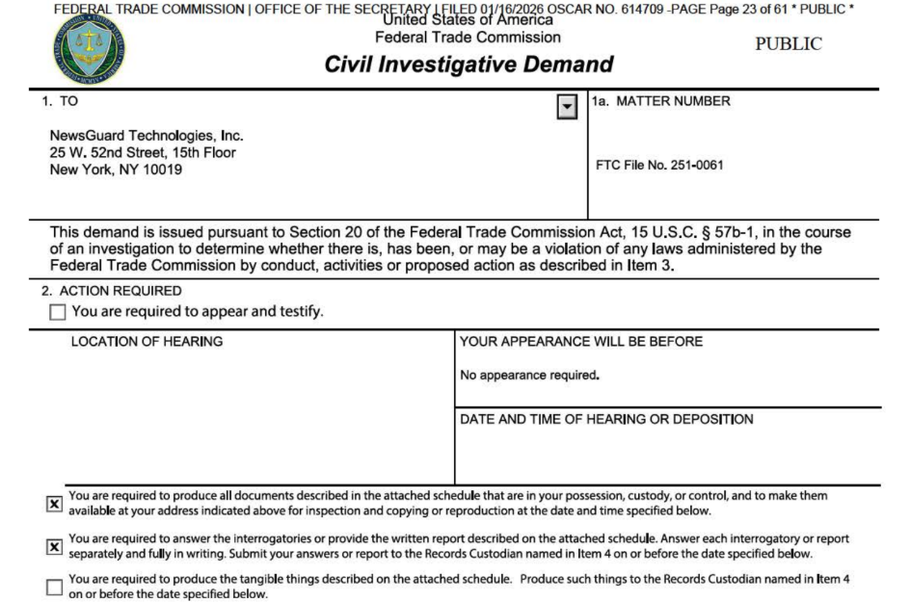
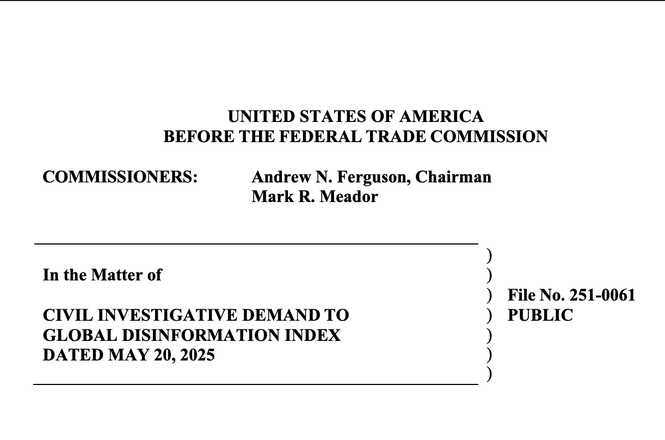
A portion of the Federal Trade Commission’s demand for NewsGuard to hand over documents regarding its operations, issued May 20, 2025, in Washington, D.C.
FTC drops demand for documents from NewsGuard
The Federal Trade Commission dropped its legal order for records from the NewsGuard service on April 16, 2026, telling a Washington, D.C., federal court that the agency’s recent settlement with three advertising companies had eliminated its need for the records.
NewsGuard, which uses journalistic methods to generate reliability ratings of media outlets, responded that the FTC’s settlement had, in fact, “substantially broadened the scope of its retaliation campaign,” and reinforced the need for an injunction against the agency.
NewsGuard received a civil investigative demand, which functions like a subpoena, from the FTC in May 2025. The demand sought records related to NewsGuard’s rating system, journalistic materials, methodologies and communications, and asked NewsGuard to identify rated entities and employees from 2018 onward.
NewsGuard filed a petition in January 2026 to strike down the demand and followed with a complaint in federal court in February, accusing the FTC of violating the First and Fourth amendments by seeking to chill the organization’s journalism and penalize its clients.
The organization detailed public criticism by FTC Chair Andrew Ferguson and other officials that culminated in the May 2025 demand, and noted that an FTC consent order approving a merger between advertising giants Omnicom and Interpublic Group effectively prohibited Omnicom from using NewsGuard’s services. NewsGuard requested a preliminary injunction forbidding the FTC from enforcing the demand or the Omnicom-IPG merger condition.
The FTC separately denied NewsGuard’s petition to quash the records demand in March.
But in April, the FTC notified the court that it had withdrawn the demand. Its settlement with advertising holding companies Dentsu, WPP and Publicis, it said, prevented those companies from directing advertisers’ money according to “viewpoints as to the veracity of news reporting” and “adherence to journalistic standards or ethics,” without the advertisers explicitly requesting it.
“The conditions these permanent injunctions impose are materially identical to the conditions imposed by the Omnicom consent order,” the FTC wrote, and the agreement “resolved the issues related to NewsGuard that gave rise to the CID,” referencing the demand.
In its response, NewsGuard accused the FTC, through the merger condition and then the settlement, of working to prevent NewsGuard from selling its services to ad agencies. The demand withdrawal due to the settlement “compounds NewsGuard’s harm and its bases for relief in this Court,” NewsGuard wrote.
At a hearing a day after the response was filed, U.S. District Judge Dabney Friedrich denied NewsGuard’s motion for a preliminary injunction against the FTC “because she said NewsGuard had not shown irreparable harm,” an attorney for NewsGuard told the U.S. Press Freedom Tracker. The injunction request was denied “without prejudice,” meaning NewsGuard can refile it. NewsGuard immediately appealed the denial.
NewsGuard sues FTC, calling demand for documents unconstitutional
NewsGuard, a service that uses journalistic methods to generate reliability ratings of media outlets, filed a lawsuit against the Federal Trade Commission in a Washington, D.C., federal court on Feb. 6, 2026, in response to the FTC’s sweeping legal order for NewsGuard’s records.
NewsGuard received a civil investigative demand, which functions like a subpoena, from the FTC in May 2025. It sought records related to its rating system, journalistic materials, methodologies and communications, and asked NewsGuard to identify rated entities and employees from 2018 onward.
NewsGuard filed a petition in January 2026 to strike down the demand, calling it unconstitutional retaliation. It said that it had produced more than 41,000 pages of documents and met with the FTC multiple times to avoid court intervention, but that FTC staff, under Chair Andrew Ferguson, continued to seek additional materials.
The February complaint, like the January petition, outlined public criticism by Ferguson and other officials that culminated in the May 2025 demand, and noted that an FTC consent order approving a merger between advertising giants Omnicom and Interpublic Group effectively prohibited Omnicom from using NewsGuard’s services.
“There is a direct causal connection between NewsGuard’s protected journalistic activity and the FTC’s retaliatory actions,” the complaint says. “The FTC’s campaign against NewsGuard is based on the false premise that its news rating service disfavors conservative viewpoints.”
The suit accuses the FTC of violating the First and Fourth amendments by seeking to chill the organization’s journalism and penalize its clients. It asks the court to declare that the investigative demand and the Omnicom-IPG merger condition violate the law, and to forbid the FTC from enforcing either one.
The Foundation for Individual Rights and Expression, which filed the suit on behalf of NewsGuard, said the legal action was intended in part to “remind the federal government it has no business using its power to censor journalism whose reporting it opposes.”
FIRE Chief Counsel Bob Corn-Revere said, “If the government, regardless of the party in charge, can use its levers of power to punish an organization over its coverage, there’s no reason it can’t do the same to pursue other news organizations that it disfavors.”
The Federal Trade Commission issued a sweeping legal order on May 20, 2025, in Washington, D.C., for documentation from NewsGuard, an outlet that uses journalistic methods to generate reliability ratings of media outlets.
NewsGuard has opposed the civil investigative demand, which functions like a subpoena, arguing to the FTC in a Jan. 16, 2026, petition that the investigation constitutes retaliation against NewsGuard for exercising its protected First Amendment rights.
“The CID’s unconstitutionally broad and intrusive demands impermissibly chill NewsGuard’s speech,” the petition states.
The agency, under Chair Andrew Ferguson, ordered NewsGuard to produce extensive records related to its rating system, journalistic materials, methodologies and communications. It also asks for the identities of rated entities and employees dating back to 2018.
NewsGuard said the request effectively encompasses all of its work since its founding.
Despite objecting to the scope of the demand, NewsGuard said it has cooperated with the FTC, producing more than 41,000 pages of documents and participating in at least 10 work sessions designed to avoid court intervention, but FTC staff continued to seek additional materials.
NewsGuard’s petition outlines public criticism by Ferguson and other officials that culminated in the May 2025 demand. NewsGuard noted that a recent FTC consent order approving a merger between ad/marketing giants Omnicom and Interpublic Group effectively prohibited Omnicom from using NewsGuard’s services.
In November 2024, Federal Communications Commission Chair Brendan Carr accused NewsGuard of being part of a “censorship cartel” in a letter to technology companies.
That same month, Ferguson wrote on X that NewsGuard “led collusive ad-boycotts — possibly in violation of our antitrust laws — to censor the speech of conservative and independent media in the United States.” In December, he said the FTC should launch an investigation into the company and claimed it “seems to give a free pass” to major left-leaning outlets.
In its petition, NewsGuard disputed those claims, saying its ratings are based on transparent, apolitical criteria. The organization has reported on foreign propaganda campaigns and misinformation, while also facing criticism and litigation from outlets across the political spectrum over low ratings, according to the petition.
“NewsGuard’s guiding principle has been that no government entity should be in the business of deciding what news people consume,” the document states.
The U.S. Press Freedom Tracker catalogs press freedom violations in the United States. Email tips to [email protected].