Incident details
- Date of incident
- May 20, 2025
- Location
- Washington, District of Columbia
- Targets
- Global Disinformation Index
- Case number
- 1:25-cv-4137
- Case status
- Ongoing
- Type of case
- Civil
- Legal orders
-
-
subpoena
for
communications or work product
- May 20, 2025: Pending
- June 10, 2025: Carried out
- Sept. 17, 2025: Objected to
-
subpoena
for
communications or work product
- Legal order target
- Institution
- Legal order venue
- Federal
Subpoena/Legal Order
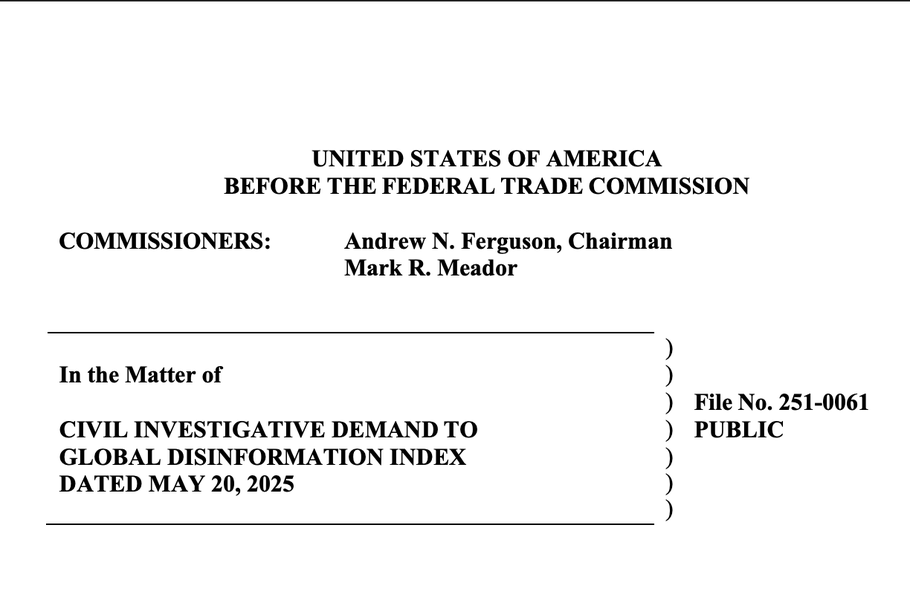
A portion of a Federal Trade Commission document concerning its demand for records from the Global Disinformation Index, issued in Washington, D.C., on May 20, 2025.
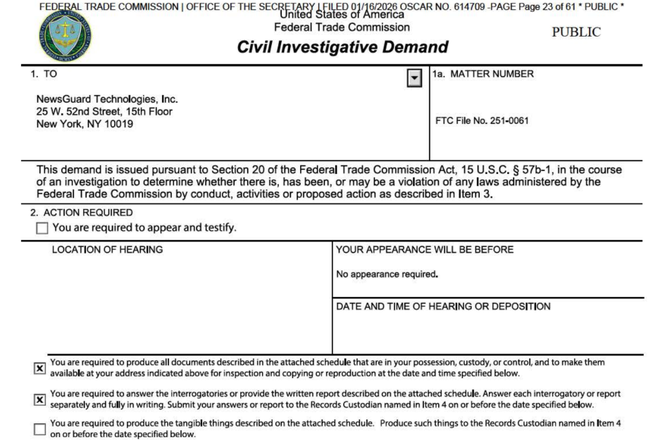
In the wake of a Federal Trade Commission demand for internal records issued May 20, 2025, in Washington, D.C., the British media ratings service, Global Disinformation Index, is suing the agency, describing the request as exhaustive and unconstitutional.
The FTC, under Chairman Andrew Ferguson, directed GDI to produce 29 categories of documents dating back to its 2018 founding, including internal research, methodologies, communications and operational records.
According to the London-based outlet, which publishes research and risk ratings of online news sites, the order encompasses nearly every aspect of its work, including its assessments of news outlets based on their journalistic standards, ownership and funding transparency, editorial independence and fact-based reporting.
GDI asserted journalistic privilege in federal court filings and argued that the FTC’s civil investigative demand — which functions like a subpoena — is retaliation against the outlet for exercising its First Amendment rights.
“This chilling effect has silenced GDI’s constitutionally protected speech and undermined its ability to fulfill its mission of promoting information integrity,” it wrote in court filings.
One of the service’s primary tools is its Dynamic Exclusion List, a database identifying websites it assesses as high risk for publishing disinformation. The list was licensed to advertisers and advertising technology firms to help them evaluate the risks of placing ads alongside certain content.
GDI flagged outlets across the political spectrum, including some with ties to the Trump administration and others that were left-leaning, the organization claimed in its lawsuit.
The organization’s complaint notes that some high-risk outlets launched retaliation campaigns against GDI. Then, in November 2024, Ferguson, already serving on the FTC but before becoming chair, wrote on the social platform X that GDI “led collusive ad-boycotts—possibly in violation of our antitrust laws—to censor the speech of conservative and independent media in the United States.”
In April 2025, Secretary of State Marco Rubio wrote that GDI’s list of riskiest online news outlets was “a direct bid to drive off their ad revenue and put them out of business.”
Weeks later, Ferguson, now chairman, signed the civil investigative demand.
GDI emphasized that it does not buy, sell or direct advertising, instead providing research tools that subscribers use to make independent brand-safety decisions.
“The CID is part of the coordinated effort among Chairman Ferguson and a cadre of other former, current, or future Trump administration officials and House Republicans who claimed—and continue to claim—that GDI led a conspiracy to boycott conservative and independent media,” the nonprofit wrote of the civil investigative demand.
According to its lawsuit, the FTC investigation has had significant consequences. Since November 2024, GDI’s funding has dropped by roughly $1 million, its staff has shrunk from 22 employees to four, and it has largely halted U.S. operations. It says it stopped publishing the Dynamic Exclusion List out of fear of further retaliation.
“The harm suffered by GDI as a result of the Commission’s investigation is not hypothetical,” the filing states. “It is a direct consequence of escalating government-led harassment and public attacks targeting organizations engaged in disinformation research.”
After receiving the demand, GDI provided some documentation to the FTC regarding its nonprofit status on June 10, 2025, and asked the FTC to withdraw the rest of its request Sept. 17, ultimately filing suit Nov. 25. The Commission denied the request to withdraw the full demand Dec. 10.
In its denial, the commission rejected GDI’s constitutional claims and disputed its assertion of a journalist’s privilege, arguing that licensing the Dynamic Exclusion List to paying “clients and subscribers” under private agreements constitutes commercial activity rather than public dissemination of journalism.
“When the Commission acts in its law enforcement capacity, as it does here, the public interest in the ability to thoroughly gather evidence outweighs any qualified First Amendment privilege,” the document states.
The U.S. Press Freedom Tracker catalogs press freedom violations in the United States. Email tips to [email protected].