Incident details
- Date of incident
- April 11, 2026
- Location
- Los Angeles, California
- Targets
- Mel Buer (Independent)
- Assailant
- Law enforcement
- Was the journalist targeted?
- Yes
Assault
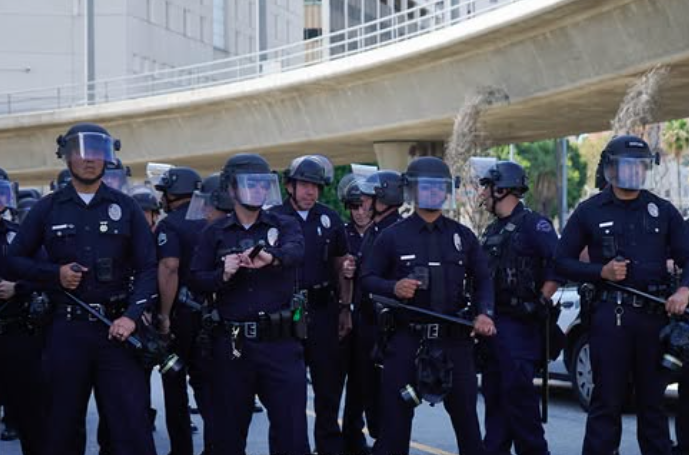
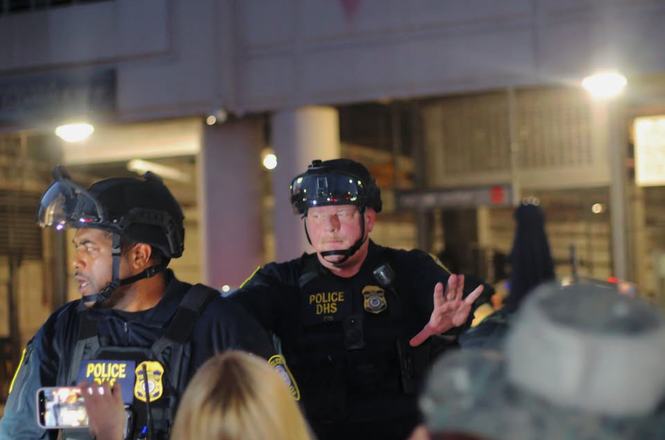
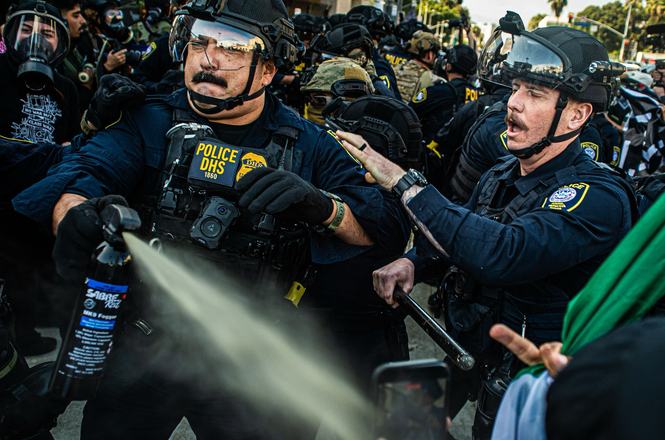
Police respond to a protest against immigration raids in Los Angeles, California, on April 11, 2026. Journalist Mel Buer was pushed by an officer while documenting the demonstration.
Independent journalist Mel Buer was pushed by police and warned she would be detained while documenting a protest against immigration raids in Los Angeles, California, on April 11, 2026.
The protest, which included a few dozen participants, gathered at the downtown Metropolitan Detention Center, where immigrants are being held and where numerous demonstrations have taken place since the start of intensified immigration enforcement in the city in June 2025.
Buer told the U.S. Press Freedom Tracker that she was filming outside the detention center when the LA Police Department started making arrests. Officers pushed about a half-dozen reporters down the street, away from the police action.
“I was shoved pretty hard by an officer,” said Buer, who recalled her ribs hurting for about two hours after. “My colleagues say I took a baton to the ribs, but I don’t remember feeling it.”
In a video Buer posted on Bluesky, police moved in to arrest a protester. Other officers then positioned themselves in front of members of the media and aggressively advanced on them, using their batons and yelling for them to back up. One journalist was kicked.
“You have been advised to leave, all the members of press. You are subject to arrest — all of you. Now,” an officer told them, adding, “You cannot get in the way of arrests.”
“We’re not,” one journalist said.
“You’re coming over here when we’re making arrests,” the officer replied.
California law allows members of the press to cover protests and exempts them from dispersal orders. It also protects them from arrest or interference by police while doing so. A federal preliminary injunction against the city is in place to uphold those protections.
While the statute states press may access closed areas during emergencies, it does not extend that access to designated crime scenes or secured perimeters established by law enforcement. In one video, an officer using a megaphone told the media they were subject to arrest, and the area had been declared an emergency operation.
Police make the designated area broad — across a block or more — to prevent press from crossing the line during a dispersal, Buer said.
Buer, who two weeks earlier had been caught in a police kettle and threatened with arrest, told the Tracker that her main frustration is the confusing and often contradictory directives provided to the press at protests.
“There’s no main point of contact telling us where to go. Everyone’s giving different directions, and when we don’t move out of the way fast enough, they use their batons and shove us,” Buer said. “I should not be shoved by an officer in such a way when I’m attempting to film what is happening.”
In an emailed statement, an LAPD public information officer told the Tracker that an unlawful assembly was declared in response to “vandalism and in the interest of public safety.” The officer added, “Following the lawful dispersal order, officers moved to regain control of the area and successfully dispersed those engaged in unlawful activity.”
The officer said the department is “aware of the complaints that have been raised,” adding that “each allegation will be subject to a comprehensive and thorough investigation in accordance with established Department policies and procedures.”
LAPD Chief Jim McDonnell said in a statement after a March 28 “No Kings” rally weeks earlier — which resulted in at least 11 press freedom violations — that any use of force or allegations of mistreatment involving media members would be investigated and addressed.
“The LAPD recognizes the media’s right to cover events and makes reasonable efforts to accommodate, with those efforts consistent with our primary duty to maintain public safety and order,” the statement said.
Update: This story was revised to include comment from an LAPD spokesperson.
The U.S. Press Freedom Tracker catalogs press freedom violations in the United States. Email tips to [email protected].