Incident details
- Date of incident
- March 28, 2026
- Location
- Los Angeles, California
- Targets
- Luke Harold (Independent)
- Arrest status
- Detained and released without being processed
- Arresting authority
- Los Angeles Police Department
- Unnecessary use of force?
- No
Arrest/Criminal Charge
- Assailant
- Law enforcement
- Was the journalist targeted?
- Yes
Assault
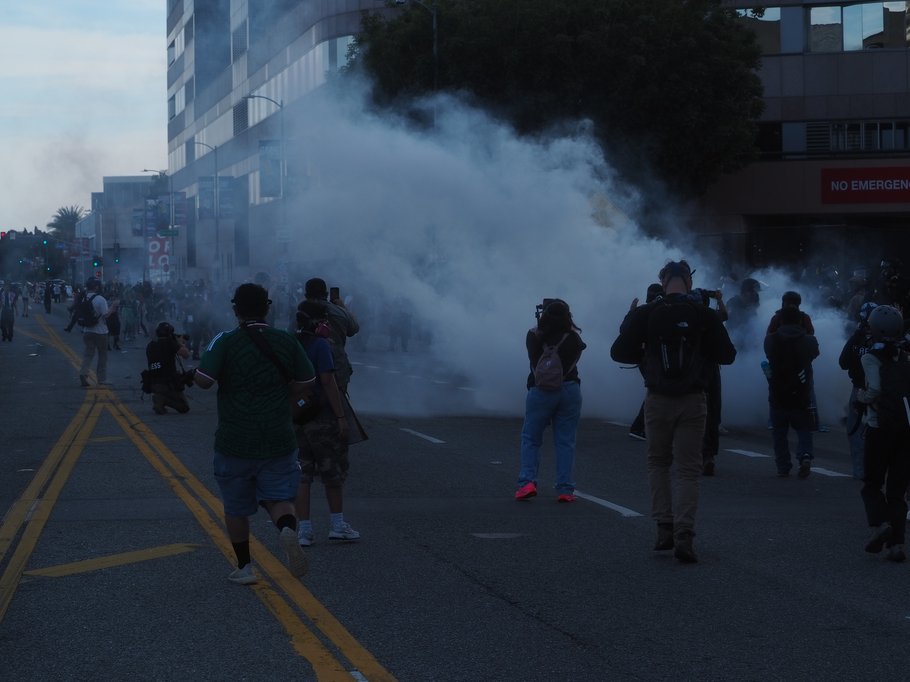
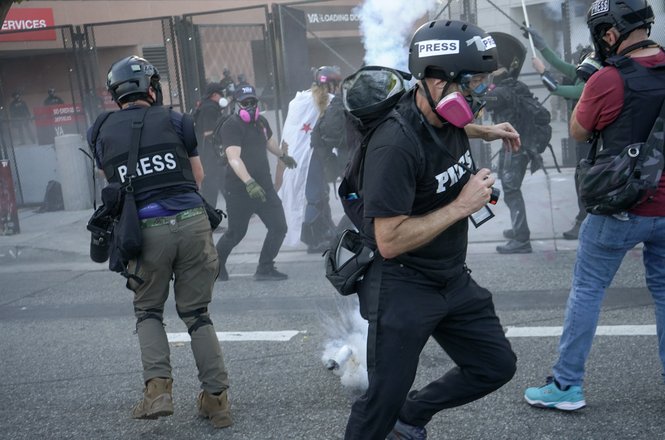
Journalists document a protest near a federal building in Los Angeles on March 28, 2026. The photographer, independent journalist Luke Harold, was shoved by a federal agent and detained by LA police that day.
Independent journalist Luke Harold was shoved by a federal agent while documenting an immigration protest in downtown Los Angeles, California, on March 28, 2026, and was later kettled by police and taken to the police station, before being released without charge.
The protest followed LA’s “No Kings” demonstration, one of some 3,300 against Trump administration policies that took place that day across the U.S., drawing more than 8 million people nationwide, organizers said.
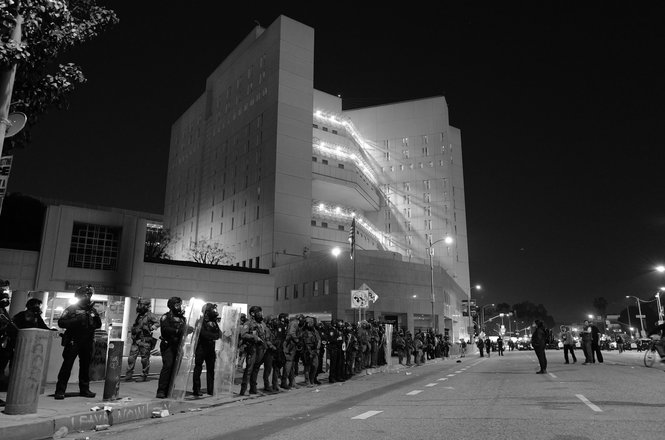
After the main march, people gathered outside the Metropolitan Detention Center, where immigrants are held, and the Roybal Federal Building, locations where many demonstrations have centered since sweeping immigration enforcement began in the city in June 2025. The LA Police Department said 75 people were arrested after officers issued a dispersal order and declared an unlawful assembly.
Harold told the U.S. Press Freedom Tracker that he went to take photos and videos of the protest independently, although he is also a reporter for The San Diego Union-Tribune and member of the journalism faculty at the University of Southern California Annenberg.
He said he was standing in front of the federal building when a few people started kicking the fence and throwing objects over it toward Department of Homeland Security officers on the other side. In response, DHS officers started firing tear gas canisters and pepper balls at the crowd, and most people retreated.
He said he was mostly protected by a gas mask and goggles, but that his eyes were badly affected by the chemical irritants at one point, when he rushed to put on the goggles and they didn’t seal properly.
Shortly after, he was shoved by one of the DHS officers. Harold and other members of the press were documenting officers piled on top of a protester and pinning him to the ground, as other officers formed a perimeter and issued warnings to stay back.
“Those of us who were there trying to document it were not in the way at all, and we were responsive to verbal warnings to stay out of the way as they walked the protester into the building. But that one DHS officer still aggressively walked up to us to shove us backward anyway,” Harold said.
The journalist captured the incident in a video posted on Instagram.
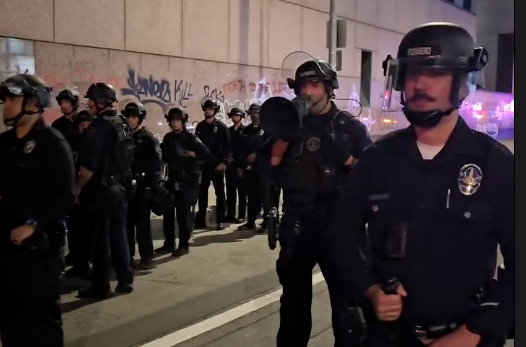
Around the same time, LAPD officers blocked off both ends of the block, effectively penning in the group of protesters and press. Harold said he received a dispersal order on his phone at that point.
“Many others inside the kettle agreed that the phone notification was the first we heard of a dispersal order, but we were not free to leave at that point,” he said.
The police instructed members of the press to go to the sidewalk, and one officer said that press could leave. Harold, who was carrying his digital camera, explained to multiple officers that he was press, was working independently that day and was also employed by the Union-Tribune and USC. However, he was told repeatedly to wait — even when he was sent by an officer to speak to a supervisor.
“I know from dealing with LAPD in my previous job and from this last year covering these protests that if you’re not legacy media or on assignment for an outlet they’re familiar with, the officers on the ground will not consider you a journalist, even though that’s not a legally viable position for them to take,” he said.
A September preliminary injunction barred LAPD officers from interfering with journalists covering protests, including by arresting, detaining or citing them solely for failing to disperse. The order also states that journalists are not required to wear credentials or work for a major media outlet to be considered press, and that carrying professional gear, such as photographic equipment, should be seen as an indicator they are there as journalists.
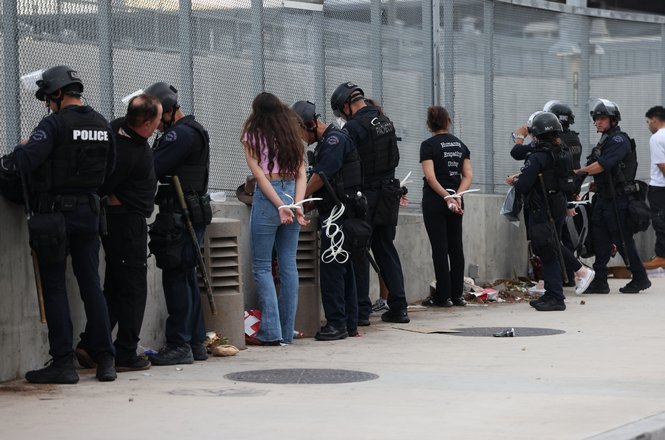
After about an hour in the kettle, Harold was zip-tied and taken to the booking area of LAPD headquarters. As they were processing his citation for failure to disperse, he asked why he wasn’t allowed to leave the kettle when he identified himself as a member of the press.
He was then pulled aside and eventually spoke to an officer later identified as Lt. Bruce Coss, a media liaison. Harold again explained that he was a journalist, there to document the protest independently, and described his professional affiliations.
“He’s telling me that I was out there as a journalist, but I wasn’t on assignment for anyone, so he said something to the effect that that puts me in a gray area, as far as they’re concerned. He asked if I understood that. I told him no, I don’t understand that. My full-time living for the last 11 years has been as a journalist in Southern California, and that includes my freelance and independent work,” Harold said.
“It kind of defeats the purpose of journalism if LAPD gets to regulate who gets to hold them accountable in those situations,” he added.
The officers eventually acknowledged that Harold was a member of the press and let him go without a citation for failure to disperse. He said his belongings, including his digital camera and phone, which were confiscated when he was arrested, were returned to him.
However, the journalist said that Coss and another officer separately gave him warnings that if he went back out to the federal building, he could get arrested again, and then they would give him a citation.
“So on one hand, they’re acknowledging that I’m a journalist and letting me go without a citation, but on the other, they’re saying I won’t have the protections I’m supposed to be entitled to if I go back out there and continue to act as a journalist, which perfectly sums up the arbitrary standards, if not outright disregard, they have for the terms of the federal injunction,” he said.
In a written statement shared April 2, LAPD Chief Jim McDonnell said that police were responding to acts of violence and vandalism and eventually issued a dispersal order. Anyone identifying as a “duly authorized” member of the media was contacted, verified and separated from those facing arrest for failure to disperse, according to the statement.
McDonnell added that any use of force or allegations of mistreatment, including those involving media members, would be investigated and addressed.
DHS did not respond to a request for comment.
Several journalists were detained in the kettle that day; some who showed media credentials were allowed to leave, while others who did not have formal credentials were held for longer.
“It is frustrating that LAPD lacks any coherent policies or procedures to deal with press at these protests,” Harold said. “You pretty much can’t get an LAPD-issued press card unless you’re legacy media who covers them regularly, which means they have no system in place to deal with the much wider array of journalists who come out to cover something as big as a No Kings Day.”
The U.S. Press Freedom Tracker catalogs press freedom violations in the United States. Email tips to [email protected].