Incident details
- Updated on
- Date of incident
- June 8, 2025
- Location
- Los Angeles, California
- Case number
- 2:25-cv-05563
- Case status
- Ongoing
- Type of case
- Class Action
- Assailant
- Law enforcement
- Was the journalist targeted?
- Yes
Assault
- Equipment damaged
- Actor
- Law enforcement
Equipment Damage
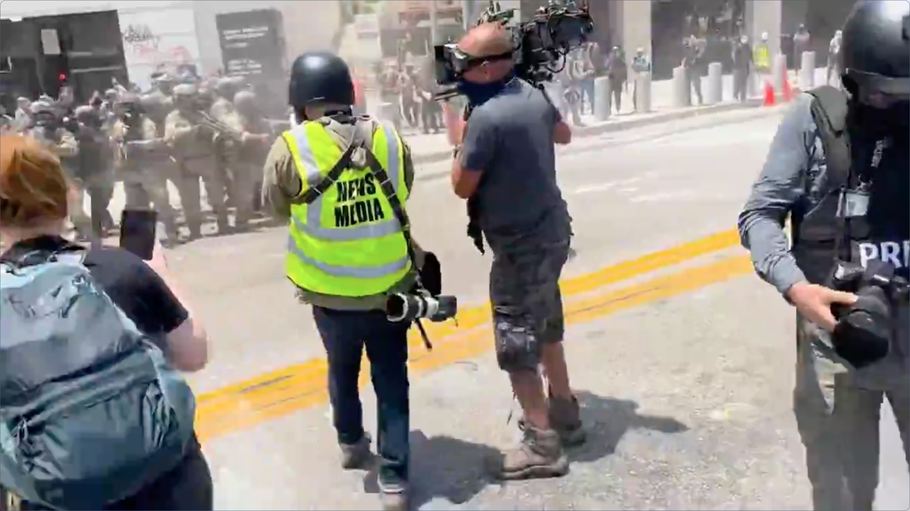
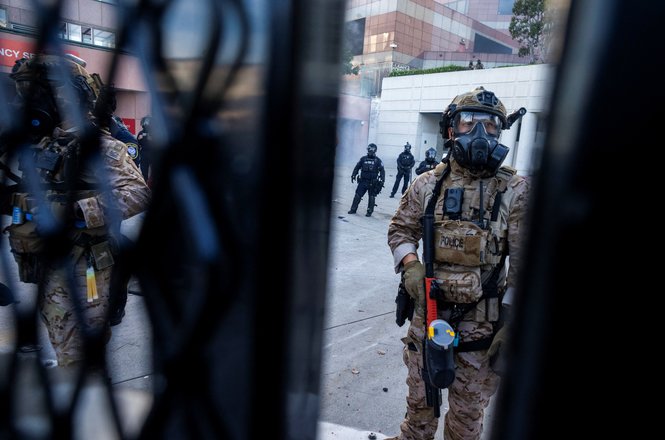
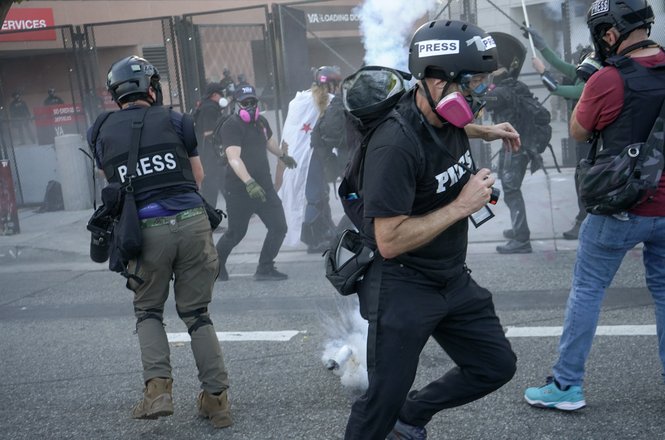
Freelance journalist Sean Beckner-Carmitchel filmed as federal officers shot pepper balls at him and other members of the press documenting protests in downtown Los Angeles on June 8, 2025. A round struck his press credential, damaging it.
Journalists to keep most protections in reworked injunction over DHS assaults
A federal judge upheld the bulk of earlier press protections in a July 10, 2026, revised preliminary injunction limiting violent tactics used by the Department of Homeland Security while policing protests, in a win for California journalists, including photojournalist Sean Beckner-Carmitchel.
U.S. District Judge Hernán Vera, however, narrowed some protective provisions following an appeals panel finding that the original September 2025 injunction was overbroad.
Freelance photojournalist Beckner-Carmitchel originally sued the agency in June 2025, after he was twice assaulted by federal agents while covering early June protests against federal immigration raids in and around Los Angeles, California.
The suit, which has since been certified as a class action, was filed in the U.S. District Court for the Central District of California on behalf of Beckner-Carmitchel, and journalists Lexis-Olivier Ray and Ryanne Mena, along with LA Press Club, The NewsGuild, and various legal observers and participants in the protests.
The plaintiffs argued that DHS’s “excessive and indiscriminate use of force against journalists, observers, and protesters” violated their constitutional rights.
The plaintiffs had won a preliminary injunction in September 2025 protecting them from violence by federal agents, which was then appealed by the government.
Although a federal appeals court in San Francisco agreed that the injunction was necessary, it sent it back in April 2026 for the lower court to rework.
In his July 2026 ruling, Vera maintained his previous order that journalists working in the Central District of California — a seven-county region in Southern and Central California — should generally not be prevented from observing federal officers’ actions or threatened with crowd-control weapons.
He also specified that journalists are only subject to dispersal orders if they are impeding federal operations, vandalizing, or part of a crowd posing an immediate threat to “public safety, peace, or order.”
However, he narrowed the scope of the injunction from the general public to only apply to the suit’s plaintiffs, including all those who were members of The NewsGuild and LA Press Club at the time of the violations.
Vera also downgraded his requirement for DHS to provide two audible verbal warnings before deploying crowd-control weapons, ruling that only one warning would suffice and that it should be “amplified” rather than “audible.”
Class-action status granted for journalists’ lawsuit against DHS
A lawsuit brought by journalists including Sean Beckner-Carmitchel against the Department of Homeland Security and then-DHS Secretary Kristi Noem was granted class-action status by a federal judge on June 25, 2026.
Freelance photojournalist Beckner-Carmitchel originally sued the agency in June 2025, after he was twice assaulted by federal agents while covering early June protests against federal immigration raids in and around Los Angeles, California.
The suit was filed in the U.S. District Court for the Central District of California on behalf of Beckner-Carmitchel, journalists Lexis-Olivier Ray and Ryanne Mena, along with several press groups, and various legal observers and participants in the June protests.
The plaintiffs argued that DHS’s “excessive and indiscriminate use of force against journalists, observers, and protesters” violated their constitutional rights.
The plaintiffs won a preliminary injunction in September 2025 protecting them from violence by federal agents. Although a federal appeals court in San Francisco later ruled the injunction overbroad and sent it back to a lower court to rework, the court did grant that the injunction was necessary.
On March 5, 2026, Beckner-Carmitchel and his co-plaintiffs filed a motion to certify their suit as a class action, comprising anyone who has recorded DHS immigration enforcement and removal operations or related protests in the region since June 6, 2025.
U.S. District Judge Hernán Vera agreed, writing that the plaintiffs “have sufficiently shown for present purposes that Defendants have a policy of treating the recording of their agents as an unlawful threat that may be responded to with force.”
In a statement shared with the U.S. Press Freedom Tracker, the ACLU Foundation of Southern California, which represents the plaintiffs, called the decision “another victory for the freedoms of speech and the press, reaffirming the right to document abuses and unlawful conduct by government agents.”
“DHS has treated cameras as threats and people holding phones as criminals,” it added. “This ruling ensures that those who are affected by the department’s illegal actions can defend their right to legally observe.”
DHS did not immediately respond to a request for comment.
Court orders narrowing of LA injunction, but affirms First Amendment protections
A federal appeals court in San Francisco, California, ruled on April 1, 2026, that a preliminary injunction protecting Los Angeles journalists from violence by federal agents was overbroad, sending it back to a lower court to rework.
But in its ruling, the 9th U.S. Circuit Court of Appeals granted that the injunction was necessary to protect the plaintiffs’ First Amendment rights against law enforcement, pointing to “extensive evidence that Defendants acted with retaliatory intent.”
The suit was filed in June 2025 against the Department of Homeland Security and its then head, Kristi Noem, in response to a wave of assaults against journalists at protests over federal immigration raids in the LA area. The plaintiffs include a group of journalists, several press groups and various legal observers and participants in the June protests.
In September, the plaintiffs won a preliminary injunction prohibiting DHS agents from dispersing, threatening or assaulting journalists or legal observers without probable cause, using crowd-control weapons and kinetic impact projectiles without threats of imminent harm and before giving two audible warnings, and firing weapons at sensitive areas of the body.
The government appealed the injunction. In its ruling on the appeal, the appellate panel agreed that the order was overbroad in that it contained provisions affecting nonplaintiffs, including a restriction on firing tear gas canisters or flash-bang grenades at “any person.” They also wrote that requiring two audible warnings before the use of crowd-control weapons “invites strategic or near-frivolous contempt proceedings.”
The ACLU Foundation of Southern California, part of the plaintiffs’ legal team, celebrated what it called an affirmation of the plaintiffs’ need for legal protection.
“Today’s ruling confirms that the Constitution does not permit the government to silence dissent through intimidation or violence,” Peter Eliasberg, chief counsel, said. “The court recognized the harms inflicted on journalists, observers and protesters are real, ongoing and unconstitutional. We will continue to fight to ensure that those protections are not just recognized but enforced.”
Plaintiff Lexis-Olivier Ray called the ruling “an important step towards accountability.”
A hearing is scheduled for May on the plaintiffs’ request for the court to certify a class of those who have filmed or photographed DHS agents since June 2025.
LA journalist sues DHS over protest assault
Freelance photojournalist Sean Beckner-Carmitchel sued the Department of Homeland Security and DHS Secretary Kristi Noem on June 18, 2025, after he was twice assaulted by federal agents during early June protests against federal immigration raids in and around Los Angeles, California.
The suit was filed in federal court on behalf of Beckner-Carmitchel, journalists Lexis-Olivier Ray and Ryanne Mena, several press groups, and various legal observers and participants in the June protests, arguing that “DHS’s excessive and indiscriminate use of force against journalists, observers, and protesters has prevented people, including Plaintiffs, from exercising their constitutional rights.”
On Sept. 10, the plaintiffs won a preliminary injunction placing new restrictions on DHS agents’ violent tactics while policing protests in the LA area.
Beckner-Carmitchel was documenting a protest on June 7 in Compton for the Los Angeles Public Press when he was struck in the temple with a tear gas canister fired by federal officers. A day later, federal agents shot a pepper ball into his press pass, rendering it unusable.
On the day the plaintiffs filed the suit, they also requested a temporary restraining order forcing DHS to stop “indiscriminately and excessively using unnecessary force against reporters, legal observers and protesters at events within the Los Angeles area.”
The court denied the request on June 20, ruling that the plaintiffs had not proven that DHS agents’ alleged constitutional violations had continued after the events outlined in the complaint. It added that the order plaintiffs sought was also too broad.
A month later, the plaintiffs requested a preliminary injunction instead, pointing out that DHS assaults had continued, including on the day the TRO was denied.
In his order granting the injunction, U.S. District Judge Hernán Vera agreed with the plaintiffs that DHS seemed to be retaliating against them for First Amendment-protected behavior, acknowledging that agents’ behavior had included “targeting journalists standing far from any protest activity, launching scorching-hot tear gas canisters directly at people, and shooting projectiles at protestors attempting to comply with dispersal orders.”
The order prohibits agents from dispersing, threatening or assaulting journalists or legal observers without probable cause, using crowd-control weapons and kinetic impact projectiles without threats of imminent harm and before giving two audible warnings, and firing weapons at sensitive areas of the body.
“Under the guise of protecting the public, federal agents have endangered large numbers of peaceful protestors, legal observers, and journalists—as well as the public that relies on them to hold their government accountable,” Vera wrote. “The First Amendment demands better.”
Adam Rose, press rights chair of the Los Angeles Press Club, one of the plaintiffs in the case, celebrated the ruling. “It was a relief to hear Judge Vera acknowledge a ‘mountain of evidence’ as we sat in his courtroom last month,” he said. “This decision affirms our right to be free from violence while doing our jobs.”
Mena, who was assaulted twice during the protests, said, “By granting this relief, the court has affirmed the journalistic duty to our communities and the essential role of a free press.”
Freelance journalist Sean Beckner-Carmitchel was shot by federal officers with pepper balls, damaging his press credential, while documenting anti-deportation protests in Los Angeles, California, on June 8, 2025.
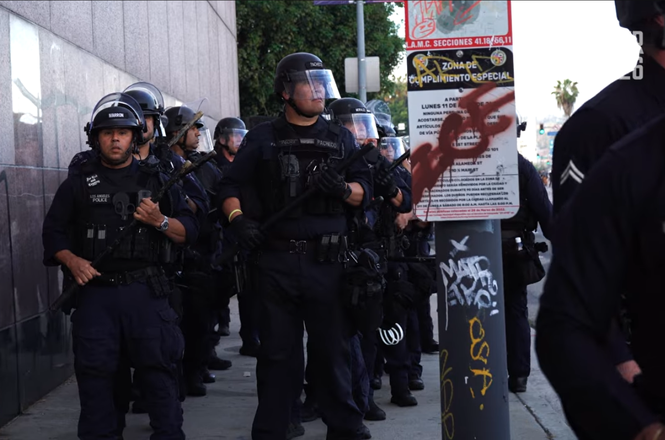
The protests began June 6 in response to federal raids in and around LA of workplaces and areas where immigrant day laborers gathered, amid the Trump administration’s larger immigration crackdown. After demonstrators clashed with local law enforcement officers and federal agents, President Donald Trump called in the California National Guard and then the U.S. Marines over the objections of California Gov. Gavin Newsom and LA Mayor Karen Bass.
Beckner-Carmitchel told the U.S. Press Freedom Tracker that he was on assignment for the Los Angeles Public Press, covering what he said was a peaceful march from the neighborhood of Boyle Heights to the Metropolitan Detention Center.
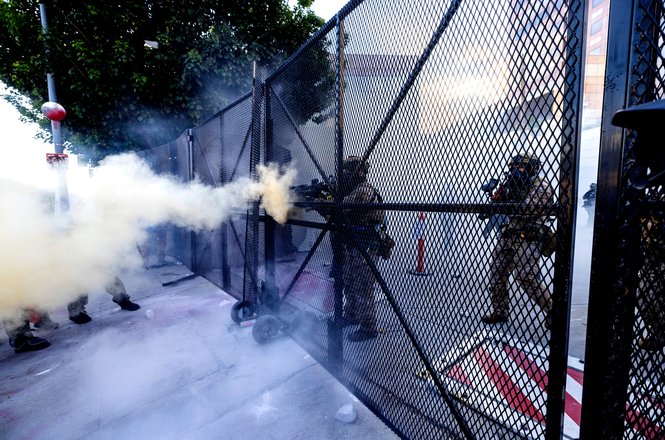
When they arrived at the detention center, Beckner-Carmitchel said they found another crowd already there, and it was around that time that National Guardsmen and Immigration and Customs Enforcement agents began deploying crowd-control munitions “pretty indiscriminately.”
“I saw a lot of people with ‘Press’ patches coughing from tear gas, possibly pepper spray as well; I saw them deploy that a little bit,” he said.
Beckner-Carmitchel told the Tracker he was standing alongside mostly journalists and was at least 30 feet away from the action when he was shot with a crowd-control munition.
“While I was off to the side, I literally got hit in the press pass with a pepper ball,” he said.
The press credential had “gone through it” over the weeks of protests and was more or less illegible, with scorch marks on it and a crack in the middle, he added. After it was struck with the pepper ball, Beckner-Carmitchel said he had to stop using it entirely.
He said he felt the shot was very deliberate. “You do aim those things, you have a sight on that, you know?” he told the Tracker.
Beckner-Carmitchel was shot with other crowd-control munitions and exposed to chemical irritants multiple times while covering protests the two previous days, and was shoved to the ground by police in the city of Whittier a few days later.
In a statement emailed to the Tracker, DHS Assistant Secretary Tricia McLaughlin urged journalists to be cautious while covering what she characterized as “violent riots,” and added, “President Trump and Secretary Noem are committed to restoring law and order in Los Angeles.”
The U.S. Press Freedom Tracker catalogs press freedom violations in the United States. Email tips to [email protected].