Incident details
- Updated on
- Date of incident
- June 10, 2025
- Location
- Los Angeles, California
- Assailant
- Law enforcement
- Was the journalist targeted?
- Yes
Assault
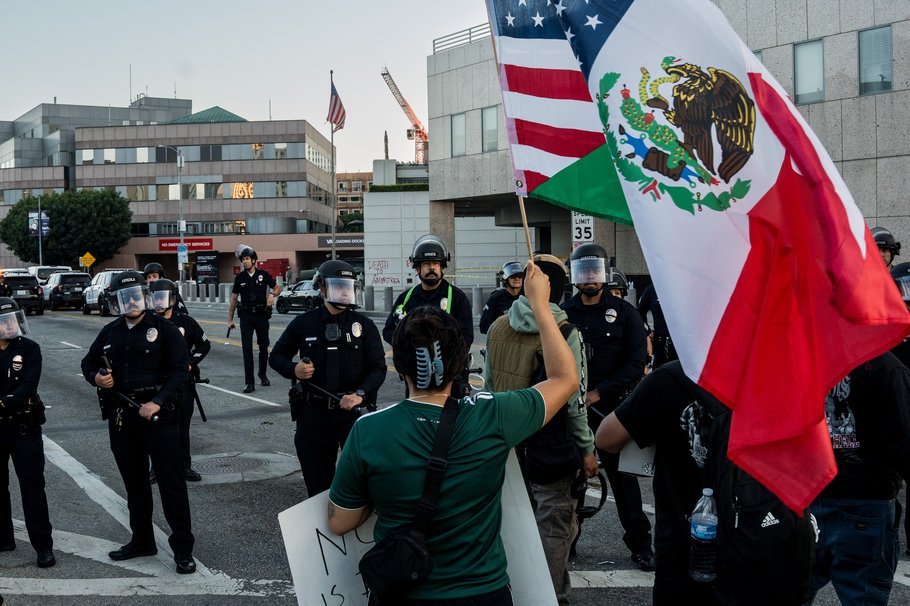
Law enforcement and protesters face off during an immigration protest in downtown Los Angeles, California, on June 10, 2025. LA Times reporter James Queally said he was shoved by police while covering the demonstration.
LAPD exonerates officer who shoved LA Times reporter during protest coverage
A police officer who shoved reporter James Queally while he was covering a June 2025 anti-immigration enforcement protest in Los Angeles, California, was exonerated by the LA Police Department on May 26, 2026.
On June 10, 2025, while LA Times journalist Queally was filming a skirmish between protesters and police as an 8 p.m. curfew approached, a police officer yelled at him to leave the area and shoved him.
Queally told the Tracker at the time that he was clearly displaying press credentials and was at least 10 feet away from the scuffle. He additionally reminded the officer that the curfew did not apply to members of the press.
Queally posted about the incident on the social platform X, saying: “Could’ve done without the officer shoving me in response to a reminder that media is exempt from the curfew. Oh well, they’re just laws I guess.”
The incident was submitted for review to the LAPD by Adam Rose, the LA Press Club’s press rights committee chair and deputy director of advocacy at the Freedom of the Press Foundation, of which the U.S. Press Freedom Tracker is a project.
Almost a year later, the department informed Rose that the investigation was complete and that it had exonerated the officers involved.
In a letter, Chief of Police Jim McDonnell and Captain Andre Rainey said that the use of unauthorized force had indeed occurred, but that it was “justified, lawful, and proper.”
On the investigation, Queally told the Tracker he was “not certain how they even identified the offending party much less thoroughly reviewed the conduct,” given that he was contacted only once about the incident.
“I did not make an internal affairs complaint, nor was I ever interviewed for any investigation, so I’m not entirely sure how the LAPD completed any legitimate investigation,” Queally said.
He added that he remained “committed to doing the kind of reporting that shines a light on and thoroughly reviews allegations of police misconduct.”
James Queally, a reporter for the Los Angeles Times, said he was shoved by a police officer while covering an anti-deportation protest in downtown Los Angeles, California, on June 10, 2025.
A series of protests began June 6 in response to federal raids in and around LA of workplaces and areas where immigrant day laborers gathered, amid the Trump administration’s larger immigration crackdown. After demonstrators clashed with LA law enforcement officers and federal agents, President Donald Trump called in the California National Guard over the objections of California Gov. Gavin Newsom and LA Mayor Karen Bass.
In an interview with the U.S. Press Freedom Tracker, Queally said he was reporting on a protest led by interfaith clergy near the Edward R. Roybal Federal Building, a federal complex that includes an immigration detention center.
As an 8 p.m. curfew approached, Queally said the scene grew chaotic. Multiple law enforcement agencies were present, and the LA Police Department was moving in to disperse crowds. Mounted police units added to the confusion.
Queally, clearly displaying press credentials, was filming the police skirmish line from at least 10 feet away when an officer accused him of impeding police work. The officer then yelled that Queally was violating curfew and ordered him to leave. Queally reminded him that the curfew did not apply to journalists. As he jogged to reposition, the officer ran up behind him and shoved him.
“I didn’t even fall down. There was no injury, but it was just a completely unnecessary maneuver,” he said. Queally later posted on the social platform X: “Could’ve done without the officer shoving me in response to a reminder that media is exempt from the curfew. Oh well, they’re just laws I guess.”
Earlier, Queally posted on X after a June 8 demonstration where the National Guard and Department of Homeland Security agents deployed chemical agents — including tear gas canisters and smoke grenades — along with impact projectiles that struck both protesters and the media. “I got hit but fine after an eye rinse,” he added of the exposure to the pepper ball irritant.
In a June 11 post, Queally reflected on the week’s confrontations with law enforcement, “Journalism is not a crime.”
Throughout the protests, police aimed crowd-control weapons above the chest at anyone, including press, and ignored clear media credentials, according to Queally.
“Their inability to delineate media and demonstrators, or their unwillingness to do so lately, definitely makes me a little bit more inclined to be off to the side,” he said.
To mitigate the chances of being hit, Queally said he generally stands about 15 to 20 feet away from the action, enough distance to still observe and newsgather.
“It’s the cost of doing business covering protests,” he said. “I’m not OK with getting hurt, but I’m at peace with the fact that it’s a risk.”
The LAPD directed the Tracker to the department’s social media accounts. In a June 10 statement posted to X, the department acknowledged that LAPD officers used numerous “less-lethal rounds” when responding to the protests, but did not address the use of munitions against identifiable press.
The U.S. Press Freedom Tracker catalogs press freedom violations in the United States. Email tips to [email protected].