Incident details
- Date of incident
- December 5, 2025
- Location
- San Diego, California
- Targets
- Jonathan Chang (Independent)
- Government agency or public official involved
- Type of denial
- Change in policy or practice
Denial of Access
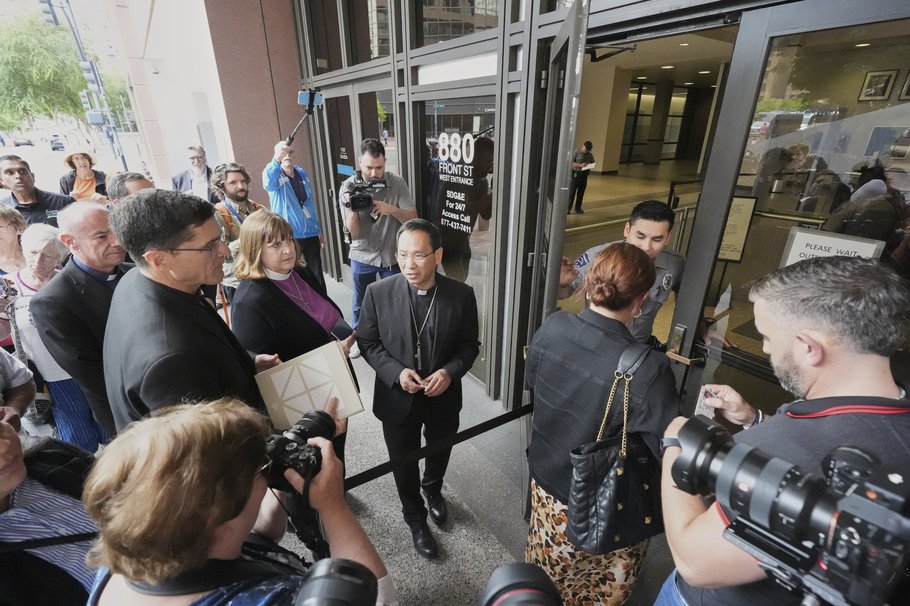
An interfaith group entering a federal building during immigration hearings on June 20, 2025, in San Diego, California. Photojournalist Jonathan Chang was prevented from bringing his camera into the same building on Dec. 5.
Independent photojournalist Jonathan Chang was barred from bringing his professional camera into a federal building in San Diego, California, on Dec. 5, 2025.
In an account for digital news outlet The LA Ten Four, Chang wrote that he had previously visited the Edward J. Schwartz Federal Building multiple times without issue as part of his ongoing efforts to cover the immigration court housed there.
“I would state my purpose with security guards at the entrance, they would scan my camera. I would walk through a metal detector and make my way into the building,” he wrote.
His experience when visiting Dec. 5, he added, was far different.
Two private security guards contracted with the federal building pulled him aside, informing him that he couldn’t enter with his camera but that he could take pictures with his cellphone. Chang wrote that he then spoke with a Department of Homeland Security police officer, who confirmed the restrictions.
“I affirmed to her I understand I could not take photos inside the courtroom. I was not going to the courtroom; I was going into the building,” he wrote. “I told her I’d be staying in the hallways to document the story of the volunteers inside the building to capture any detentions that may happen while I was there.”
The officer referred Chang to a DHS policy that took effect in November, asserting that the photojournalist needed permission from one of the federal building’s tenants to bring in his camera.
The policy only speaks to active use of a camera, not simply carrying one, and also provides exceptions for members of the media filming in publicly accessible areas in and around the federal building.
A fact sheet from the Department of Justice’s Executive Office for Immigration Review, however, specifies that immigration court hearings are generally open to the public with limited exceptions.
“Access to observe immigration court hearings necessarily entails access to EOIR space, which includes courtrooms, interior entrances, exits, corridors, conference rooms, and the waiting areas that are in direct view or control of security, the immigration court, or are otherwise part of EOIR’s daily operations,” it continues.
Chang told the U.S. Press Freedom Tracker that the officers didn’t seem to understand the rules governing their own buildings, and he was frustrated by their apparent unwillingness to engage with him.
“It’s another data point of the government’s censorship of the press,” he said.
Adam Rose, deputy director of advocacy for Freedom of the Press Foundation, of which the Tracker is a project, said in a statement, “There’s no excuse for obstructing photography in public hallways of a federal building.
“Violations should be alarming to federal courts, which depend on public participation and trust,” he continued. “The press contributes to both by serving as the eyes and ears of the public.”
Neither the Executive Office for Immigration Review nor official contacts for the federal building responded to requests for additional information or comment.
The U.S. Press Freedom Tracker catalogs press freedom violations in the United States. Email tips to [email protected].