Incident details
- Date of incident
- January 2026
- Targets
- Media
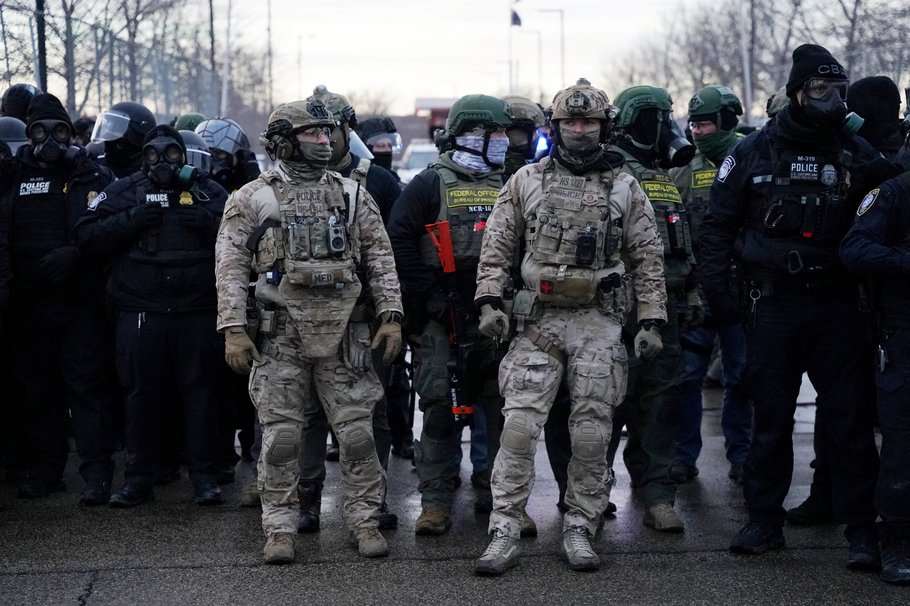
Federal officers and other law enforcement stand guard at the Whipple Federal Building amid immigration protests in the Minneapolis, Minnesota, area on Jan. 17, 2026.
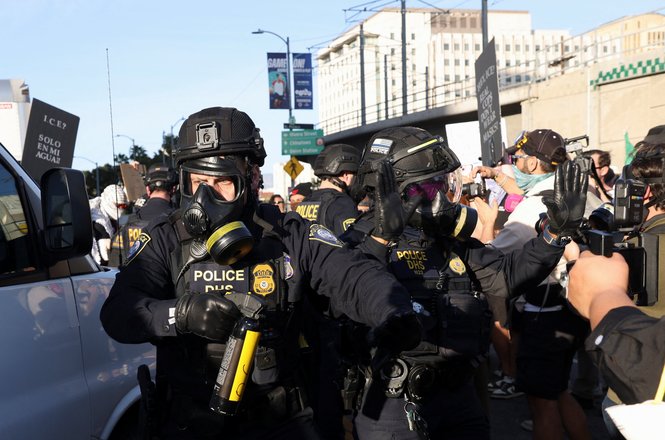
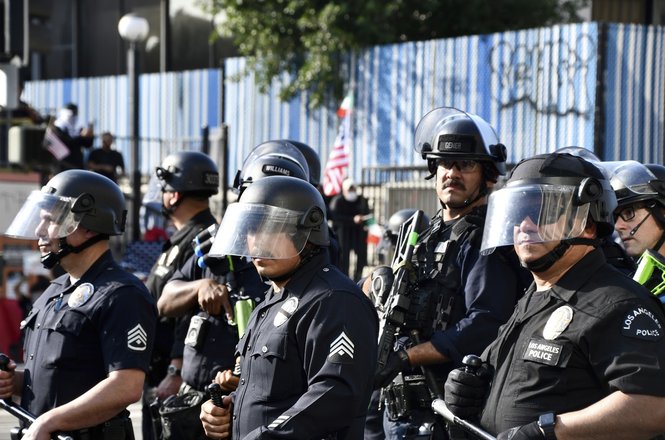
Protests erupted across the Minneapolis, Minnesota, area in January 2026, after a sweeping federal immigration enforcement surge heightened tensions between residents and federal agents. Many demonstrations centered around the Bishop Henry Whipple Federal Building in nearby Fort Snelling, where Immigration and Customs Enforcement agents were operating. More unrest followed after Department of Homeland Security agents fatally shot Minneapolis residents Renee Good and Alex Pretti, and shot and wounded another man.
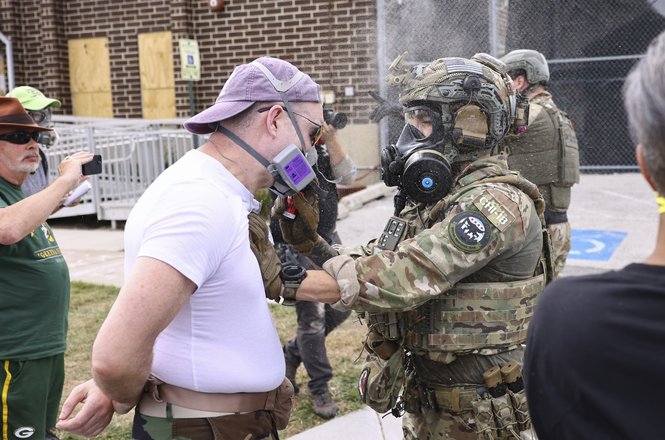
As demonstrations unfolded, some journalists covering them were threatened with arrest, while others were repeatedly exposed to chemical irritants such as tear gas and pepper spray. At times, the exposure forced reporters to pause their coverage, retreat to other areas or wash out their eyes — echoing the types of disruptions seen at similar immigration protests in Illinois and California last year.
DHS has not responded to requests for comment about journalists affected by its use of the munitions.
While these January incidents are not formally classified as press freedom violations under the U.S. Press Freedom Tracker’s 11 established categories, we’ve provided a roundup of them below, organized by date and location. This roundup will be updated as additional incidents are verified.
To learn more about how the Tracker documents and categorizes violations of press freedom, visit our FAQ page.
Jan. 6, 2026
In Minneapolis
- Freelance photojournalist Tim Evans was on assignment for Reuters covering ICE operations in the city, when he parked and exited his vehicle to photograph agents “socializing” at an intersection. Evans told the Tracker that he was approximately 30 feet away, and that multiple agents shouted at and taunted him as he approached, saying things like “Photograph my good side.” Another agent pointed at Evans while speaking to a colleague. As the agents returned to their vehicles, Evans said he noticed another ICE vehicle parked behind his car. He added that the agents inside “appeared to be documenting my license plate before driving away.”
Jan. 7, 2026
In Minneapolis
Protests erupted in the Central neighborhood of Minneapolis after an ICE officer shot and killed Minneapolis resident Renee Good. Good and her partner were among a number of residents standing watch as students were dropped off at a nearby elementary school, given heightened ICE activity in the neighborhood.
- Photojournalist Tim Evans and a second photojournalist were documenting ICE agents as they detained a delivery driver, when Evans said multiple federal agents took photos of them using their cellphones. Evans said that not long after, a group of agents a few blocks away were engaged in a separate operation that ultimately resulted in Good’s shooting. When Evans arrived to cover the immediate aftermath, he was tear-gassed alongside other media, community members and protesters. “Tear gas, pepper spray, and other munitions were deployed by federal agents when people would not clear the adjacent street and alleyway to let federal vehicles out, and some people threw snowballs at agents,” Evans wrote to the Tracker. “The gas was deployed indiscriminately, as many people in the vicinity were impacted.” He added that while he was wearing a gas mask at the time, he removed it after the agents departed, and the lingering gas continued to affect him for about an hour, causing him to cough and spit.
- Videographer Oliya Scootercaster, founder of FreedomNews.TV, was exposed to tear gas while capturing video of protests following the shooting.
- KMSP-TV reporter Karen Scullin and other media were affected by chemical irritants after ICE officers pepper-sprayed protesters blocking the road. “Got hit just being near. That stuff hurts bad,” Scullin wrote on social media. “Skin, eyes, lungs. Waiting it out.”
Jan. 8, 2026
In Fort Snelling
- Photojournalist Tim Evans was covering protests at the Whipple Building when federal agents deployed tear gas, pepper spray and other crowd-control munitions to disperse those blocking the building’s parking lot. “The gas was deployed indiscriminately, as many people in the vicinity were impacted, not just those blocking the street,” Evans wrote to the Tracker. “I was not wearing my mask when gas was first deployed, as I wasn’t expecting it to be used just then, but quickly moved away from the crowd and put my mask on afterward.” A federal agent, who had previously unholstered his firearm and aimed it at the demonstrators, aimed a pepper ball gun at Evans’ face and others. The photojournalist said he didn’t think he was targeted as a member of the press, as he was amid the crowd and the only things identifying him as such were his camera and press credentials around his neck.
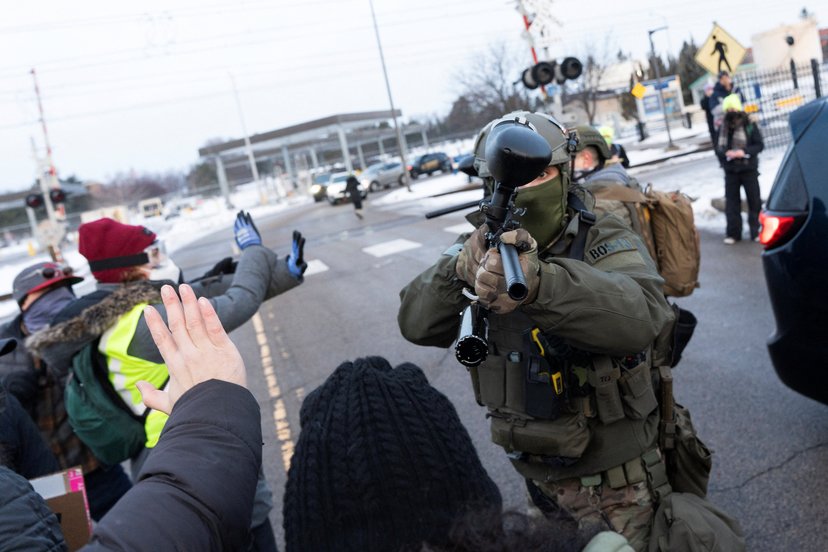
A federal agent aims a pepper ball gun at freelance photojournalist Tim Evans and others while he was documenting anti-deportation protests outside the Whipple Building in Fort Snelling, Minnesota, on Jan. 8, 2026.
— REUTERS/TIM EVANS- During a video report outside the Whipple Building, CNN correspondent Ryan Young can be heard coughing as he says, “The pepper ball spray is very strong. They use that to make sure that the crowd stays back.” Later in the video, smoke is seen filling the air. “They have deployed an agent, folks,” Young said.
Jan. 9, 2026
In Minneapolis
- Photojournalist Tim Evans told the Tracker he spotted a group of around five or six Customs and Border Protection agents stop a young man who appeared to be of East African descent in the Ventura Village neighborhood of Minneapolis, which has a large foreign-born population. Evans quickly exited his vehicle and walked toward the scene on the sidewalk, wearing his press credentials, as well as a vest marked with “PRESS” in all caps, and carrying a professional camera. He began photographing as he approached, positioning himself about 15 feet away on a snow mound to the right of the sidewalk, confirming with an agent in front of him that it was all right that he stand there. “As an unmasked agent interacted with the stopped man, he turned his attention to me, asking how I’m doing and if I’m a United States citizen. I initially didn’t respond and continued to photograph,” Evans wrote. “The agent then approached me, stood a couple of feet away, and introduced himself and a CBP agent, at which point I told him I’m a U.S. citizen. The agent then asked if I was born in the U.S. or am naturalized; I told him I was born here.” The agent then turned away and returned to the detained man, ultimately releasing him.
Jan. 11, 2026
In Fort Snelling
- Status Coup journalists JT Cestkowski and Jon Farina told the Tracker they were repeatedly caught in the clouds of tear gas and impacted by federal agents’ deployment of stun grenades. “No distinction was made between press and protesters,” said Cestkowski, who was also shot in the arm and buttocks with pepper balls that day. Farina was also struck by a crowd-control munition during the coverage.
Jan. 12, 2026
In Minneapolis
- Photojournalist Tim Evans told the Tracker he was covering an active scene after ICE agents crashed into a Hispanic man’s car and proceeded to question him about his immigration status. When Evans and a colleague arrived, a crowd of observers and community members had already formed. “A long standoff ensued, as the crowd of onlookers, media, and agents grew, with dozens of agents present at the peak,” Evans wrote. “The situation continued to deteriorate over the next 30 minutes, with agents deploying multiple tear gas canisters and shooting pepper balls at people.” Evans was among those targeted with the pepper ball munitions, with a federal agent shooting directly at his feet. Later, as the agents drove away, they deployed more tear gas, and one leaned out of his window and pepper-sprayed everyone standing along the side of the road. Evans said he and at least four other members of the press were affected. “I was sprayed in the hands, which burned for a couple of hours after. When I incidentally touched my face, it left my eyes and lips burning,” he wrote. Of the agents’ tactics, Evans said, “In a situation where a scene is active, and you’re planning to leave, I don’t understand the tactical benefit or logic or justification for casually throwing tear gas canisters out of a car door as you’re driving away. It feels punitive.”
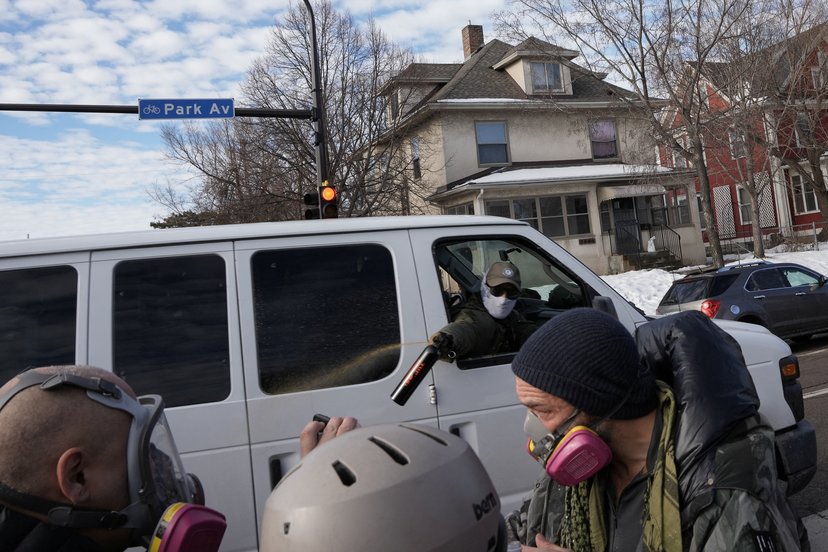
A federal agent pepper-sprays a crowd of demonstrators and members of the press, including photojournalist Tim Evans, as officers depart following an incident where a civilian’s car was hit by ICE agents in Minneapolis, Minnesota, on Jan. 12, 2026.
— REUTERS/TIM EVANSJan. 13, 2026
In Minneapolis
- Photojournalist Tim Evans told the Tracker he arrived to cover an ICE raid at a home in the racially diverse Central neighborhood of Minneapolis at around 9:40 a.m., documenting as two young Hispanic individuals were brought out of the home by federal officers. At approximately 10 a.m., a woman driving through a nearby intersection was detained by officers, who broke her window, cut her seat belt and carried her by her arms and legs to a federal vehicle. As Evans crouched to photograph her face between the agents’ legs, one shoved him to the ground. A short while later, he noticed a federal law enforcement vehicle driving past demonstrators and stepped forward to photograph it. “As the vehicle passed, an agent shot pepper spray from out of his window, indiscriminately spraying numerous people,” Evans wrote. “I was sprayed directly in the eyes, which immediately blinded me.” The photojournalist called out to a colleague who began to assist him, as a disorientation device detonated behind them. The pair made their way to a nearby church, where Evans was able to wash the irritants from his face.
Jan. 14, 2026
In Minneapolis
- Reporter Wali Khan said in an Instagram post that an ICE officer threatened him with arrest while he was filming the aftermath of protesters flattening the tire of an unmarked ICE vehicle. “Just press,” Khan said in the Instagram video. “I don’t give a fuck if you’re the press,” the officer responded. “We’re giving everybody a fucking warning: If they fuck around, they’re going to get arrested.”
- Status Coup journalist Zach Roberts and photographer Jon Farina were exposed to tear gas fired by various law enforcement agencies. Also that day, Roberts was hit in the head with debris from a crowd-control munition.
- CNN correspondent Whitney Wild said on air that she and her crew were hit with chemical irritants. “It’s a little hard to breathe because they just let off several flash bangs, multiple tear gas canisters.” She added that she and her producer, Meridith Edwards, got separated from photographer Jonathan Schaer at one point because it was so foggy from the tear gas, as shown in another CNN video.
Jan. 15, 2026
In Fort Snelling
- Photographer John Abernathy was subjected to intense tear gas and deliberately pepper-sprayed as federal officers detained and arrested him outside the Whipple Building. “As soon as that hit me, I was 100% defenseless. It was extreme pain. My eyes were burning, my face was burning and that was near my last breath,” Abernathy told the Tracker of the pepper spray.
- Photojournalist Tim Evans told the Tracker that he was also tear-gassed by federal agents, most of whom were from Customs and Border Protection. “They deployed tear gas as they charged forward, tackled a local independent photographer to the ground, maced him heavily at point-blank range, and detained him,” Evans wrote, referring to Abernathy. “I was wearing a mask at the time. I experienced light coughing and spitting after removing my mask.”
- Martha Kelner, a reporter for Sky News, struggled to report after federal officers fired chemical irritants into the air. “As you can see, the police, with their weapons drawn, they’re firing tear gas, pepper bullets, too,” she said before she was overwhelmed. “Apologies, as you can hear that tear gas is really catching in the throat of everyone here.”
- Reporter Wali Khan can be heard reacting in pain and coughing as he is exposed to tear gas fired by federal agents in an Instagram video taken outside the Whipple Building.
In Minneapolis
- CNN correspondent Julia Vargas Jones told the Tracker that she, her producer Sarah Moon and photojournalist Orlando Ruiz were affected by pepper ball residue. “We were in the crowd where federal officers were shooting to disperse the crowd,” Jones said. Ruiz’s eyes were especially irritated by the gust of the chemical irritant, and he needed to stop filming to clean them before continuing to report.
- In a CNN video, reporter Shimon Prokupecz retreated, coughing, from the area of a protest as law enforcement deployed tear gas and percussion grenades. “Wow. This is nasty,” Prokupecz said as he continued to choke through his report.
Jan. 16, 2026
In Fort Snelling
- Photojournalist Tim Evans was reporting on protests outside the Whipple Building when dozens of agents rushed into the street to chase an individual. The agents then formed a line in the roadway, threatening all those present with arrest if they did not move off the main roadway. An agent with CBP’s Special Response Team also shot pepper balls at Evans while he was crouched to photograph the line of agents.
Jan. 21, 2026
In Fort Snelling
- Daniel Knowles, a Midwest correspondent for The Economist, told the Tracker he had RSVP’d to a DHS news conference but was denied entry for security reasons. “Pretty much all the foreign press there were excluded from what I could tell,” he wrote in an email.
Jan. 23, 2026
In Minneapolis
- Independent journalists Margaret Killjoy and James Stout were repeatedly threatened with arrest while trapped between a line of Hennepin County sheriff’s deputies and a wall near the Whipple Building. Stout told the Tracker that they were documenting protests near the building that day, but had gone to their vehicle for additional clothing layers and hand warmers to defrost Stout’s equipment, which had stopped working in the -30˚F weather. After they returned to the scene, they found that sheriff’s deputies had pushed protesters back from the building and were blocking the journalists’ way out of the area. The officers then informed them they had only five minutes to disperse or else face arrest, directing them to head east toward a road, but no one around them knew where that was. “On one side of us is a military installation, so we’re not going that way. On the other side of us is fenced off. Then there’s the pathway that goes around the side of the federal building, kind of behind us. And then where we are standing is directly next to a light rail station.” Stout said he tried to approach the deputies, but they started advancing toward them and gesturing for them to leave. He added that he was clearly identifiable as a journalist — wearing a bright red helmet labeled “PRESS” in all caps and carrying a professional microphone. Killjoy was also wearing a helmet with similar markings. At what Stout said felt like the last possible moment, a light rail train happened to pull into the station, and they were able to board, bypassing the deputies’ skirmish line.
Jan. 24, 2026
In Minneapolis
Protests erupted in Minneapolis’ Whittier neighborhood after local resident Alex Pretti was fatally shot by Border Patrol agents. Pretti had been filming agents in the street when he attempted to help a woman who had been shoved to the ground by federal officers.
- Independent journalist Sean Beckner-Carmitchel was deliberately drenched in pepper spray by federal officers while documenting an impromptu protest in the hours after the shooting. He wrote on social media that protesters were gathered less than a block from where the shooting took place, and federal agents targeted them with large volumes of chemical irritants. “I got absolutely covered in spray,” he added in a subsequent post. “Really grateful to some protesters who have helped remove the dousing all over one of my jackets, face and camera.”
- KSTP-TV photojournalist Joe Caffrey and reporter Eric Rasmussen were tear-gassed on live TV while covering an impromptu protest in the hours after Pretti’s death. “They’re moving us back,” Rasmussen reported while violently coughing and catching his breath. “There was no warning. I got to get to safety, I’m sorry, guys.” Caffrey was also struck in the thigh with a crowd-control munition by federal agents as the pair attempted to move back from the growing cloud of chemical irritant.
- Status Coup journalists JT Cestkowski and Jon Farina were caught in tear gas while documenting the protests. In a video posted to Instagram, both journalists move back from gas and pepper spray, as Cestkowski is heard coughing. Later, he reported that residents offered water to him and those affected by the chemical irritant. “The tear gas that’s being fired there is not being fired by the local law enforcement; it’s being fired by the federal government,” he said of the continuous barrage.
- Photojournalist Tim Evans told the Tracker that as agents set up a caution tape perimeter around where Pretti had been killed, a federal agent was walking up and down the line photographing those present, including Evans and other members of the press. The photojournalist was also repeatedly tear-gassed by federal agents, Minnesota State Patrol troopers and Minneapolis Police Department officers while covering the impromptu demonstrations that followed. He told the Tracker that when he returned to his vehicle, he found two spent tear gas canisters — one under the engine block and one under the rear passenger-side door. “My car was covered in smoke residue and smelled strongly of gas inside for two days,” he wrote.
- KARE reporter Joe McCoy and anchor Jana Shortal, while on air covering the demonstrations, were driven from the scene with others in the crowd after several loud bangs were heard. McCoy told the studio anchor that law enforcement had launched tear gas into the gathering, but that he and Shortal were unharmed. The incident occurred shortly after Shortal was shoved by federal agents and sprayed in the eye with a chemical irritant.
- CNN reporter Sara Sidner and photographer Jerry Simonson were also inundated by a cloud of tear gas while reporting from the scene. In a video posted to Instagram, Sidner chokes violently after federal agents deploy the gas. “I can’t breathe,” she said, as the sound cuts on and off. Later, in another Instagram video, she said, “There was no physical reaction from protesters; the only thing they were doing was speaking their minds, and suddenly we were all gassed and munitions fired toward us.”
- KARE television reporter Samie Solina reported that she was sprayed with tear gas as crowds gathered. “I was kind of coughing up and throwing up a little bit earlier in the day because of that chemical irritant,” Solina said.
- Wall Street Journal reporter Mariah Timms reported that federal agents deployed tear gas near where she was reporting, causing people around her to start wretching from the exposure. “It was getting cloudier down in that intersection,” she said in a video, adding that she quickly got her mask on, though it was not properly secured in the frenzy. “It was that sort of spicy, back-of-your-throat, difficult-to-catch-your-breath feeling,” she said.
- Independent journalist Nick Valencia was repeatedly exposed to chemical irritants launched by federal officers. In a Facebook video, his eyes begin watering as he visibly reacts to the barrage. “This stuff is like pepper spray on steroids,” he told the Tracker. “I was basically left blinded for about 90 seconds.” Also that day, Valencia was pushed by a Border Patrol agent and struck with tear gas canisters.
Jan. 25, 2026
In Minneapolis
- Status Coup reporter Tina-Desiree Berg and photojournalist Jon Farina reported that they were covering a “noise demonstration” outside a hotel where federal officers were believed to be staying when officers deployed tear gas and disorientation weapons to disperse a gaggle of journalists who were already complying with orders to move back from the hotel. Both journalists were caught in the growing cloud of chemical gas. In footage of the incident, Berg can be heard saying “I can’t breathe” multiple times as explosions continue in the background. Farina tells her to cover her face and reassures her, “I got you.” As Berg struggles to continue moving, Farina says, “We have to keep going. Come here, we’re almost safe.” Both journalists needed to rinse off the irritant before they could continue reporting, according to Status Coup. The incident occurred shortly after a federal officer seized Berg from behind and shoved her to the ground.
- The day after previous incidents, independent journalist Nick Valencia was exposed to chemical irritants and ordered to leave while documenting federal agents making at least two arrests, he told the Tracker. In a video Valencia posted to Facebook, he identifies himself as a journalist. An agent responds, “Don’t care,” before shining a light in his face. Valencia later posted an Instagram photo showing an agent pointing a gun at him, which he told the Tracker was likely loaded with crowd-control munitions. “You show up with a camera, they show up with a gun and point it at you,” he wrote on the post. “I repeatedly identified myself as a journalist and was repeatedly told by the feds they didn’t care who I was. They would shoot me.” Valencia told the Tracker the encounter was brief and did not feel like an imminent threat at the time.
The U.S. Press Freedom Tracker catalogs press freedom violations in the United States. Email tips to [email protected].