Incident details
- Date of incident
- March 28, 2026
- Location
- Los Angeles, California
- Targets
- Media
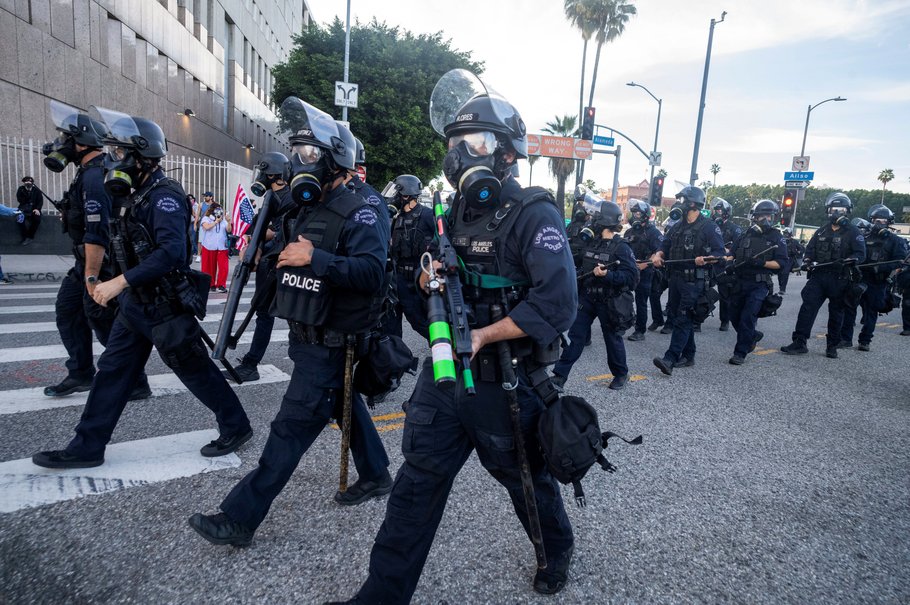
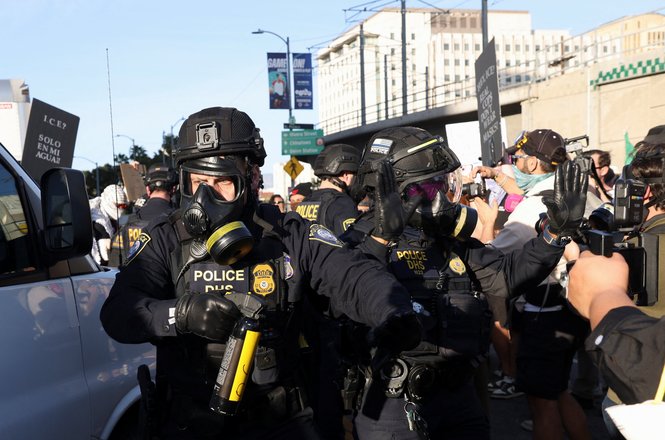
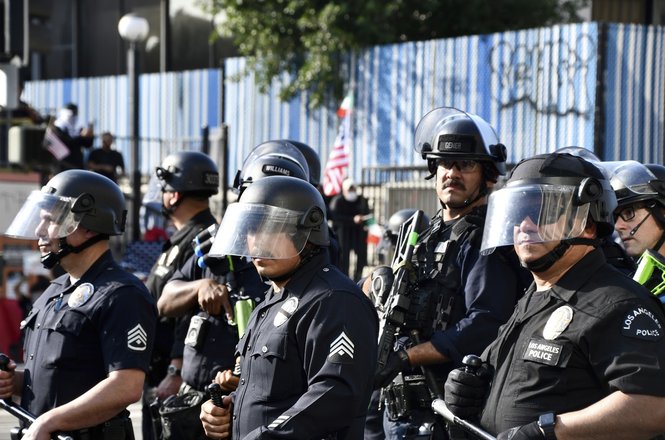
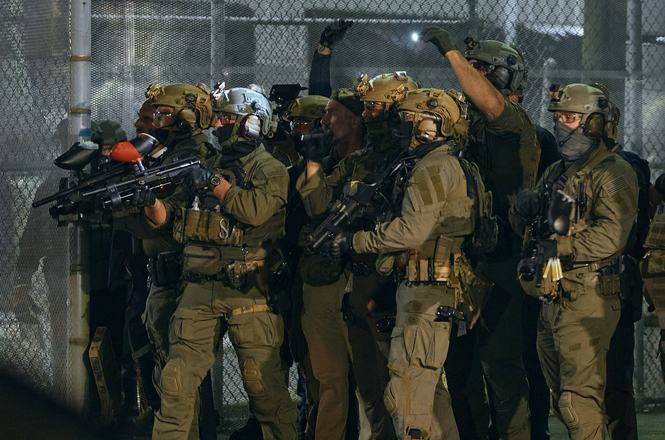
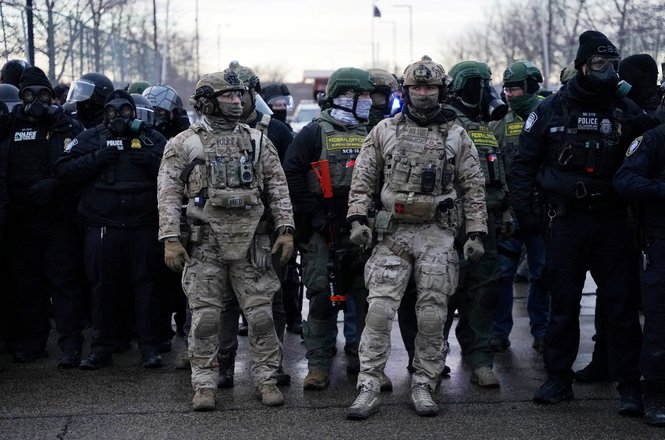
Police clear the street near a federal immigration detention center after a “No Kings” protest against Trump administration policies in Los Angeles, California, on March 28, 2026.
Multiple journalists covering a March 28, 2026, protest in downtown Los Angeles, California, were hit with tear gas and other chemical irritants, corralled by police and, in some cases, blocked from documenting arrests as they unfolded.
The protest followed a “No Kings” demonstration held earlier in the day in LA, one of thousands held nationwide against the Trump administration’s policies, drawing over 8 million people, organizers said.
In downtown LA, at least 75 people were arrested near the Metropolitan Detention Center, where immigrants are held, according to the LA Police Department. The site has become a focal point for demonstrations since the start of sweeping immigration enforcement actions in June.
The obstructions described by reporters on the ground echo incidents documented during protests in June 2025 and January 2026.
Although these incidents do not meet the U.S. Press Freedom Tracker’s standards for official documentation of press freedom violations, they have been compiled below. This roundup will be updated as additional incidents are verified. And you can see our reporting on the March 28 violations in LA here.
LAPD Chief Jim McDonnell, in a written statement shared April 2, said that police were responding to acts of violence and vandalism and eventually issued a dispersal order. Anyone identifying as a “duly authorized” member of the media was contacted, verified and separated from those facing arrest for failure to disperse, according to the statement. McDonnell added that any use of force or allegations of mistreatment, including those involving media members, would be investigated and addressed.
“The LAPD recognizes the media’s right to cover events and makes reasonable efforts to accommodate, with those efforts consistent with our primary duty to maintain public safety and order,” the statement said.
A September preliminary injunction barred LAPD officers from interfering with journalists covering protests, including by arresting, detaining or citing them solely for failing to disperse.
The Department of Homeland Security did not respond to a request for comment about the cases of journalists who faced press violations on March 28.
To learn more about how the Tracker documents and categorizes violations of press freedom, visit our FAQ page.
- Status Coup reporter Tina-Desiree Berg told the Tracker that the chemical irritants deployed into the air by federal officers left a rash on her leg. “I had to throw my T-shirt out as well,” she said. “It was so soaked in chemical irritants I removed it while still there. Thank goodness I had double-layered that day. It was absolutely insane.”
- Independent photographer Steven Berumen told the Tracker that he was affected by chemical irritants when he took his gas mask off a block away from where law enforcement was deploying them. “I wasn’t safe. I started coughing; I was out for about 10 minutes,” he said. “I got treated by some people and then went back to taking photos.” Also that day, an officer deliberately shoved Berumen’s camera in his face, and he was struck with a crowd-control projectile.
- Mel Buer, an independent journalist, told the Tracker that she was inundated with tear gas after DHS officers threw canisters into the crowd of what appeared to be mostly press. “It just enveloped them; a lot of people couldn’t see, a lot of people were throwing up, a lot of people ran into the street, unable to breathe,” she said. “I was kind of blind for a bit.” Also that day, she discovered pepper ball residue on her shoe, and was caught in a kettle with journalists and threatened with arrest.
- Student journalist Delfino Camacho told the Tracker that he was affected by tear gas DHS officers deployed outside the detention center. “It put me out of commission for a few minutes,” he said.
- Independent journalist Henry Cherry told the Tracker that he was impacted by tear gas fired by federal officers after the gas seeped through his mask. “I would have to get off the line for a second so I could breathe,” he said. “It’s so permeating, and this was a stronger batch of tear gas than I had ever come across before.” Cherry was also struck with projectiles.
- Independent photographer Enrique Dominguez told the Tracker he was affected by tear gas while documenting the protest. “It affected my lungs and my eyes; I couldn’t breathe properly for a couple minutes,” he said. “I was able to regain my breath after being carried out by street medics.”
- Abraham Elizalde, Violet Garcia, Victor Montiel and Daniela Raymundo — who were covering the protest for Los Angeles Pierce College’s The Bull Magazine — were affected by chemical irritants, Garcia told the Tracker. “Our eyes were stinging, and then it went a little bit past stinging, and they were burning and tearing up, but we were still able to see. Our noses were starting to burn a little bit as well. And then some of my colleagues started to describe a foul taste,” Garcia, who was wearing a KN95 mask, explained. All four were also cornered by police, ordered to show press credentials and escorted away from the protest.
- Independent journalist Luke Harold, who was documenting the protest, told the Tracker that his eyes were badly affected by the chemical irritants fired by DHS officers at one point, when he rushed to put on his goggles and they didn’t seal properly. He was also shoved by a federal agent and detained by LA police that day.
- Ryanne Mena, a reporter with the Los Angeles Daily News, told the Tracker that she was affected by tear gas fired by federal agents, which seeped behind her protective goggles. “My eyes were burning, and I was totally debilitated. It was really painful. That day, Mena was also pushed by a police officer.
- Mena and Los Angeles Times reporter Connor Sheets told the Tracker they were among about a dozen journalists who were sequestered to a designated area while officers made arrests, and were not allowed to get close enough to document the process. Journalist Kevin Foster posted a video on Instagram saying he and other press were prevented from documenting the arrests. “There’s no way that we can effectively document what is happening there,” he said. “They want to do this mass arrest in secret.” Photojournalist Jake Crandall told Freedom of the Press Foundation, of which the Tracker is a project, that he was also part of the group being obstructed. Photojournalist Jill Connelly told the Tracker that she was also among those who were moved too far away to document, adding that a supervising officer eventually allowed her and other press to get close enough to see people being put into police transport vehicles. Berg reported for Status Coup that an officer, with her hand stretched out to block reporters, shouted, “Press must stay!” In a video Sheets posted to the social platform X, an officer said they were blocking off the area because, “We’re going to do some mass arrests right now, that’s why. Our main thing is your safety.”
- Independent photographer Jonny Morales told the Tracker that police denied him access to cover parts of the demonstration because he did not have a press badge, despite state law not requiring him to wear credentials. “I was unable to document it; I felt like my First Amendment rights were taken away,” Morales said. “If it wasn’t for my buddy, who had a press pass and allowed me to go through, I might have been arrested.”
- Jose Ossa, a student filmmaker at California State University, Dominguez Hills, who was documenting the protest, told the Tracker that his eyes and respiratory system were affected by the residue of a chemical irritant in the air when he approached the detention center, even though he was wearing a mask and goggles. He had to retreat from the area twice before the air cleared. Later that day, he and fellow student Giovanni Cruz were detained in a police kettle and zip-tied by LAPD.
- Independent photographer Santiago Restrepo was documenting the protest but had to stop because his eyes were tearing up, he was coughing and his skin was burning due to the irritants, he told the Tracker. He was treated on the street by a medic. Restrepo was later detained in a police kettle, arrested and cited for failing to disperse.
- Nick Stern, an independent photographer, told the Tracker that he was affected by tear gas deployed by federal agents outside the detention center. “I actually got lungs full of tear gas, which pretty much incapacitated me for five to 10 minutes,” he said.
- Independent journalist Dexter Thomas told the Tracker he was affected by tear gas fired by federal agents at the detention center. The chemical irritant got in his eyes, temporarily blinding him. In a video he posted to Instagram, he can be heard coughing as the gas fills the street. “I’m good; I just got to wait it out,” he said in the clip. Also that day, he was caught in a police kettle and threatened with arrest.
The U.S. Press Freedom Tracker catalogs press freedom violations in the United States. Email tips to [email protected].