Incident details
- Date of incident
- July 20, 2026
- Targets
- Media
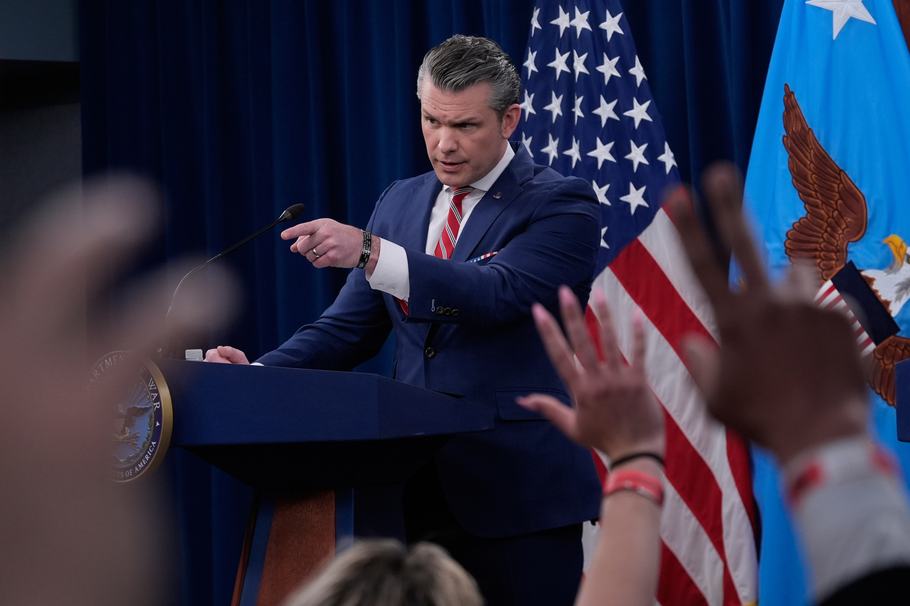
Defense Secretary Pete Hegseth holds the Pentagon’s last formal press briefing in Arlington, Virginia, on May 5, 2026.
The Pentagon hasn’t held a news conference for 2 1/2 months, leaving renewed airstrikes with Iran and recent deaths of U.S. service members unexplained by Defense Secretary Pete Hegseth, a CNN analysis reported on July 20, 2026.
“The public deserves transparency about the US war in Iran. But that’s not what we’re getting — not even close,” CNN’s chief media analyst Brian Stelter wrote. He noted that news briefings were held regularly during past conflicts, but under Hegseth the most recent was May 5.
“It’s all indicative of a larger effort to control information, limit access and avoid difficult questions about the war,” Stelter added.
During his tenure, Hegseth has sharply restricted press access by requiring media escorts, barring photographers from briefings and repeatedly trying to chill coverage throughout 2025 and 2026.
As official information has become increasingly scarce, Stelter pointed out that reporters have relied more heavily on anonymous sources to uncover significant developments, a practice Hegseth has sought to curb by targeting alleged leakers.
In a statement to CNN, the Pentagon’s chief spokesman Sean Parnell said the U.S. government “has consistently provided comprehensive, real-time updates” on the strikes in Iran.
“President Trump and Secretary Hegseth have been constantly providing updates directly to the media and the American people online, delivering clear, unfiltered insight into our objectives and decisive actions,” Parnell said. “Additionally, questions from Fake News reporters do very little to inform the public at all. Their primary goal is to get clips that can be used online to promote themselves and push their preferred narrative.”
In a related development in July, the Navy denied an Associated Press request for a sailor’s biography, initially stating that it had changed its policy to restrict press access to sailors’ service histories — information that had been routinely available for decades.
The service later reversed course and walked back the statement, the outlet reported. It has since provided AP with the requested biography.
A Navy official, who spoke to AP on the condition of anonymity, said a Navy spokeswoman had misinterpreted a recently released Navy policy mandating the service remove all public-facing information about its commanding officers.
Parnell, in a lengthy post on X, wrote, in part: “There has been NO change to the Navy’s policies governing the release of service records.”
The U.S. Press Freedom Tracker catalogs press freedom violations in the United States. Email tips to [email protected].