- Published On
- February 26, 2026
- Written by
- Kirstin McCudden from Freedom of the Press Foundation
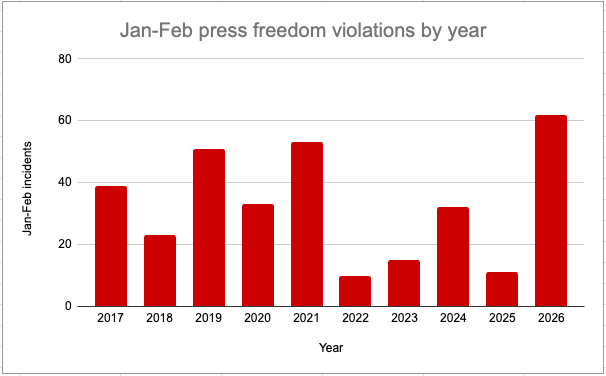
The Tracker has documented the highest number of press freedom incidents for the first two months of any year since we started measuring in 2017.
Friends of the U.S. Press Freedom Tracker:
If there’s any question about how 2026 is stacking up for press freedom in the United States, we simply need to look at the tape. As we close out February, we’re documenting the highest number of press freedom incidents for the first two months of any year since we started measuring in 2017.
We tracked 54 incidents in January, an all-time high. February documentation continues, and includes assaults of journalists covering protests around immigration policy in Minneapolis and Los Angeles.
Journalist questioned by FBI about identities of protesters
In Oregon, journalist Robert Scherle has been covering protests around Eugene’s Federal Building, where Department of Homeland Security immigration enforcement operations are based. On Jan. 27, the independent photographer was shoved and hit with projectiles multiple times.
It was what happened about a week later, however, that he said stressed him out. On Feb. 4, Scherle was questioned at his home by two FBI agents, asking him about the identities of people who attended protests he’d been covering. The agents asked him to provide any photographs he had taken of people destroying federal property, which Scherle declined. He told the Tracker that the agents were not overtly threatening. “It was sort of just an implied threat, just by the fact that they’re there,” he said.
Including Scherle, we’ve documented seven assaults of journalists covering immigration-related protests in Oregon this year; all hit with impact projectiles by law enforcement.
Celebrating student journalism on Student Press Freedom Day
Today is Student Press Freedom Day, a moment to recognize the accomplishments and essential role of student journalists. And to recognize that their work is more crucial than ever: More student journalists were assaulted, detained, denied access or faced legal orders in 2025 than any other year in the Tracker’s database.
Already in 2026, three student journalists have been assaulted, all while covering immigration-related protests.
Press freedom aggressions against student journalists
Use the tag “student journalism” to see all high school and collegiate-level press freedom incidents in the Tracker.
Notable updates — courts edition
- Last month, I wrote about how a Nevada judge ejected Las Vegas Review-Journal journalists from the courtroom during testimony in a high-profile sexual assault trial in Las Vegas. They had objected to restrictions placed on media coverage, a prior restraint. On Jan. 28, the state Supreme Court ruled the judge’s eviction violated the journalists’ constitutional rights.
- Early this month, Maryland prosecutors dropped subpoenas demanding testimony from The New York Times Magazine contributor Jeffrey Toobin and researcher Rudy Lee around a 2025 article.
- On Feb. 2, journalists Jonathan Peltz and Kate Gallagher reported to a judge that their federal suit against the city of Los Angeles had settled. The suit followed the Knock LA reporters’ arrests in March 2021, along with 17 other journalists, while documenting demonstrations near the city’s Echo Park Lake.
- Oregon journalists Mason Lake and Hugo Rios won a temporary restraining order on Feb. 3 in their federal suit against President Donald Trump, DHS and its head, Kristi Noem. In his order forbidding agents to use chemical or projectile munitions in the absence of imminent threat of physical harm, or to use weapons on or fire crowd-control munitions at the head, neck or torso, District Judge Michael Simon wrote that the U.S. was at a crossroads between a “constitutional democratic republic” and an “authoritarian regime.” “Plaintiffs are currently suffering First Amendment chill,” Simon found.
- During Don Lemon’s Feb. 13 arraignment, his lawyer revealed that federal agents had seized the former CNN anchor’s phone when they arrested him in California last month. The phone is still in custody of the government.
- After a sheriff’s deputy shot independent photojournalist Nick Stern in the leg with a crowd-control munition that sent him to the emergency room for surgery last summer, Stern sued Los Angeles County and its sheriff’s department staff in California state court on Feb. 18.
- On Feb. 24, a federal judge ruled the court, not the government, would review information on devices seized during last month’s disturbing home raid on Washington Post reporter Hannah Natanson. Her devices — two laptops, a phone, a storage device, an audio recorder and her Garmin watch — remain in custody of the government.