- Published On
- May 28, 2026
- Written by
- Kirstin McCudden from Freedom of the Press Foundation
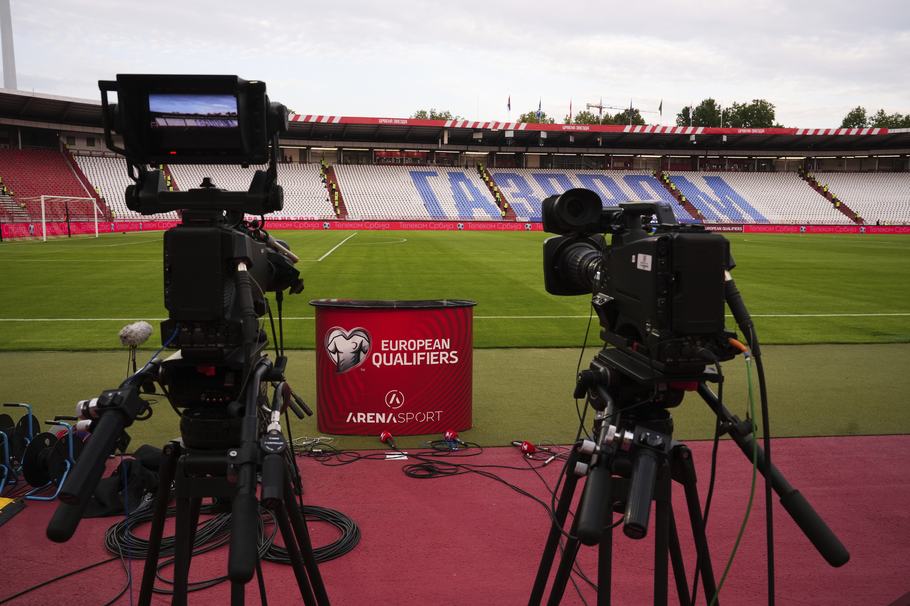
Cameras are set up in Belgrade, Serbia, ahead of a 2025 qualifying match for the 2026 FIFA Men’s World Cup.
Dear Friend of Press Freedom,
Welcome back to your newsletter around press freedom violations in the United States as captured by the U.S. Press Freedom Tracker, a project by Freedom of the Press Foundation.
FIFA said it has distributed about 16,000 media accreditations for the 2026 World Cup in the U.S., Mexico and Canada this summer.
I sat down with Briana Erickson, the Tracker’s West Coast reporter, who just published an analysis looking at a cross section of Tracker data — border stops of journalists, assaults by the Department of Homeland Security at immigration policy protests, detentions of journalists across administrations and more — and what’s fueling concerns for reporters arriving to cover the massive sporting event.
Briana told me what struck her the most while reporting this piece was the sheer number of recent DHS-related press freedom aggressions. “I knew there had been a surge when protests erupted last summer, but seeing that nearly half of all cases documented happened in the last year was pretty striking,” she said.
Kirstin: Briana, we know tens of thousands of journalists and media workers will be traveling to cover the 2026 Men’s World Cup, especially with the U.S. being home to 11 of the 16 host cities. It’s a huge deal. And I know you love the game and even play in an adult league. What made you want to pull together this analysis?
Briana: Yes, I do love soccer. My own championship game is the week the World Cup starts!
I first started thinking about this analysis while the Tracker was documenting hundreds of press freedom violations at immigration-related protests last year and examining the broader range of aggressions tied to the issue.
I wanted to focus on what’s happening to immigrant journalists also on the front lines. After Mario Guevara’s deportation in October, he shared his story with me from El Salvador.
His experience felt especially timely to examine through the lens of one of the world’s biggest sporting events, particularly as foreign-born journalists prepare to travel here amid growing hostility toward both journalists and immigrants.
While I was compiling the data, Estefany Rodríguez was arrested in March. It immediately brought me back to something Mario had told me: “I don’t think I’ll be the only one.”
I wanted to zoom out from the individual cases and highlight the broader pattern the data reveals: That even journalists with legal status have faced difficulties traveling to or working in the U.S.
You’ve been reporting on Spanish-language journalists Rodríguez and Guevara since their respective arrests and detentions by Immigration and Customs Enforcement. (Rodríguez was arrested in Tennessee in March; Guevara was arrested in Georgia last June while reporting from a “No Kings” protest.)
Rodríguez spent more than two weeks in ICE detention centers. When you told her that you were looking at her treatment from immigration officials in the context of the World Cup, what were her thoughts?
Rodríguez acknowledged that she is scared, but emphasized how important it is to continue the work, particularly for Latinos, who she believes have a fundamental duty to report to their communities right now. She said she tells people to be careful, and to make sure their legal status in the U.S. is in order.
When I asked her what message her case sends to foreign journalists traveling to the U.S. or to immigrant journalists living here, she said: “The duty to report chases us, and we have to keep doing it.”
Guevara spent nearly four months in ICE custody, then was deported to El Salvador, his country of origin. Did he have any advice for how other journalists should be thinking about covering the World Cup and crossing borders this summer?
When I followed up with Mario in mid-May, he told me he was considering going to the U.S.-Mexico border to report on journalists traveling for the World Cup. He said an event of this scale could affect hundreds of journalists around the world, and urged them to be aware of the state of press freedom in the U.S. and to be careful in their reporting.
“If you come to this country, you understand that you are at risk simply because, as immigrants, you are already exposed to becoming victims of abuse of power,” he said. “Nowadays, even carrying your press credentials or your visa-stamped passports is no longer a guarantee that your rights will be respected.”
Freedom of the Press Foundation
Separately, you talked to Ecuadorian journalist Diego Arcos, who’s covered eight other World Cups, and is traveling again for his ninth. Is he preparing differently for this set of matches?
Diego is a pro when it comes to traveling to the United States, and he’s had a work visa before. But this year, he began preparing months in advance to secure both the work and tourist visas required to cover the tournament.
While on assignment, he plans to protect his devices and create daily backups of his reporting and contacts so a lost or seized device doesn’t wipe out days of work. He also plans to carry his passport, visas and media credentials with him at all times, rather than locking them in a hotel safe, in case his press badge alone is not enough.
Although Diego said he feels confident traveling to the U.S. with experience and the proper documentation, he said many of his colleagues are “really, really scared” about immigration enforcement. Some have scrapped their travel plans altogether, while others may avoid reporting on immigration issues entirely.
You also look at the Tracker category of Border Stops, and how secondary screening or even denial of entrance is one obstacle possibly facing visiting journalists this tournament. How did DHS respond when asked about journalists crossing borders for the World Cup?
When I reached out to DHS, I asked how the agency plans to handle the influx of foreign journalists traveling to the U.S. to cover the World Cup, including whether there are specific policies or procedures for press entering the country. I also cited reports of journalists being questioned about their reporting and having their devices searched at the border. I asked the department about its screening process, including whether journalists face additional scrutiny and under what circumstances.
In an emailed response, DHS said it will work with federal and local partners to secure the World Cup and encouraged foreign travelers to prepare their documentation and travel plans in advance.
The statement read, in part: “What makes someone a target for immigration enforcement is whether or not they are illegally in the U.S. — full stop. Speculation to the contrary is ill-informed.”
Given that the 2026 FIFA World Cup is the first to include human rights, including that of the press, in its bidding requirements — and the first to have a formal human rights strategy and mandatory standards for host cities — how are those commitments being enforced?
Human Rights Watch found that, as of late April, most host cities still have not published their human rights plans. Los Angeles’ plan does not mention journalists on its related webpage, while Atlanta’s 57-page plan references journalists only once.
A FIFA spokesperson told me that entry into host countries is an immigration matter outside the organization’s control. Though it has a policy pledging to protect journalists during tournaments and says it will use its leverage with authorities when issues arise, advocates tell me enforcement is inconsistent and slow, if it happens at all.
As Andrea Florence, executive director of the Sport & Rights Alliance, put it: “This year really puts those policies to a test. And right now, FIFA is failing to live up to its own policies.”
Other notable Tracker updates
- The federal government dismissed its obstruction case against photographer John Abernathy on May 6; he was shot with pepper balls, pepper-sprayed and arrested while documenting anti-deportation protests in the Minneapolis area in January.
- The FBI launched a criminal leak investigation into Atlantic journalist Sarah Fitzpatrick’s sources following her exclusive April 17 report on Director Kash Patel’s job performance.
- The Federal Communications Commission ordered The Walt Disney Company to apply for license renewals for all of its ABC TV stations, giving them until May 28 to comply. The April demand came after President Donald Trump called on the network to fire late-night host Jimmy Kimmel. The licenses aren’t set to expire for two years or more.
- On April 29, a Florida man was sentenced to 27 months in prison for sending death threats to Catherine Rampell, then of The Washington Post, and journalist Mehdi Hasan.