Incident details
- Updated on
- Date of incident
- August 5, 2025
- Legal orders
-
-
subpoena
for
other testimony
- Aug. 5, 2025: Pending
- Aug. 18, 2025: Objected to
- Sept. 3, 2025: Objected to
- Nov. 19, 2025: Partially upheld
-
subpoena
for
other testimony
- Legal order target
- Journalist
- Legal order venue
- Federal
Subpoena/Legal Order
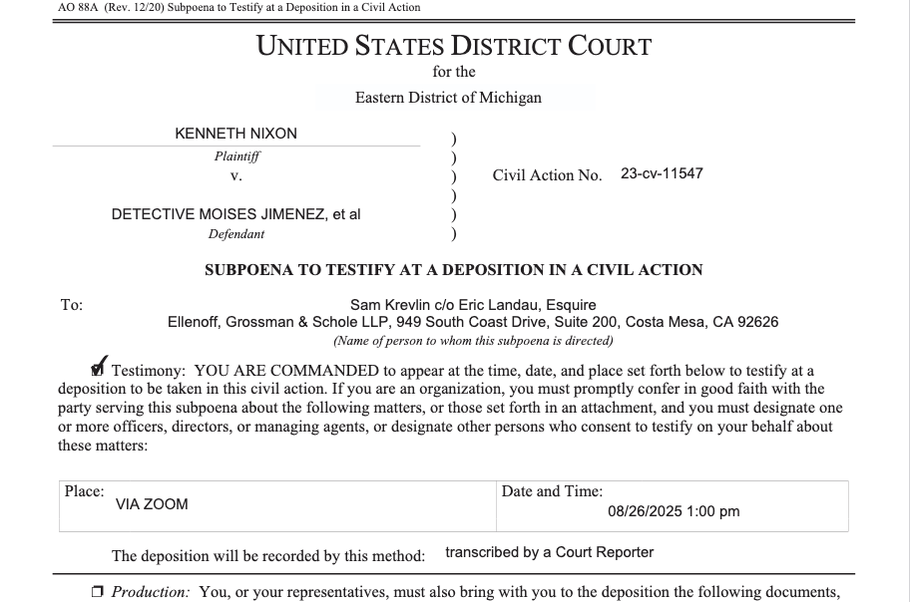
A portion of an Aug. 5, 2025, subpoena issued to Sam Krevlin for a deposition about his reporting as a student journalist working on Northwestern University’s Medill Innocence Project in Evanston, Illinois, in 2018.
Deposition order for student reporting in exoneration case partially struck down
A subpoena for testimony from former student journalist Sam Krevlin was partially struck down on Nov. 19, 2025, when a federal judge in a civil suit in Detroit, Michigan, severely restricted the details Krevlin could be compelled to disclose about his journalistic work.
Krevlin was subpoenaed in connection with an investigation he conducted seven years earlier for the Medill Justice Project as an undergraduate at Northwestern University’s journalism school. Krevlin reported on Kenneth Nixon, incarcerated for a 2005 homicide, for an article published by the Detroit Free Press in October 2018.
Nixon was later exonerated and released, then sued members of Detroit’s police department in June 2023, alleging that they framed him. In turn, the defendants subpoenaed Krevlin in March 2025 for reporting materials on Nixon’s case and in August to testify in a deposition. Krevlin’s attorneys filed a motion to quash the subpoenas.
In November, U.S. District Judge Margaret Garnett partially granted the motion, setting strict limits on the testimony Krevlin could be compelled to give and quashing the document subpoena entirely.
Garnett ruled that Krevlin was protected by federal journalist’s privilege, and had waived that privilege only for the information he disclosed to an investigator for the county prosecutor’s Conviction Integrity Unit in 2020.
She ordered that his deposition, or even just an affidavit, cover only the logistics — not the content — of the interviews he conducted with police informant Stanley January Jr., along with statements under oath about the accuracy of what he’d told the investigator and what the Free Press had reported about the January interviews.
Former student journalist Sam Krevlin was subpoenaed in connection with a civil suit in Detroit, Michigan, on Aug. 5, 2025, ordering him to appear remotely to testify about journalistic work he conducted at Northwestern University seven years earlier.
Krevlin, who did not respond to requests for comment, was an undergraduate at the university’s Medill School of Journalism in Evanston, Illinois, in 2018 when he was selected to participate in the Medill Justice Project, now known as the Medill Investigative Lab. According to court filings, he was assigned to the team reporting on Kenneth Nixon, who claimed he was innocent of the 2005 homicide for which he had been incarcerated.
The team’s reporting was published by the Detroit Free Press in October 2018. Nixon was exonerated and released from prison two years later, 16 years after his conviction.
In June 2023, Nixon filed a federal lawsuit with claims against the city of Detroit — which were later dismissed — and members of its police department, alleging that they framed him.
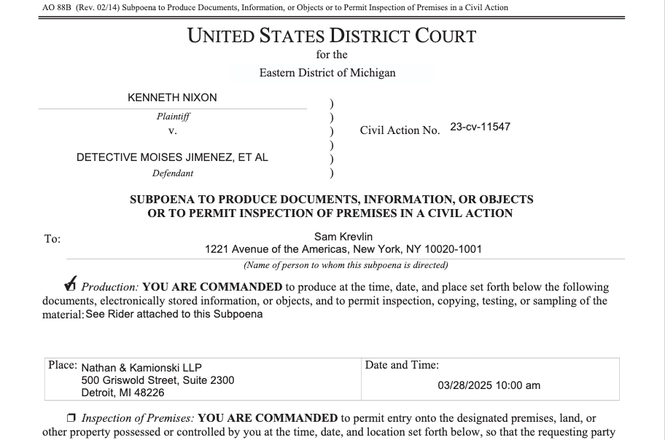
As part of pretrial discovery in that suit, in March 2025 the defendants sent Krevlin a subpoena for his “entire case file”: email, letter or text communications with sources; interview recordings and transcripts; notes; and any documents received via public records requests.
After initial objections and communications in April, attorneys for the police defendants “went dark,” according to Krevlin’s attorneys. Months later, they issued Krevlin a new subpoena, ordering him to sit for a deposition later that month but without any requests for records.
Attorneys for Krevlin, who now lives in New York, first raised objections to the request Aug. 18 and then filed an official motion to quash Sept. 3.
In a response filed two weeks later, attorneys for the defendants argued that Krevlin had waived his privilege by discussing his reporting with an investigator for the county prosecutor’s Conviction Integrity Unit in 2020. They also asked that the court order Krevlin to comply with both the deposition and production subpoenas.
Krevlin’s attorneys objected to that request, arguing that the information sought could be obtained from nonprivileged sources; that the requested materials are in the possession of the university, not Krevlin; and that Nixon’s exoneration wasn’t solely on the basis of Krevlin’s reporting and interview with police informant Stanley January Jr.
“To the extent the Detroit Free Press Article was the catalyst to question the veracity of Mr. January’s testimony this does not make it the crux of the CIU’s recommendation to overturn Mr. Nixon’s conviction,” Krevlin’s attorneys wrote.
In October, attorneys for the defendants asked U.S. District Judge Margaret Garnett to set a date for oral arguments or to issue a ruling on Krevlin’s motion to quash, citing the ramifications the decision may have for their ongoing discovery efforts. As of publication, no such date or ruling has been entered.
The U.S. Press Freedom Tracker catalogs press freedom violations in the United States. Email tips to [email protected].