- Published On
- January 29, 2026
- Written by
- Kirstin McCudden from Freedom of the Press Foundation
Friends of the U.S. Press Freedom Tracker:
True to its reputation, the month of January has been long and dark, including for press freedom aggressions.
It’s also been cold. CNN’s Sara Sidner posted on Instagram how her hands froze together while in Minneapolis, Minnesota, covering the ongoing unrest around federal immigration enforcement. She also described “getting a face full of tear gas” with a videographer colleague and taking shelter in a local shop to recover. Like Sidner, journalists in Minnesota report getting caught in heavy, indiscriminate chemical irritants. We’re capturing them in this roundup.
So far this month, the Tracker has documented at least nine assaults of journalists in the Minneapolis area. It’s worth noting the vast majority of the assaults involve a journalist being hit with a crowd-control munition of some type, like pepper balls, stun grenade shrapnel or projectiles, while reporting.
One, photographer John Abernathy, was hit twice with pepper balls in close succession, then pushed from behind to the ground by federal officers.
“All of a sudden I got hit from behind without warning, and I was lying facedown on the ground, and for a second I didn’t know what was going on,” Abernathy told the Tracker.
As Customs and Border Protection agents began to detain him, they released another canister of tear gas near his face, Abernathy said, and pepper-sprayed his face directly.
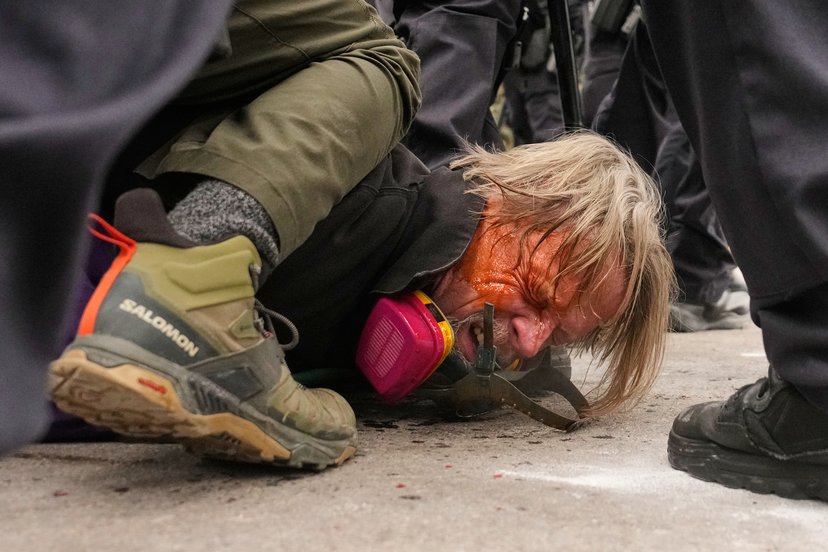
Federal agents hold photographer John Abernathy on the ground outside the Bishop Henry Whipple Federal Building in the Minneapolis, Minnesota, area on Jan. 15, 2026.
— AP Photo/John Locher“The smoke was so thick that I couldn’t breathe, and I was gagging,” Abernathy said. During the violent arrest, Abernathy tossed his camera to another photographer for safekeeping. The image captured by Pierre Lavie is worth checking out on Instagram.
Abernathy was later released and went to the hospital that evening for his wounds. He continues to face an obstruction charge.
There’s a lot to follow coming out of Minneapolis. As we focus on what’s happening to journalists there and across the U.S., use these filter links for the most recent data:
A shocking early-morning raid — and other search and seizures of journalists’ equipment
When federal agents executed a search warrant at the home of Washington Post reporter Hannah Natanson on Jan. 14, they seized her phone, two laptops and a smartwatch as part of a leak investigation. Natanson was not charged with a crime. But the seizure immediately disrupted her reporting, sweeping up confidential newsgathering material along with whatever evidence investigators were seeking.
Watch: Journalists attacked, raided and restrained — a dark January for aggressions against the press
Freedom of the Press Foundation
A federal judge has barred the government from searching the devices while litigation proceeds (the next hearing is scheduled for Feb. 20). The seizure itself, however, may have already had a chilling effect.
“Without access to my devices, I cannot contact my sources,” Natanson wrote in a court declaration. “Even if I am ultimately able to reconnect with my sources, there is a substantial likelihood that they will be deterred by the government’s seizure of my devices from communicating with me in the future.”
On the same day as the raid, the Post received a subpoena demanding it turn over communications between Aurelio Luis Perez-Lugones, a government contractor, and other employees. Perez-Lugones has since been charged with five counts of unlawfully transmitting classified national defense information. In a note to staff about the subpoena, Post Executive Editor Matt Murray called the FBI’s actions “provocative and aggressive” and said the outlet was “continuing to vigorously defend our journalists and our work.”
Journalists’ equipment searched or seized by law enforcement
Research from Tracker reporter Briana Erickson found that, since the database’s 2017 launch, the Tracker has recorded 122 incidents in which law enforcement searched or seized journalists’ equipment. While 54 occurred during protests, dozens of others unfolded far from protest lines — at reporters’ homes, in newsrooms, at courthouses, and at airports and border crossings.
The data shows a consistent pattern: Journalists’ equipment is often seized first — and in some cases held for months or years — while courts assess the legality of those seizures much later. In 14 cases, the seized equipment remains in government custody.
Law enforcement obtained search warrants just 17 times. Officers most often seized cellphones (63 incidents) and cameras (53 incidents) — the primary tools journalists use to communicate with sources and document events. Officers seized unpublished journalistic work product in 20 incidents.
Here are some notable search and seizure cases documented by the Tracker:
- In August 2023, Kansas police raided the offices of the Marion County Record and the home of its co-publishers, seizing computers, servers, cellphones and reporting materials as part of an investigation into alleged identity theft. Days later, the county attorney withdrew the search warrants. The city and county later agreed to more than $3 million in settlements to resolve lawsuits filed by the paper and its staff.
- The FBI raided the Florida home of independent journalist Tim Burke in May 2023, and seized virtually all of the electronics in his newsroom. He faces seven felony counts of conspiracy, wiretapping and violations of the Computer Fraud and Abuse Act.
- Police raided the home and office of freelance journalist Bryan Carmody with guns drawn as part of a leak investigation, seizing notebooks, computers, phones and cameras in May 2019. Multiple judges later ruled the warrants invalid, and the city of San Francisco agreed to pay a $369,000 settlement.
- Department of Homeland Security agents questioned journalists about their reporting and searched their phones at U.S. airports, including Australian writer Alistair Kitchen — who was deported after arriving in Los Angeles — and Palestinian American journalist Hebh Jamal in New Jersey.
- After investigative reporter Jeff German was murdered outside his Nevada home in September 2022, police seized his phone, computers and storage devices as part of the homicide investigation. Courts ultimately ruled that the state’s shield law protects journalists’ materials even after death, limiting how the devices could be reviewed.
Other notable updates
- After the Department of Defense announced plans to take over editorial decision-making for the military newspaper Stars and Stripes on Jan. 15, jeopardizing its long-held editorial independence, Editor-in-Chief Erik Slavin wrote to staff that the military deserves independent news. “The people who risk their lives in defense of the Constitution have earned the right to the press freedoms of the First Amendment.”
- A Nevada judge ejected Las Vegas Review-Journal journalists from the courtroom during testimony in a high-profile sexual assault trial in Las Vegas on Jan. 21 after they objected to the judge placing restrictions on media coverage, a prior restraint. The ejection (the reporters were later allowed back into the courtroom) followed an initial prior restraint by the judge a week earlier, which was modified after objections from the Review-Journal.