Incident details
- Updated on
- Date of incident
- June 8, 2025
- Location
- Los Angeles, California
- Assailant
- Law enforcement
- Was the journalist targeted?
- Unknown
Assault
- Equipment damaged
- Actor
- Law enforcement
Equipment Damage

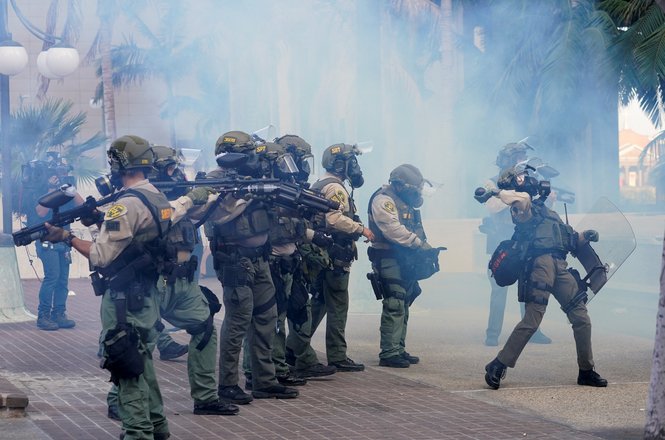
California National Guard members line up to face demonstrators during a protest against immigration raids in downtown Los Angeles on June 8, 2025. Reporter Jeremy Cuenca was struck and injured by impact projectiles while covering the event.
LAPD exonerates officer who nearly severed reporter’s fingertip at protest
A police officer who nearly severed photojournalist Jeremy Cuenca’s fingertip with a projectile while the reporter was covering a 2025 protest in downtown Los Angeles, California, was exonerated by the LA Police Department on June 23, 2026.
Cuenca, a photojournalist for the LA Community College newspaper Collegian, was documenting an anti-immigration enforcement protest in downtown LA on June 8, 2025. He was shot twice by crowd-control munitions, once in the leg and once on his finger, nearly severing his fingertip.
He told the Tracker at the time that surgeons managed to reattach the fingertip during what Cuenca described as a long and “tedious surgery process.”
The incident was submitted for review to the LAPD by Adam Rose, the LA Press Club’s press rights committee chair and deputy director of advocacy at the Freedom of the Press Foundation, of which the U.S. Press Freedom Tracker is a project.
A year later, the department informed Rose that the investigation was complete and that it had exonerated the officers involved.
In a letter, Chief of Police Jim McDonnell and Captain Andre Rainey said that the use of unauthorized force had indeed occurred, but that it was “justified, lawful, and proper.”
They also added that Rose’s allegation that the officer’s use of unauthorized force was informed by a perception of Cuenca’s political beliefs on immigration was classified as “insufficient evidence to adjudicate.”
Rose told the Tracker: “All too often, these reply letters say nothing about misconduct by officers but reveal a lot about bureaucratic incompetence at LAPD. Someone is sitting at a desk copy-pasting the same denial language even if it’s irrelevant.”
In the Cuenca case, Rose cast doubt on the LAPD’s exoneration, given that “their own lawyers previously admitted in court filings they couldn’t find video of the incident.”
“I probably wouldn’t be upset if they had closed that case with a finding of ‘insufficient evidence,’ but instead they seem happy to undermine their own credibility by insisting they’re somehow ‘exonerated.’”
Cuenca declined to comment for this story.
Reporter Jeremy Cuenca was struck by impact projectiles — first in the leg, then in the hand, nearly severing the tip of his pinkie — while covering an immigration protest on June 8, 2025, in Los Angeles, California.
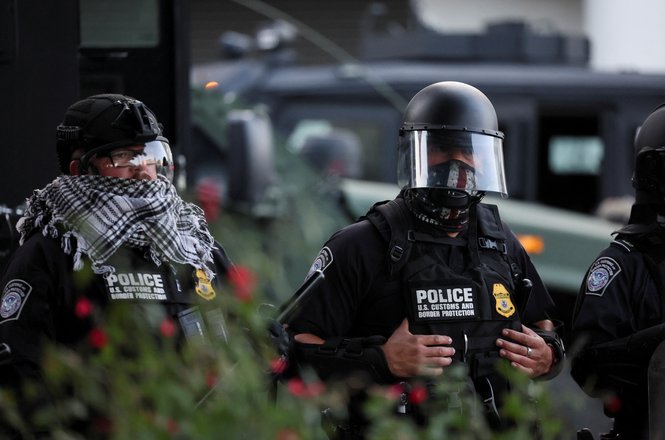
It was one of many protests that began June 6 in response to federal raids in and around the city at workplaces and areas where immigrant day laborers gathered. After demonstrators clashed with LA law enforcement officers and federal agents, President Donald Trump called in the California National Guard and then the U.S. Marines over the objections of California Gov. Gavin Newsom and LA Mayor Karen Bass.
On June 8, Cuenca, a recent graduate of Los Angeles City College, was eager to put his newly issued press pass to use and capture the unfolding events for the college’s newspaper, the Collegian.
“I felt compelled to go out and document what’s going on — especially because it’s targeting my community, the Hispanic and Latino community,” he told the U.S. Press Freedom Tracker.
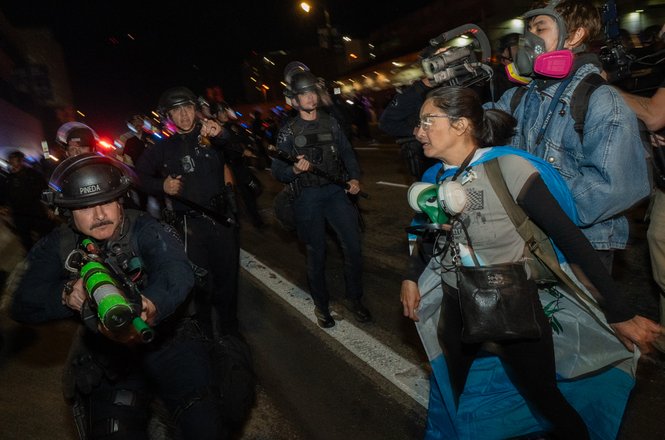
Outside the Metropolitan Detention Center in downtown Los Angeles, protesters gathered to support detained immigrants. Cuenca found himself on the sidelines, alongside other journalists with press credentials, caught between the crowd and a line of law enforcement officers clad in riot gear.
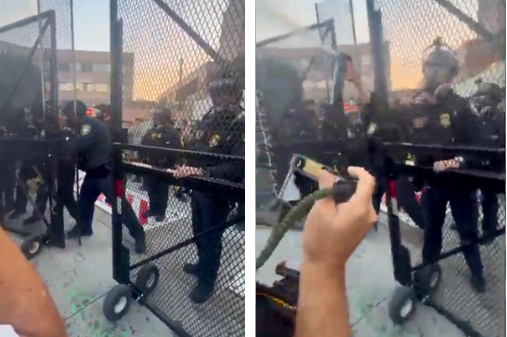
Suddenly, the Los Angeles Police Department began shooting off crowd-control munitions without any warning, Cuenca recalled.
“They just started firing tear gas and rubber bullets into the crowd, kind of endlessly, it felt,” he said.

The bruise left on reporter Jeremy Cuenca’s thigh after being struck by an impact projectile while covering an LA protest on June 8, 2025.
— SCREENSHOT COURTESY COLLEGIAN WIRED/JEREMY CUENCA VIA YOUTUBEThe dense crowd quickly descended into chaos — people were crying, choking and struggling to breathe, he said. As he tried to move away from the gas, Cuenca was struck in the leg by an impact projectile, leaving a deep bruise.
Moments later, another impact projectile hit his left hand while he was still gripping his camera.

Reporter Jeremy Cuenca’s damaged camera after it was struck by an impact projectile while he was covering an LA protest on June 8, 2025.
— SCREENSHOT COURTESY COLLEGIAN WIRED/JEREMY CUENCA VIA YOUTUBEA bystander quickly wrapped Cuenca’s injured finger in gauze before he was rushed to a nearby hospital. Surgeons managed to reattach the fingertip during what Cuenca described as a long and “tedious surgery process.”
“I’m just grateful that I was holding the camera, because it definitely could have been a lot worse,” Cuenca said.

Jeremy Cuenca’s left pinkie after it was struck by impact projectiles while covering an LA protest on June 8, 2025.
— SCREENSHOT COURTESY COLLEGIAN WIRED/JEREMY CUENCA VIA YOUTUBEThough he’s still healing, Cuenca has been hesitant to return to the hospital due to the high costs.
“It still hurts pretty bad,” he said. “I’m trying not to use my hand at all.”
Cuenca, who has an associate degree in psychology, said he is planning to enroll in journalism and photojournalism classes in the fall. Though the thought of returning to the field brings up some anxiety, he said the strong support he’s received from the community has helped him stay motivated to pursue journalism.
“This is really crucial right now. In this day and age, everyone has access to record with a microphone and a camera. No matter what’s going on in your community, it’s important to document everything around you,” Cuenca said. “All we have to protect ourselves is our own evidence.”
The LAPD did not respond directly to the Tracker’s request for comment but referred to a statement posted to its social media platform X, which said officers were responding to “significant acts of violence, vandalism, and looting.”
“Multiple deployments of less-lethal munitions were necessary to manage the crowds and prevent further harm to people or property,” the department said, adding that its professional standards bureau would be reviewing allegations of excessive force.
The U.S. Press Freedom Tracker catalogs press freedom violations in the United States. Email tips to [email protected].