Incident details
- Date of incident
- June 2025
- Location
- Multiple, California
- Targets
- Media

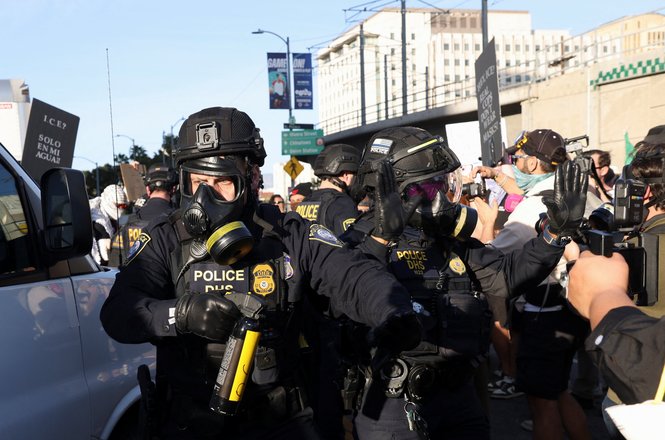
Police officers stand guard during an anti-deportation protest in Los Angeles, California, on June 9, 2025.
Federal immigration raids in early June 2025 in Los Angeles, California, sparked large and sometimes chaotic protests in and around the city. Journalists covering the demonstrations faced serious disruptions to their reporting — exposure to chemical irritants like tear gas or restricted access to certain areas.
Protests continued through September in LA’s downtown, near the Metropolitan Detention Center, where immigrants were being detained, and surrounding suburbs like Compton and Paramount. But the sweeping use of chemical irritants that marked the June demonstrations — including the June 14 protest criticizing Trump’s broader policies — subsided, according to the U.S. Press Freedom Tracker’s analysis of press freedom violations. By September, most chemical-irritant deployments occurred at similar protests in Illinois.
While these June incidents do not fall under the 11 types of press freedom violations formally cataloged for the Tracker database, we’ve provided a roundup of them below, organized by date and location. This roundup will be updated as additional incidents are verified.
Meanwhile, legal challenges stemming from law enforcement actions during the protests have yielded results for journalists. On Sept. 10, a federal judge issued two separate rulings — one against the Department of Homeland Security and one against the city of LA — granting preliminary injunctions in favor of journalists and the LA Press Club, declaring in one order: “The First Amendment deserves better.”
In December, a federal judge ordered the Trump administration to immediately end its current deployment of the California National Guard, ruling the federal government had illegally kept them in the city long after the protests ended.
A separate accounting of press freedom violations in which members of the press were assaulted, arrested or had their equipment damaged while covering these protests can be found here.
To learn more about how the Tracker documents and categorizes violations of press freedom, visit our FAQ page.
June 6, 2025
In Los Angeles
- Independent reporter Sean Beckner-Carmitchel told the Tracker he and other members of the press were caught in the crossfire of police actions, including tear gas. He said he was also shot with pepper balls and pepper-sprayed by federal officers that day.
- Jeremy Lindenfeld, a journalist reporting for news nonprofit Capital & Main, told the Tracker he was exposed to tear gas while reporting. The air was thick with it as federal agents advanced, he said, adding, “It was an incredibly chaotic scene.” He was also hit with multiple pepper balls that day.
- Freelance photojournalist Mykle Parker told the Tracker she was exposed to tear gas and pepper spray deployed by Department of Homeland Security agents outside the Metropolitan Detention Center, including by one agent who aimed a projectile launcher at her. “I had to back up and get as far away as I could, while I was coughing and continuing to cover the scene,” she said, adding that she ultimately left because she lacked protective gear.
- Freelance photographer Ethan Noah Roy told the Tracker he was exposed to tear gas. Federal officers also shot at him with pepper balls that day, including while he was holding his hands up and identifying himself as press.
June 7, 2025
In Los Angeles
- Reporter Mekahlo Medina and his KNBC television crew were affected by tear gas in a crowd mixed with Los Angeles police and federal officers, the outlet reported. They were also struck that day with pepper balls.
- Lauren Pozen, a reporter for KCBS-TV/KCAL-TV, was hit with tear gas and temporarily blinded while reporting on protests against Immigration and Customs Enforcement raids. While on air, she reported: “We have tear gas, we have fireworks going off, tear gas is in the air, people are dispersing. I can’t see anything. I’m sorry, I can’t see anything.” Pozen kept coughing until the broadcast switched to aerial footage from a helicopter. She came back on air about three and a half minutes later. “My back was turned to the camera and all of a sudden, we heard that big boom. And, of course, that was a massive amount of tear gas,” she said.
- Videographer Rocky Romano of Winters Rock Entertainment said he was hit with tear gas deployed by federal agents. In footage he shared with the Tracker, he can be heard coughing violently as tear gas fills the air. “It was almost impossible to stay out and keep filming because the gas was insanely bad,” he said. That day, he was also struck with pepper balls.
- Freelance journalist Joey Scott told the Tracker he was exposed to tear gas when a canister landed at his feet. “It was just all over the place, and it’s just hard to report in those moments,” he said. He was also nearly struck by a flash-bang grenade fired by federal officers that day.
In Paramount/Compton
- Photojournalist Jonathan Alcorn said in court records that he was exposed to intense tear gas. A federal agent also shot him near the elbow that day, causing a hematoma and burn on his arm, according to a court complaint.
- Jon Baird, a reporter at KNX-FM, was affected by tear gas fired by law enforcement. In a Facebook video posted by KNX News, Baird describes the moment officers fired it into the crowd. “I could hear the pop pop pop from the tear gas canisters going off,” Baird said. “When I first got there, people came running back and the tear gas formed this big cloud. And then it would dissipate, and they would all go back. My eyes were really burning; somebody stopped to help me wash them out.”
- Independent journalist Sean Beckner-Carmitchel and Ryanne Mena, a reporter for the Los Angeles Daily News, were surrounded by tear gas. Mena told the Tracker it was particularly debilitating because she has asthma. Mena and Beckner-Carmitchel later sued the Department of Homeland Security after Mena was assaulted by federal agents on June 6 and June 7, and Beckner-Carmitchel was struck in the head with a tear gas canister.
- Journalist Ben Camacho, co-founder of The Southlander, told the Tracker he was exposed to tear gas deployed by the Los Angeles County Sheriff’s Department. He was also shot twice with crowd-control munitions that day and later sued the department and its sheriff.
- An unmarked KTTV news vehicle was damaged and vandalized, journalist Matthew Seedorff reported in an Instagram video. Seedorff said the tires were slashed, the windshield and windows broken, and personal belongings were stolen. In the footage, the words “FUCK ICE” can be seen spray-painted across the side of the vehicle.
- Jeremy Lindenfeld, a journalist with the news nonprofit Capital & Main, told the Tracker he was exposed to tear gas fired by federal agents. He was also struck with a projectile that day.
- Student reporter Joe Trujillo was exposed to tear gas fired by the LA County Sheriff’s Department, he wrote in a column for Fullerton College newspaper The Hornet: “Teargas made me cough for a week.”
- A freelance photographer, who asked not to be named due to fear of legal trouble when traveling abroad, told the Tracker he was affected by tear gas fired by the LA County Sheriff’s Department. He was also struck in the face with projectiles at the protest, suffering a hematoma and requiring stitches.
June 8, 2025
In Los Angeles
- An unidentified photojournalist from The Associated Press ducked for cover just before a police crowd-control munition landed nearby, according to video footage posted to YouTube. The Tracker was unable to identify the journalist or determine whether or not they were deliberately targeted.
- Gabriela Bhaskar, a photojournalist for The New York Times based in LA, was affected by tear gas fired by federal officers, according to the Los Angeles Times and as shown in a photo in the Boyle Heights Beat.
- LA Police Department officers explicitly ordered members of the press to leave the area during a protest, in violation of a California law that, in part, largely shields them from dispersal orders. In a video shared by journalist Sean Beckner-Carmitchel, armed officers, some wielding batons, can be heard shouting, “Leave the area!” “Media, go!” and “Get out of here!” as they patrolled the scene. In another video posted by Beckner-Carmitchel, National Guard troops fire crowd-control munitions and spray what appears to be a chemical irritant toward a group of both demonstrators and press.
- Reporter Constanza Eliana Chinea posted to Instagram a video showing her and other members of the press sequestered behind a skirmish line of LAPD officers, unable to cover the protest happening in front of them. She said the press was pushed and threatened with arrest for not complying, and that she came “incredibly close” to being struck by crowd-control munitions.
- Reporter Jeremy Cuenca told the Tracker he was exposed to tear gas fired by the LAPD. As he tried to move away from the gas, he was also struck in the leg and hand with police projectiles, nearly severing the tip of his pinkie.
- Pete Demetriou, a reporter for radio station KNX-FM, was tear-gassed by National Guard troops while covering a demonstration downtown. “You’ve got a mist and then all of a sudden, you got a white cloud of smoke coming at you,” Demetriou told KNX News. “Your eyes close, your nose shuts down, your throat locks up. You can’t do anything but try to struggle to breathe.” He was also struck in the leg with a crowd-control munition that day.
- Photojournalist Benjamin Hanson, on assignment for Middle East Images and Royol News, was tear-gassed by California Highway Patrol while covering an ICE protest on the freeway. “I was able to get out before it harmed me,” he told the Tracker. “I was just part of the large crowd.”
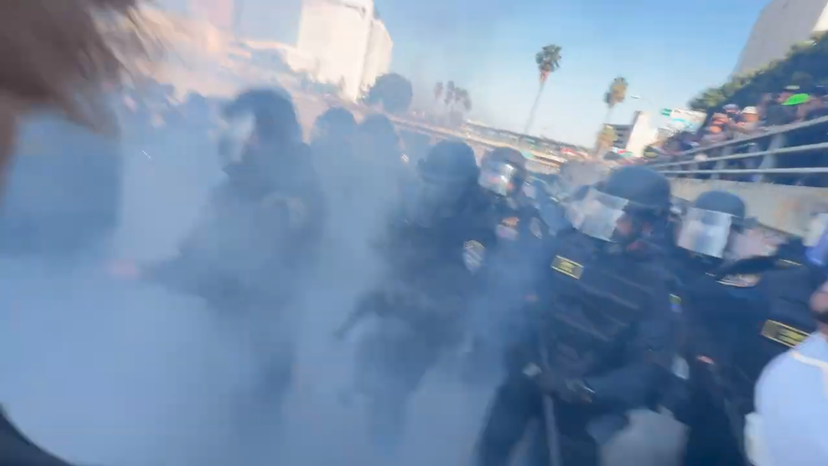
A video still captures the moment California Highway Patrol released tear gas into the crowd during a protest on June 8, 2025. Photographer Benjamin Hanson was among those affected by the chemical irritant.
— SCREENSHOT VIA BENJAMIN HANSON- Photographer J.W. Hendricks, while on assignment for CalMatters, told the Tracker he and two other journalists found themselves caught between two LAPD skirmish lines as officers tried to push back protesters. Hendricks said he and his colleagues identified themselves as press, but officers repeatedly refused to lower their projectile launchers and warned them not to cross certain areas, even when they went the direction they were told to go. “They wouldn’t lower their weapon,” he said. “I was screaming, ‘Do not shoot us. We are press.’”
- Reporter Michael Monks, of local AM station KFI, was live on the air while caught by tear gas in a crowd that included National Guard troops, and said in a broadcast that his eyes were burning and he was coughing. He lost signal later that day and reported through his cellphone to convey the scene in the streets to the studio. “All of us got tear-gassed,” he said of media members, who were temporarily blinded and choking.
- James Queally, a reporter for the Los Angeles Times, filmed as federal officers began deploying tear gas and smoke grenades into the crowd around the Metropolitan Detention Center. In a post on social media, Queally wrote that the use of force was an apparent effort to make a “clear path for a convoy of DHS/Border Patrol vehicles.” He noted that he was affected by the chemical irritants, but was fine after rinsing his eyes.
June 9, 2025
In Los Angeles
- Photographer J.W. Hendricks, on assignment for CalMatters, told the Tracker an LAPD officer wrongly identified him as a protester and ordered him to leave. When Hendricks told him that press was exempt from dispersal orders, the officer insisted Hendricks was with two protesters who had briefly walked beside him, despite him clearly wearing press identifiers and gear. “Did you just assume that I was with them because I was standing next to them?” Hendricks asked. “Yes,” the officer replied.
- During a Fox News broadcast, journalist Jonathan Hunt reported that law enforcement fired flash-bang grenades at his crew’s vehicle — which may have been unmarked — as it approached a police roadblock around 3 a.m., even though a member of their security team flashed a law-enforcement-issued press badge. One of the crowd-control munitions landed a few yards away. “These guys were not playing around this morning,” Hunt said. “The simple answer to us approaching that roadblock was: ‘Don’t even dare. Get back.’ That’s how tense the situation is in LA today.”
- Anna Moltke, an independent photographer, told the Tracker that she was affected by chemical irritants deployed by law enforcement. Also that day, she was shot in the helmet with an impact projectile.
- Independent photographer Victor Montiel and a friend were exposed to tear gas fired by police while covering a demonstration downtown. “We felt the burn,” he said.
June 10, 2025
In Los Angeles
- Australian Broadcasting Corporation’s North American correspondent Lauren Day told The Guardian that she had been impacted by police actions while reporting on the protests. Day said she “felt the unmistakable burn of tear gas - first in my eyes, then in my nose, lips and throat,” the outlet reported.
- A LAPD officer forcibly removed journalist Tina-Desiree Berg of Status Coup from reporting in an area she had a legal right to be. In a video posted by Status Coup, Berg pushed back against the order. “They don’t abide by the state law, and they’re police,” she said.
- Reporter Lauren Day and an anonymous photojournalist who was part of her crew were both exposed to tear gas while filming a standoff between law enforcement and demonstrators. They suddenly heard bangs and “were overcome with the impacts of tear gas,” Day told the Tracker. The photojournalist was also struck with munitions that day.
- In a CNN live broadcast, senior correspondent Kyung Lah was separated from part of her crew as LAPD officers cleared the street near the detention center. An officer said, “He doesn’t come through. You do.”
- Gabriel Ovalle, an editor and camera operator for digital media outlet Channel 5, told the Tracker he had “temporary discomfort” from tear gas that was fired by the LAPD during a protest downtown. Ovalle was also struck with a crowd-control munition that day.
- Joe Trujillo, a student reporter for Fullerton College’s The Hornet, wrote in a column that while trying to film arrests of demonstrators, he was blocked by police officers forming barriers with batons drawn. “In that highly charged moment, with more than a hundred officers in arrest mode, I stepped back,” he recounted. “No photo was worth escalating the tension.”
June 11, 2025
In Los Angeles
- Journalist Kate Burns of Left Coast Right Watch told the Tracker that law enforcement officers said they didn’t care if she was a member of the press, and that she was exposed to tear gas and pepper spray but not deliberately targeted.
June 12, 2025
In Los Angeles
- Independent photographer Anna Moltke told the Tracker that she was affected by chemical irritants deployed by law enforcement downtown. Also that day, she was pushed to the ground by a federal officer.
June 14, 2025
In Los Angeles
- Journalist Kate Burns of Left Coast Right Watch told the Tracker she was exposed to tear gas and pepper spray fired by law enforcement.
- Ethan Cohen, a student photojournalist for California State University’s Long Beach Current, told the Tracker that he was affected when LA County Sheriff’s deputies fired tear gas and other chemical irritants, such as pepper spray and pepper-ball canisters, at him and other journalists. “There were many spots where you couldn’t really escape,” he said. He was also struck in the arm by a piece of shrapnel from a flash-bang grenade at protests that day.
- KNX radio reporter Craig Fiegener was exposed to police tear gas, the outlet reported on Facebook. In a video posted to the platform, Fiegener said his throat was impacted by the chemical irritant.
- Freelance photojournalist Benjamin Hanson told the Tracker he was exposed to tear gas in a crowd that included both sheriff’s deputies and police officers. “I don’t think I was targeted, just happened to be in the crossfire,” he told the Tracker.
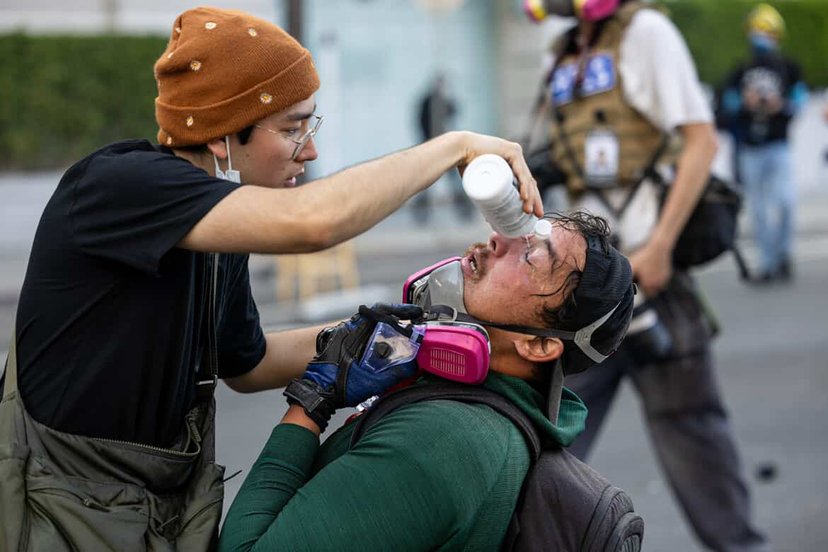
- Freelance reporter Eric Levai reported on the social platform Bluesky that he was caught in tear gas fired by law enforcement near the downtown courthouse. “I was covering the protest in LA wearing clearly marked press credentials,” he wrote.
- Jeremy Lindenfeld, a journalist reporting for news nonprofit Capital & Main, told the Tracker he was pushed by an LAPD officer on horseback as police moved the crowd. Lindenfeld said, “It definitely wasn’t a gentle suggestion,” but wasn’t sure whether it constituted an assault.
- Kayjel Mairena, a student journalist for Santa Monica College’s The Corsair, told the Tracker he was twice exposed to tear gas deployed by the LA County Sheriff’s Department.
- Independent photographer Anna Moltke told the Tracker that she was affected by chemical irritants fired by law enforcement. Also that day, she was pushed by an LAPD officer.
- Student photojournalist Griffin O’Rourke, on assignment for California State University Northridge’s the Daily Sundial, was affected by tear gas after a canister fired by a sheriff’s deputy landed beside him. “I could hardly see because my eyes were tearing up so badly,” he said, adding that he needed to wash the irritant from his eyes and that nearby flash bangs made his ears ring. Amid the chaos, he was also hit in the leg with a crowd-control projectile. Later, law enforcement aimed projectile launchers at him despite his visible press helmet and badge.
- Videographer Rocky Romano of Winters Rock Entertainment told the Tracker he was inundated with tear gas fired by law enforcement. He said the chemical irritant had burned his skin, and he had difficulty breathing in the moments afterward.
- Freelance photographer Ethan Noah Roy told the Tracker he was exposed to tear gas in a crowd that included both sheriff’s deputies and police officers, and had to flush his eyes of the chemical irritant. He was also shot with a pepper ball in the midst of the chaos that day.
- Tod Seelie, a freelance photojournalist, told the Tracker he was affected by tear gas while documenting a protest in an area with sheriff’s deputies, demonstrators and other members of the media. That day, he was also shoved by police, attacked by a group of people at the protest and struck by a crowd-control projectile.
- Freelance journalist Solomon O. Smith told the Tracker he was exposed to tear gas fired by sheriff’s deputies. “It makes you, as a reporter, reevaluate how much danger you want to put yourself in,” he said. That day, he was also struck with crowd-control munitions.
- Freelance photojournalist Madison Swart told the Tracker she was exposed to police-fired tear gas and became separated from other members of the press while reporting. Also that day, she was shot with multiple crowd-control munitions, including a tear gas canister.
- Michelle Zacarias, a reporter for Caló News, told the Tracker she was exposed to tear gas and dodged police crowd-control munitions after officers on horseback deployed them into the crowd without a clear dispersal order. “I managed to get out of the line of scrimmage but was pushed and shoved as people began to panic,” said Zacarias, who fled on foot.
- A freelance photographer, who asked not to be named due to fear of legal trouble when traveling abroad, told the Tracker he was tear-gassed by law enforcement.
The U.S. Press Freedom Tracker catalogs press freedom violations in the United States. Email tips to [email protected].