Incident details
- Date of incident
- May 2026
- Location
- Newark, New Jersey
- Targets
- Media
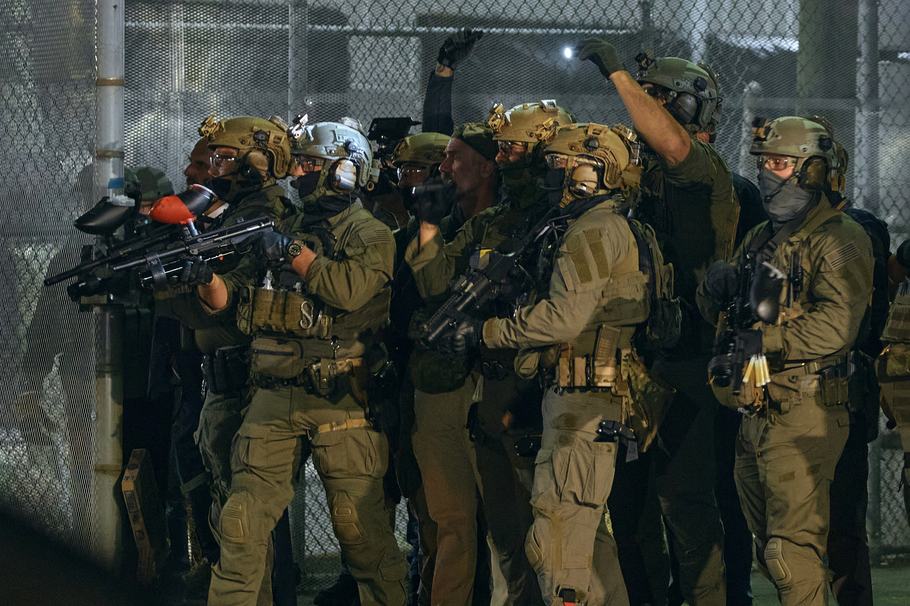
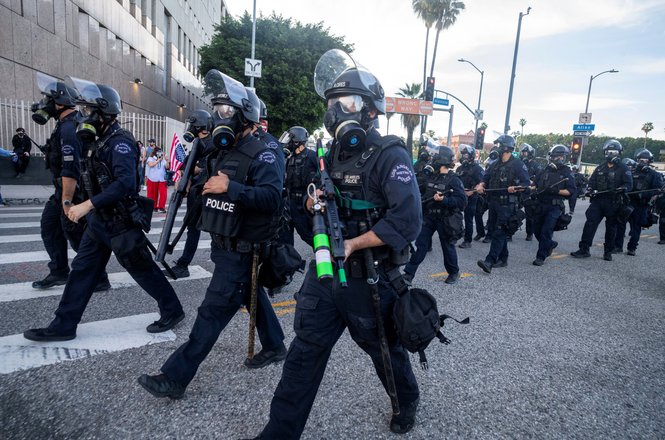
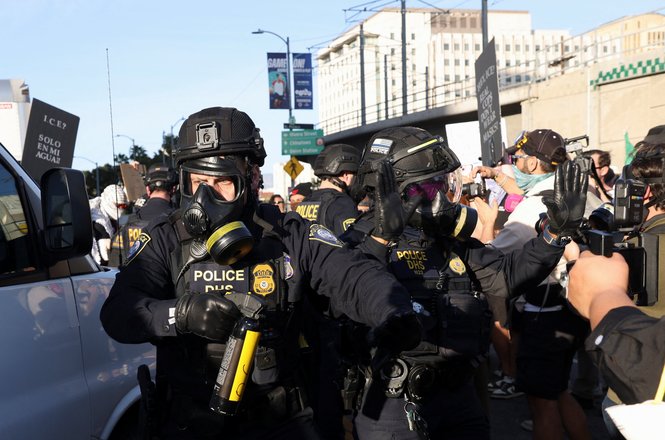
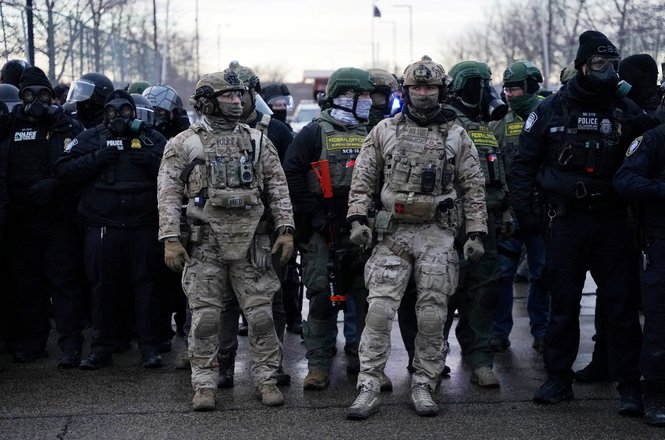
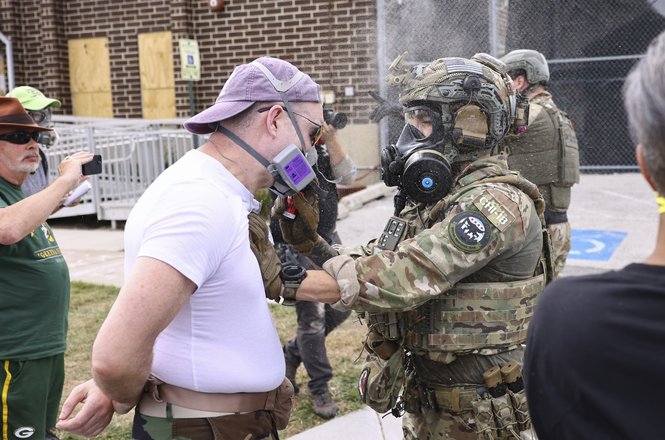
Federal agents armed with crowd-control weapons aim at protesters outside the Delaney Hall immigration detention center during a demonstration on May 29, 2026, in Newark, New Jersey.
Protests broke out in late May 2026 in Newark, New Jersey, outside the Delaney Hall immigration detention facility, when many detainees went on a hunger strike. Members of Congress, state and local lawmakers and rights groups have alleged dire conditions at the facility. The Department of Homeland Security has denied the allegations of detainee mistreatment.
Federal officers and then state and local police responded to the protests with chemical irritants, physical force and arrests.
Journalists on the ground described being exposed to chemical irritants fired by Immigration and Customs Enforcement officers and New Jersey State Police, being forced to pull back from the protest area and otherwise being impeded from documenting the protests.
Although these incidents do not constitute official press freedom violations under the U.S. Press Freedom Tracker’s criteria, we’ve provided a roundup of them below, organized by date (our reporting on the formal press freedom violations we cataloged in Newark in May and June is here).
This roundup will be updated as additional incidents are verified. To date, law enforcement agencies have not responded to multiple requests for comment.
To learn more about how the Tracker documents and categorizes violations of press freedom, visit our FAQ page.
May 26, 2026
- Ben Ackman, on assignment for the New Jersey Monitor, told the Tracker he was indirectly exposed to pepper spray used by ICE and was unable to work for about 30 minutes while flushing the irritant from his eyes. Also that day, he was shoved by an agent.
- Photographer David “Dee” Delgado, who was on assignment for Reuters, told the Tracker he was hit by pepper spray after a federal officer indiscriminately sprayed the crowd during an ICE charge toward a line of protesters. “He was just spraying everybody; it didn’t matter who.” Earlier that day, Delgado was deliberately pepper-sprayed by an officer.
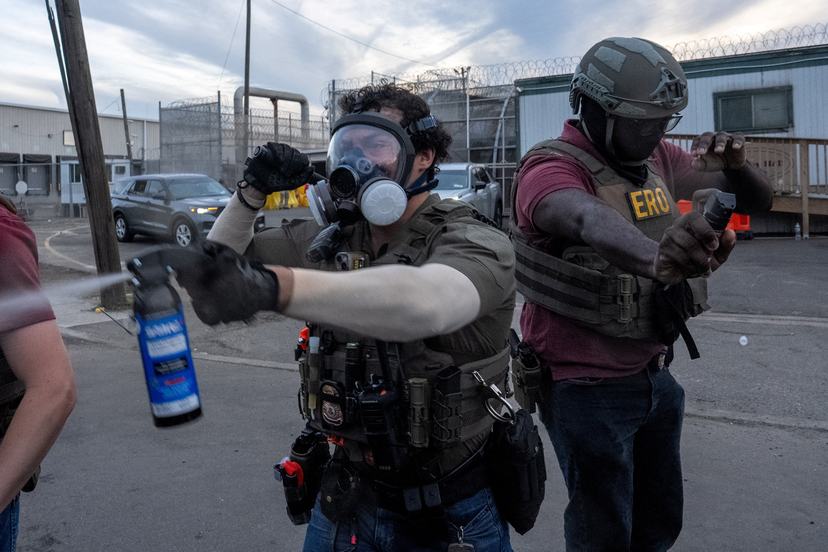
A federal officer, at left, sprays a chemical irritant during an immigration protest outside a detention facility in Newark, New Jersey, on May 26, 2026. Photojournalist David “Dee” Delgado was pepper-sprayed while covering the demonstration.
— REUTERS / DAVID “DEE” DELGADO- Freelance journalist Amanda Moore told the Tracker she was sprayed by a chemical irritant during her evening coverage, causing measurable pain. Moore, who didn’t believe she had been targeted, said federal officers were spraying “super powerful crowd-control spray on individuals.” Later that day, a federal officer pointed a Taser at her while in pursuit of a protester.
- Multimedia journalist Oliya Scootercaster posted a video on Instagram of a federal officer pepper-spraying a crowd, the irritant wafting toward her camera.
- Freelance photojournalist Christian Vazquez told the Tracker that while he was documenting the protest, ICE agents called out to him and other journalists by name, reading from their press credentials, in what he described as an “intimidation tactic.”
May 27, 2026
- EPA Images photojournalist Olga Fedorova was repeatedly pepper-sprayed while covering demonstrations that day. “Because I would get pepper-sprayed three or four times through the day or through the night,” Fedorova said, “when I took off my PPE whatever was left on my skin from that — even though I was super careful — left me instantly blinded just from the sheer quantity of it.” Also that day, she was threatened with batons and knocked to the ground multiple times by ICE officers, and her lens filter and gas mask were damaged in the process.
- Photojournalist Stephanie Keith told the Tracker that an ICE agent raised his baton at her as she was photographing him. “He lifted up the baton like he was going to bring it down like straight smack down on the top of my head.”
- Freelance photojournalist Edna Leshowitz took several photos showing a federal officer shining a light into her camera lens. She told the Tracker it felt deliberate. That day, she was also trampled and injured.
- Photojournalist Ryan Murphy, on assignment for Reuters, told the Tracker that he was caught up in pepper spray fired into the crowd by ICE officers. And in images he filed with the wire agency, a federal officer can be seen shining a high-powered light directly into his lens, a tactic reported by multiple other journalists. Also that day, he was hit with a police baton and deliberately sprayed with the chemical irritant.
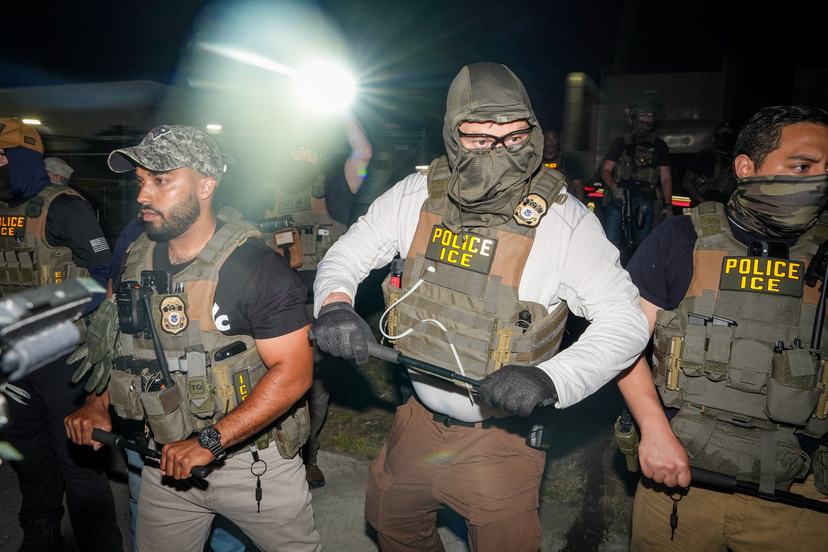
ICE agents during a protest outside an immigration detention facility in Newark, New Jersey, on May 27, 2026. One officer shines a light into photojournalist Ryan Murphy’s camera as he captures the photo.
— REUTERS / RYAN MURPHY- Photojournalist Cristina Panagi told the Tracker that pepper spray fired into the crowd by ICE seeped beneath her protective goggles and caused her forehead to burn. Also that day, she was pushed by an ICE officer.
- Videographer Theoren Papp, of Level 12 Productions, told the Tracker that he was affected by pepper spray deployed by ICE. “It got in my eyes pretty decently,” said Papp, who doesn’t think the irritant was aimed at him, though he had to briefly shut down his livestream to recover.
- Multimedia journalist Oliya Scootercaster posted a video on Instagram of an ICE agent dispensing pepper spray in her direction. In other videos posted that day, she was continuously exposed to chemical irritants.
- Independent reporter Yaakov Strasberg told the Tracker that he was affected by pepper spray fired by federal officers that still lingered in the air.
May 28, 2026
- Photojournalist Mostafa Bassim of Turkey’s Anadolu Agency told the Tracker that he was affected by chemical irritants sprayed indiscriminately by ICE officers outside the facility. He added that as soon as he arrived at the detention center, federal officers began shining high-powered lights directly at him. Later that day, an officer struck Bassim’s camera with a baton, splitting his lens in half.
- Michael Karas, a photo and video journalist for NorthJersey.com, was threatened with a chemical irritant by a federal agent while documenting the protest, as shown in a photo posted by the outlet and on his Instagram.
- Photojournalist Angelina Katsanis, on assignment for The Associated Press, was pepper-sprayed in the face by an ICE officer while documenting the protests, according to an online fundraiser posted on her behalf. Two days later, she was hit in the knee with a wooden board and had her gear bag stolen by a police officer while covering the protests.
- Photojournalist Stephanie Keith told the Tracker she was hit with an irritant that ICE deployed into the crowd. “It was like a garden hose worth of pepper spray on everybody.”
- Dean Moses, amNewYork’s police bureau chief and resident photographer, was struck by pepper spray fired by an ICE officer, the outlet reported. Moses told the Tracker that it was “very hard to know for sure” whether the officer targeted him as a member of the press. “It was so chaotic.”
- Photojournalist Ryan Murphy, on assignment for Reuters, told the Tracker that an ICE officer pointed a Taser directly at him. Also that day, he was hit in the hand with a baton, needing stitches.
- Freelance photojournalist Ian Peters told the Tracker that ICE agents shined their flashlights at his camera while he was taking pictures.
- Independent reporter Nick Valencia told the Tracker that he received a notification that an Apple AirTag, a type of tracking device, had been traveling with him while documenting the protest. “I should not have my footsteps tracked for six hours unless someone was doing something nefarious,” said Valencia, who never found a physical AirTag on his person.
- Freelance photojournalist Christian Vazquez told the Tracker that while documenting the protest in the afternoon, an ICE agent pushed a protester into him, and he suffered a minor scrape. In the evening, he was exposed to chemical irritants that ICE agents fired “randomly.” He said the irritant got through a hole in his goggles and hit his left eye, and that he was treated by medics who flushed his eyes. He described that experience in a video posted on Instagram.
- Stephen Yang, on assignment for the New York Post, told the Tracker he was also affected by the chemical irritant. “I’m still getting the pepper spray out of my equipment and clothes and bag.”
- An anonymous photojournalist told the Tracker they were sprayed with a chemical irritant while covering the protest that night, but could not say whether it was targeted. Later that night, a federal officer struck the photojournalist’s camera with a baton, smashing its flash transmitter.
- An independent photographer, who also asked to remain anonymous, told the Tracker that as they were documenting the protest, an ICE officer doused them with pepper spray that he fired indiscriminately. “I had goggles on and a mask, but that stuff goes everywhere,” the photographer said.
May 29, 2026
- Status Coup photojournalist Will Allen-DuPraw told the Tracker he was exposed to multiple crowd-control munitions, including tear gas and stun grenades, while covering the protest. Officers also struck him and shoved him back with their riot shields as he was documenting an individual’s arrest.
- New Jersey State Police ordered a three-member WNBC television news crew — reporter Checkey Beckford and two photojournalists wearing press credentials — out of their marked news vehicle and into a cloud of tear gas, Beckford reported. The police pulled one of the photojournalists out of the car.
- Freelance photojournalist Bruce Cotler told the Tracker that federal officers shined a bright light in his lens to prevent him from taking photos. Also that day, he was affected by tear gas and pepper spray and pushed over a concrete barrier.
- Status Coup photojournalist Jon Farina told the Tracker that he was filming as mounted state police officers advanced into the crowd, using the horses to “sideswipe” individuals and push everyone onto the sidewalk. “We’re backing up and scrambling, and then I had to duck under the horse’s head, because the horse’s head was coming right at me,” Farina said. “But my camera’s on the tripod, so it was above me and the horse’s head smacked right into my camera. My camera did a 360 and I mean it was freaking cartoonish.” He added that he was uninjured and the camera sustained no damage. Both Farina and Status Coup reporter and CEO Jordan Chariton were also targeted with crowd-control munitions that night, including stun grenades and tear gas.
- Freelance photojournalist Q. Sakamaki posted an image to Instagram in which a federal officer can be seen shining a bright light directly into his camera lens, a tactic that multiple journalists have said ICE officers used. A second officer appears to be making eye contact with the photojournalist as he aims a crowd-control weapon toward protesters and journalists.
- Independent reporter Nick Valencia told the Tracker that strong chemical irritants seeped under his gas mask and caused him to violently choke, which he captured on Facebook. He said state police also pointed their crowd-control munition launchers at him, fired a flash bang at him and pushed him.
- Freelance video producer Anita Wise told the Tracker that she was documenting the peaceful protest when suddenly, after dark, the state police came out shooting pepper balls and chemical irritants, and being “very aggressive.” She said she had to run away from the gas, adding, “I was just shocked; it was really absurd, especially when the protesters weren’t doing anything. And so for that reason, I came back Saturday, and I came back Sunday.” On Sunday, May 31, Wise was violently arrested while covering the protest.
- Stephen Yang, on assignment for the New York Post, said that he was affected by tear gas deployed by law enforcement while documenting the protest. “The tear gas certainly was very effective at stopping me from doing my job intermittently throughout that night.”
May 30, 2026
- Photojournalist Neil Constantine, who was on assignment for NurPhoto Agency, told the Tracker he was caught in tear gas several times and affected by the residue from pepper ball rounds being shot near him. State police also targeted him and another journalist with stun grenades and possibly tear gas as well.
- Documentary photographer Adriano Kalin told the Tracker that the excessive tear gas deployed by New Jersey State Police got in his eyes and mouth. “I can’t breathe,” he said, coughing, in a video he posted that day on Instagram. An officer also fired a flash-bang grenade at him; it landed near his feet.
- Independent reporter and photojournalist Wali Khan told the Tracker he was subjected to extensive tear gas deployed by state police. Officers also shot at him with multiple stun grenades.
- Andres Kudacki, a photojournalist on assignment for The Associated Press, posted on Instagram that while covering the demonstrations, his “mask and goggles became saturated with tear gas.”
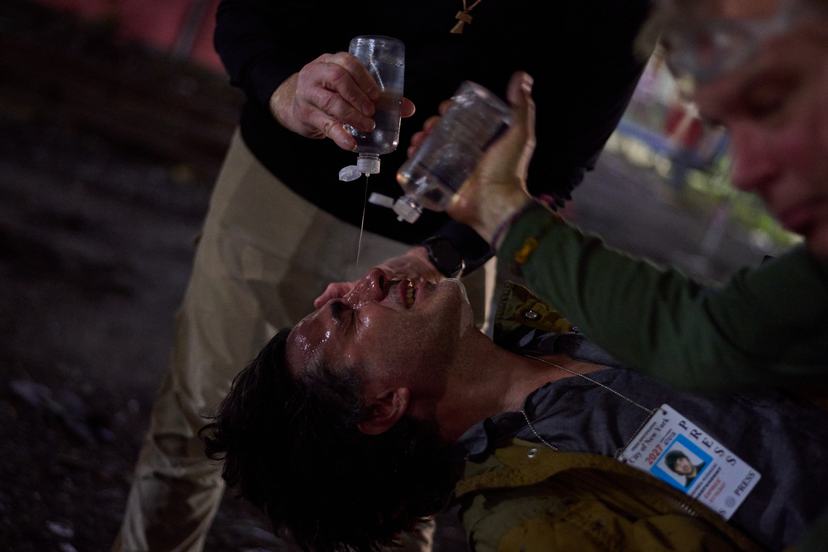
Freelance photojournalist Andres Kudacki has his eyes rinsed out after his mask and goggles became saturated with tear gas while covering protests outside a detention center in Newark, New Jersey, on May 30, 2026.
— COURTESY EDNA LESHOWITZ- Freelance photojournalist Edna Leshowitz said tear gas fired by state police repeatedly burned her eyes, despite wearing protective gear. A flash-bang grenade also landed on her head. “You don’t have a lot of time to recover in between, and it was one after another.”
- Freelance photojournalist Christian Vazquez told the Tracker that he was reporting as New Jersey State Police in riot gear responded to the protest in the late evening, and the situation “went from zero to 100 real quick.” The police fired chemical irritants to disperse protesters, and even though he was standing back and wearing goggles and a KN95 mask, the gas got into his airway and he started coughing. He said he was forced to flee the scene. “They didn’t care who they were aiming at,” he said. “They didn’t give any warning to disperse. It just happened.”
- MS NOW reporter Ali Velshi and his news crew were reporting live on the large law enforcement presence outside Delaney Hall when a Newark police officer ordered them to move back from the facility. Velshi can be heard asking how far they need to move, to which the officer responds, “You have to push out all the way back.” Velshi replies, “Unfortunately we won’t be able to cover it if we go that far back.” Seven officers then form a loose line and are later joined by others to ensure that Velshi and his crew continue to move back. “We’re not doing anything to impede law enforcement nor do we wish to,” Velshi says to the audience. “But as you can see, the police are taking removing the press from the scene very, very seriously.”
- An independent photographer, who asked to remain anonymous, told the Tracker that they were documenting the New Jersey State Police responding to the protest when they were hit with a chemical irritant. “In the melee, my mask came off,” the photographer said, “So I was blinded. It was terrible.” They added that the state police were firing pepper balls and flash grenades in front of the crowd, and tear gas behind them, “backing us into the tear gas.” The photographer described the scene as “like a war zone.”
May 31, 2026
- Independent photojournalist CS Muncy wrote on Instagram that his vision was affected by a chemical irritant while documenting the protest. “With the CS gas still in my eyes, I wasn’t even sure I was focusing properly,” he said, referring to a type of tear gas.
- Journalists Will Allen-DuPraw, Jordan Chariton, Jon Farina, Josh Pacheco, David Snow and Stephen Yang told the Tracker they were caught up in a police kettle, unable to leave, for roughly 10 minutes before officers announced that credentialed press had one chance to leave or face arrest. Officers arrested at least three journalists from the kettle.
- Yang, on assignment for the New York Post, told the Tracker that Newark police officers blocked him and other members of the press from freely covering the protest for about 20 minutes. “They held us at a distance to where we could not see what was going on,” he said. “They’ll say it’s for safety, but really what they’re doing is they’re restricting press access.” Status Coup photojournalist Allen-DuPraw said they were held approximately 150-200 feet back from the officers as they continued to make arrests. “By being pushed back in that way, like to such a high degree, we were hindered from continuing to actually report on what was happening and make as accurate a record as possible,” he told the Tracker. Another Status Coup photojournalist, Farina, told the Tracker that he, the outlet’s CEO Chariton and others were then ordered to move even further back. Farina asked why and, when an officer couldn’t provide a reason, Farina said he told him, “Nope, we’ll stay right here. We’re just going to keep working.” The officers were told over the radio to use force if necessary, but Farina warned them it would be “a big story” if they did so. The officers ultimately backed down.
June 2, 2026
- Journalist Jessica Formoso reported that she and her WNYW news crew were harassed and insulted by a man while reporting from outside Delaney Hall ahead of the Newark mayor’s news conference.
June 5, 2026
- Multiple members of the press — including photojournalists Adriano Kalin and Wali Khan, and a photojournalist for the New Jersey Monitor — reported that the Newark police prevented them from carrying bags or wearing critical personal protective equipment within a perimeter established around Delaney Hall. “If we don’t have PPE, we can’t do our job as journalists,” Khan told the Tracker. Freedom of the Press Foundation, of which the Tracker is a project, also condemned the ban. “These bans are dangerous, most importantly to journalists’ physical safety. But they also harm the public’s right to know,” wrote Senior Advocacy Adviser Caitlin Vogus. “When reporters can’t safely remain at a protest, the public loses access to independent documentation about what happened there.”
- Freelance photojournalist Ian Peters told the Tracker he was affected by pepper spray fired by employees of The Geo Group, the operator of the private detention facility. “It was just spicy,” he said of the irritant, which got in his eyes and mouth.
- Videographer David Snow told the Tracker he was affected by pepper spray fired into the air by The Geo Group. “They were just carelessly spraying it as they were exiting the facility in their vehicles,” said Snow, who was coughing and had difficulty breathing and seeing for several minutes. Later, Newark police blocked him from reentering the protest with his camera bag and gas mask.
June 6, 2026
- Freelance photojournalist Tom Hudson reported on social media that he had parked his car — clearly marked with “PRESS” in all caps on the side — in a location approved of by a police captain when he arrived at 9 a.m. that morning. Approximately 11 hours later, Hudson said, they took shelter in the car from a thunderstorm when suddenly dozens of law enforcement officers gathered around the vehicle and ordered him and Status Coup photojournalist Jon Farina to move their vehicles under threat of being towed or facing arrest. “They’re making it up as they go along, just like they were trying to restrict press from bringing their backpacks,” Hudson said. “They do not want cameras watching what they’re doing.”
- Independent journalist Marcos Quinones told the Tracker that he was covering demonstrations when an ICE agent tried to prevent him from photographing. “I had an ICE agent literally cup my lens with his hand to stop me from taking pictures and told me to back away from him, even though I wasn’t even the closest person to him,” Quinones said. He added that his press credentials were clearly visible around his neck.
June 7, 2026
- Freelance photojournalist Ian Peters told the Tracker that Newark police looked inside his camera bag and blocked him from carrying his gas mask into the demonstration. Officers also blocked videographer David Snow from bringing in a camera and asked to search his bag, but he told the Tracker he did not comply with the search. “They’re specifically targeting PPE, which is a defense,” Snow said, referring to personal protective equipment. Also that day, he was shoved by a Newark police officer.
The U.S. Press Freedom Tracker catalogs press freedom violations in the United States. Email tips to [email protected].